Jumeirah Islands: 46 clusters of 16 villas, and a market with no off-plan
A gated Nakheel community on man-made islands: 736 villas, exactly 16 homes per cluster, water instead of fences between plots. Why its statistics behave differently from the rest of the Dubai market.
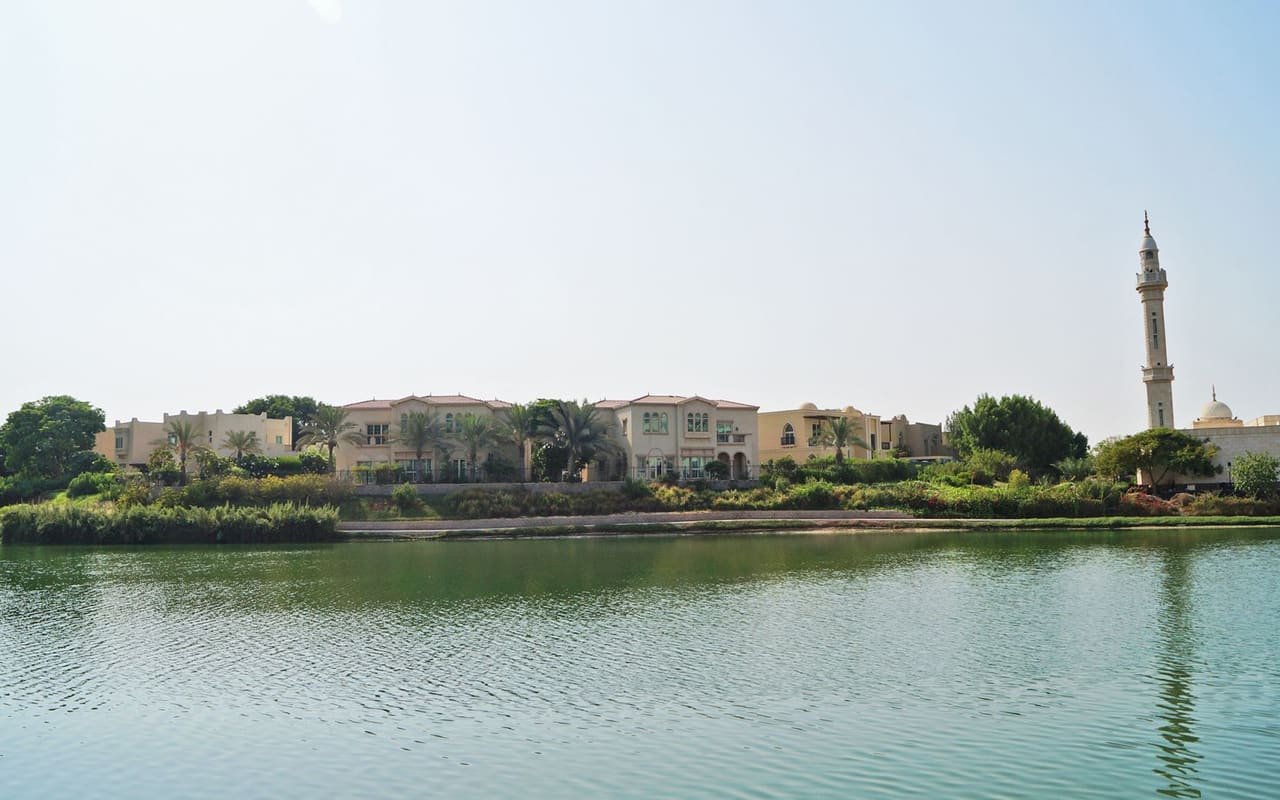
Jumeirah Islands is a gated villa community built by Nakheel on a system of man-made islands and completed around 2012. It sits between Jumeirah Lake Towers and the Sheikh Zayed Road, twenty minutes from Dubai Marina, and lives like a separate settlement rather than a district.
Islands rather than streets
The community holds 736 villas distributed across 46 residential islands, exactly 16 houses on each. Between clusters there is water, not road. That layout solves two problems at once: there is physically no through traffic inside the community, and most houses look at water rather than at a neighbour's wall.
- 736 villas.
- 46 residential islands.
- 16 houses per cluster.
- 4–6 bedrooms in the standard layouts.
Access is controlled — you get in as a resident's guest or through the management company. Privacy is sold here as explicitly as floor area.
Talk to a licensed broker: 📲 +971 50 120 32 64 on WhatsApp, @dubai_oleg on Telegram
Prices and what drives the spread
The listing range is wide and depends on cluster, plot, condition and whether the house has been rebuilt. Four-bedroom villas of 5 500–7 000 square feet appear both in the lower part of the range and above AED 20m after a full reconstruction; five-bedroom houses of 8 500–10 500 feet sit noticeably higher. The explanation is simple: the community is fifteen years old, and roughly half of what trades has been comprehensively rebuilt while the rest is in original condition.
The first half of 2026
Thirty-four transactions in the half, down 40% year on year. Median deal value up 19% to AED 26.2m; median price per square foot up 17% to AED 4 610.
Of the four prime villa communities this is the only one where the price per foot moved up substantially alongside the deal value. It does not mean every house gained 17%. It means correctly priced houses in good condition kept transacting in a slower market, while overpriced ones did not sell and therefore never appeared in the numbers.
Why there is no off-plan here
Jumeirah Islands is a closed master plan with no development land left. Everything that trades is resale, and two consequences follow.
First, supply is physically capped. Around a hundred properties sit on the market at any time against 736 houses, and one that matches your cluster, layout and outlook does not surface every week. Waiting for the right house is a legitimate strategy here.
Second, condition sets the price. In new-build a square foot is standardised; in a fifteen-year-old house it is not. Two neighbouring houses of identical size can differ twofold in price and both be fairly priced. Comparison by district price per foot works worse here than almost anywhere — comparables must match on cluster, condition and outlook simultaneously.
What to look at on a viewing
- Condition of the building services — the community is not new, and air conditioning and plumbing in unrenovated houses are at the end of their life.
- Orientation relative to water and sun: a lake view from the west side means both the view and the afternoon heat.
- Rebuild history — whether layout changes were approved by the management company and the municipality.
- The service charge and what it covers; maintaining the water bodies and landscape is a visible line here.
Video on this topic
The same subject on the English channel — each clip has a written version of its own.
 56:22Villa restoration in Dubai: what marble, wood and furniture repair costs in luxury homes4 October 2026
 14:41Home staging in Dubai: how much it adds to the rent and the sale price19 September 2026
 13:04The best townhouses in Dubai under USD 600 000: Nshama Town Square7 October 2023
 34:38Interior design in Dubai: neuroarchitecture, longevity design and soulful luxury explained8 October 2026
 12:00XXII Carat on Palm Jumeirah: 22 Mediterranean villas compared with Raffles and Zabeel Saray20 September 2023
 4:15Lamborghini villas in Meydan: half the price of Ellington, and why26 January 2024
In the news
Other write-ups on the site about the same thing.

Dubai property price index, July 2026 (ValuStrat): villas flat on the year, apartments down 4.2%
The ValuStrat Price Index for Dubai stood at 219.2 points in July 2026: down 0.3% on the month and 1.6% on the year. Villas were flat year on year at AED 2 039 per sq ft; apartments fell 4.2% to AED 1 397. Which districts are rising, which are falling, and what it means.

Dubai property market 2023 review: AED 634bn of transactions and villas past the 2014 peak
Dubai in 2023, from official data: 166 400 real estate transactions worth AED 634bn (+36% by number, +20% by value) and 71 000 first-time investors. Knight Frank had villas 9% above the 2014 peak while apartments were still 10% below it. A reference review, with the status as of September 2026.

Dubai property market 2024 review: AED 761bn of transactions and villa prices up 31.6%
Dubai in 2024: 226 000 transactions worth AED 761bn (+36% and +20%) and 110 000 first-time investors, per the DLD. ValuStrat had prices up 27.5% — villas +31.6%, apartments +23.6%, Jumeirah Islands and Palm Jumeirah villas above 42%. Figures, leading districts and the September 2026 status.

Emirates Hills: 632 villas, plots sold by the foot, and a market of eleven sales in six months
The only Emaar project where land was sold to buyers to build on themselves. How Dubai’s most expensive villa community works, why prices inside it differ thirtyfold, and what to do with statistics drawn from eleven transactions.

Al Barari: the greenest community in Dubai, and the three separate markets inside it
More than 60% of the site is gardens and water, and one address contains three different products — Ixora, Chorisia and the Estate Villas, with medians from AED 8.55m to AED 41.75m. Why a single average for the community means nothing.

Palm Jumeirah, Jumeirah Islands, Al Barari, Emirates Hills: prime villas in H1 2026
Across four prime communities 124 villas changed hands in the half against roughly 190 a year earlier — down about 35%. Median deal value rose in all four. Both facts are true, and neither means what the headline says.
Related services
Below market in Jumeirah Islands right now
From the daily off-market feed. Availability and price are confirmed on request.
All below-market listings →