
Trophy property: why it has no ROI, and what to calculate instead
A unique asset cannot be modelled like a rental flat: no comparables, no predictable income stream, no predictable exit. What actually sets price at the top of the market, and which calculations are worth doing there.
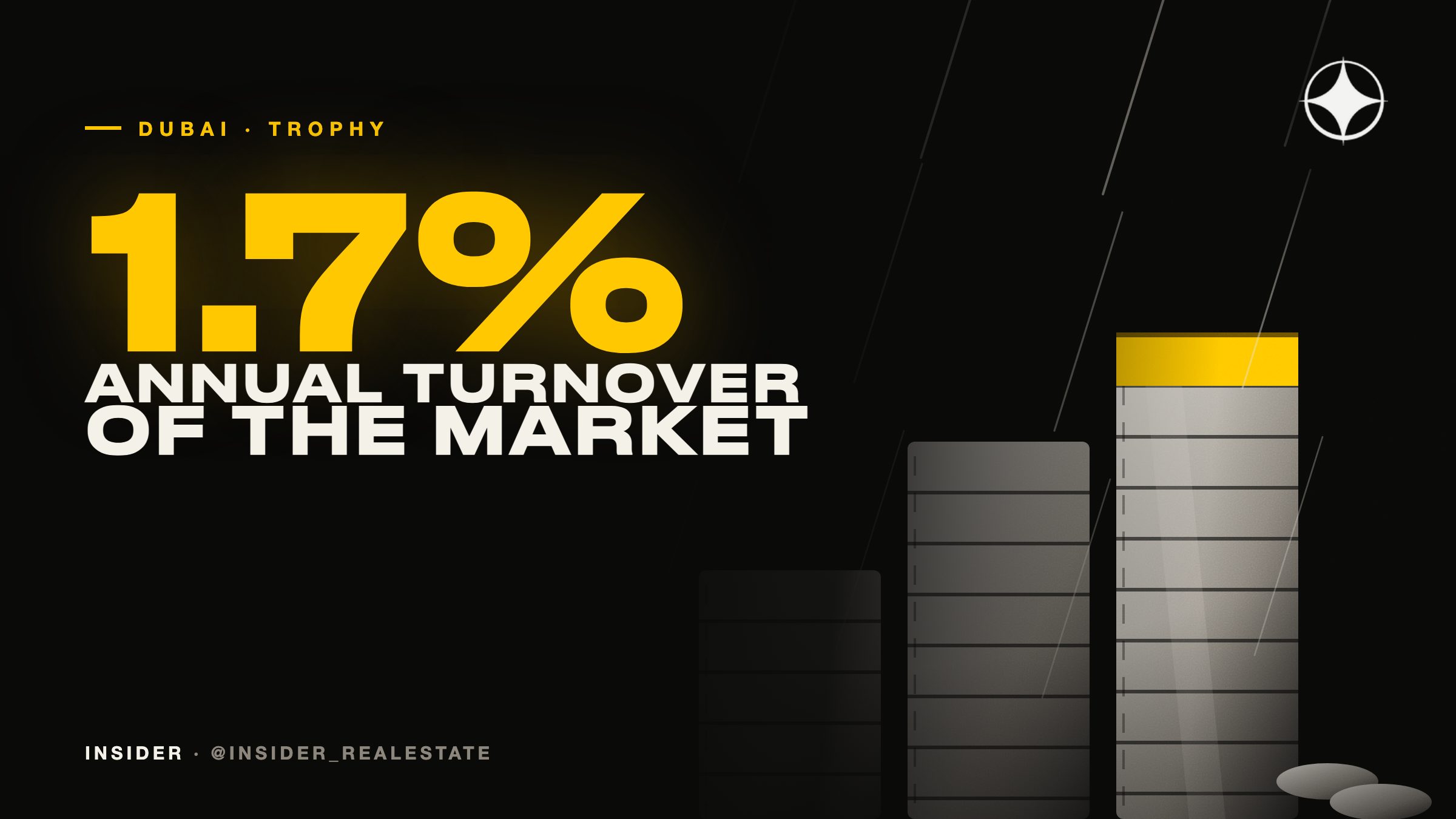
"What's the yield?" is the first question on almost any call. For a AED 1m apartment in a rental district it is a fair question with a numerical answer. For a AED 60m villa on a closed address it is not, and answering it anyway produces a figure that protects nobody.
What makes an asset a trophy
A trophy asset is one with no direct comparables. The only villa on a particular headland, a full-floor apartment in a building that has five of them, a house on a plot type no longer issued. Three properties follow, and each breaks the standard model.
- No comparison base. A yield estimate rests on comparable sales. If two comparable assets traded in a year, you do not have statistics — you have two anecdotes.
- No predictable income. Letting an asset worth tens of millions is an episodic business with long gaps between tenants. An annual yield computed from one contract forecasts nothing.
- No predictable exit. The city holds a handful of buyers for such a property. Marketing time is measured in years rather than months, and the sale price depends on whether the right person appeared at the right moment.
A number that illustrates it
In the first half of 2026, Dubai's four prime villa communities — Palm Jumeirah, Jumeirah Islands, Al Barari and Emirates Hills — registered 124 transactions between them. Emirates Hills accounted for eleven of those in six months, against a community of 632 houses. That is turnover of roughly 1.7% a year by unit count. A market where one house in sixty changes hands in half a year cannot be described in the language of yield and liquidity.
Talk to a licensed broker: 📲 +971 50 120 32 64 on WhatsApp, @dubai_oleg on Telegram
What is worth calculating instead
- Annual cost of ownership. Service charge, security, pool and grounds, utilities, insurance, depreciation of the finish. On a large villa that is a seven-figure dirham sum every year, and it does not depend on whether you are living there.
- Entry price against replacement cost. What it would cost to build the same house today: land at current prices plus construction plus finish. A market price below replacement cost is an argument. Materially above it, you should know precisely what the premium is for.
- Horizon and exit scenario. Who buys this, and in how many years. If the answer is "somebody, sometime", it is not an investment but a purchase for yourself — and saying so is more honest than inserting an invented ROI into a model.
- Share of portfolio. A trophy asset is not an instrument for growing capital but a way of holding part of it in something that does not devalue with a currency. The share should be small enough that illiquidity never becomes a problem.
The distinction that matters
Capital is earned in a business or a career. In property, in equities and in collectables it is mostly preserved. There are no extraordinary returns in real estate, in passive or aggressive strategies alike — the long-run performance of large property funds settles that argument.
None of which is an argument against buying. It is an argument against a model that presents a trophy asset as an instrument with a forecastable return. Objects of this class — watches, cars, wine, houses at unique addresses — often do appreciate handsomely over long periods. But that is not why they are bought, and it cannot be promised in advance.
Where a yield calculation genuinely belongs
For deliberate property investment the mid-market works better. The same budget buys several assets across different schemes, the cost of a mistake is lower, exit routes are more numerous, rental income is steadier, and there are hundreds of comparable sales rather than two. It is a less impressive conversation, and it is the one where the yield number means what it says.
Video on this topic
The same subject on the English channel — each clip has a written version of its own.
 56:22Villa restoration in Dubai: what marble, wood and furniture repair costs in luxury homes4 October 2026
 34:38Interior design in Dubai: neuroarchitecture, longevity design and soulful luxury explained8 October 2026
 25:11Crystals in interior design: how a Dubai designer maps a space with stones and paintings3 October 2026
 23:55Baccarat Dubai: the branded residence next to the Burj16 December 2023


Related reading
Other write-ups on the site about the same thing.
How to actually calculate the return on a Dubai apartment, with every cost included
Gross yield, net yield, cap rate and return on equity are four different numbers and get confused constantly. A worked structure that turns an advertised 9% into the figure your account will show.

Guaranteed yield and “high ROI” in Dubai listings: what stands behind the number
A guaranteed return is a contract with an end date, and an advertised ROI is usually a gross figure with the costs removed. How both are constructed, and the four deductions that turn 9% into something closer to 5%.

Branded residences: Dubai leads the world, and what the premium actually buys
Dubai has more branded residential schemes than any other city — roughly one in seven worldwide. Where the format started here, what the premium over comparable luxury pays for, and the five clauses to read before signing.

Retail with a chain tenant in Dubai: how the numbers are actually built
A unit let to a recognisable brand looks like the safest income in property. What decides whether it is: lease length, the covenant behind the name, the rent against turnover, and what happens at the break.

Whisky +191.7%, furniture +140.9%, watches +125.1% — and why that is not the comparison
The Knight Frank Luxury Investment Index ten-year table has rare whisky up 191.7%, antique furniture 140.9%, watches 125.1% — and coloured diamonds up 3.8%. A useful table, routinely misused against property. Here is the honest comparison with a Dubai apartment.

A non-refundable contribution against buying property
Most programmes offer both, and the property option is chosen far more often than the arithmetic supports. The comparison people run is not the one that decides it.