
Mira Hills
Abu Dhabi, between the two emirates — fifteen minutes to Yas Island
A master community carrying AED 55bn of stated investment, sitting exactly midway between Dubai and Abu Dhabi on the E11. In the first phase Mira Developments is not selling apartments here but land: a development plot from AED 22m at AED 325 per square foot.
- land plots
- joint venture
- for developers and large investors
What it will look like
Frames from the master developer's brochure: 22 renders — the master plan, the town centre, the lagoons, the golf course and the social infrastructure. This is design imagery, not photography: the site is still desert, and a render says nothing about what has actually been contracted.
-
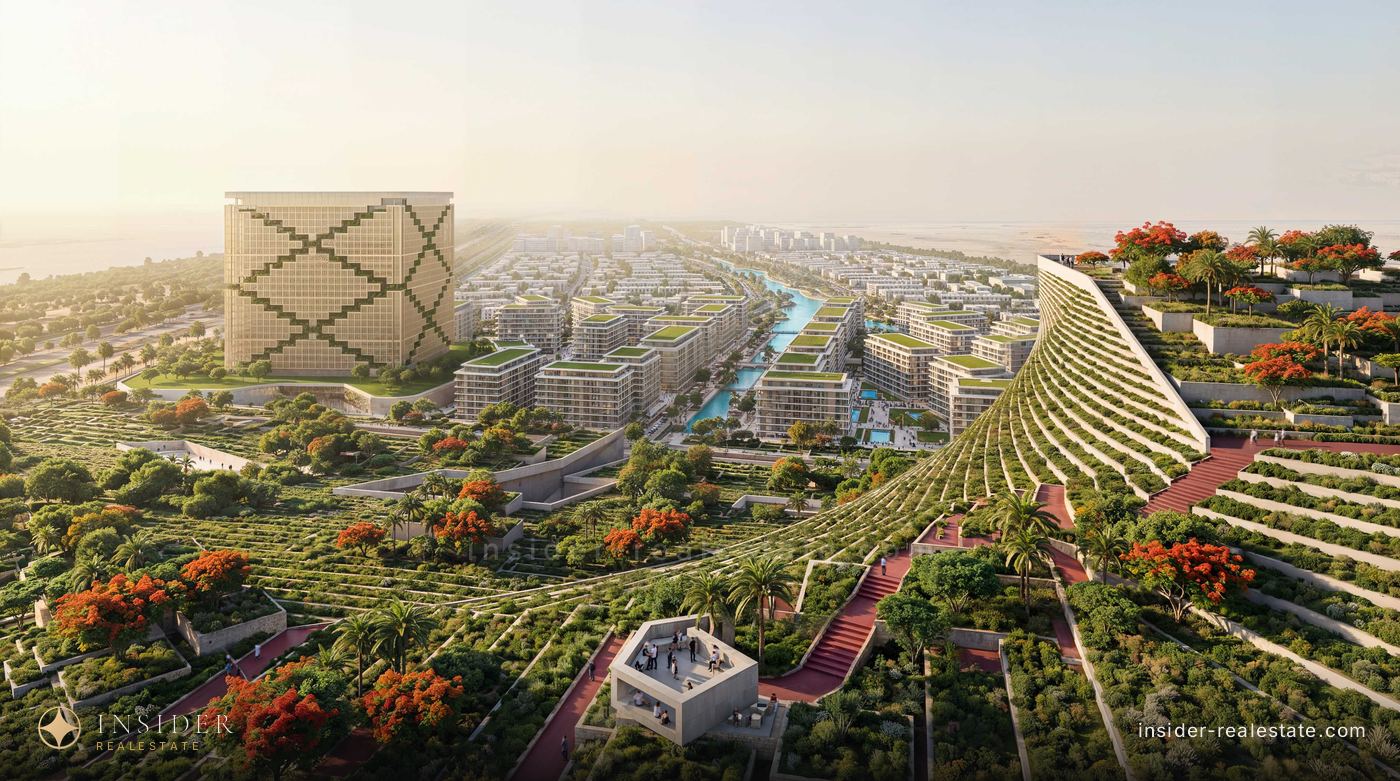
How it is drawn The first phase seen as a whole: terraced green slopes, a canal through the middle and The Cube on the left. Everything here is a design, not a building site — the plot is still desert. -
The master plan The site runs some five kilometres along its axis — south, central and north zones from left to right. Lagoons form a continuous chain and the golf course sits in the northern part. -
Between two emirates The plot sits right on the E11, halfway between Dubai and Abu Dhabi. Around it is empty land: the neighbours that will set the exit price are not there yet. -
Town hub The community centre — retail, offices and services in one node, with the golf course starting immediately behind it. -
A car-free centre Residential blocks are laid out without cars: parking is pushed to the entrances and the upper level belongs to pedestrians. That level is what the frame shows. -
The waterfront Ground floors of the residences open onto the canal: promenade, cafés and water instead of a carriageway. -
The Cube A commercial hub for the property industry: developers, brokerages and investment firms in one building. The Arabic script is part of the facade design. -
The mall Retail, dining and leisure; the indoor ski slope belongs to the same complex, and the roof is treated as an accessible park. -
Indoor ski A year-round snow slope inside the mall — the item the brochure puts first on its leisure list. -
Lagoons A water network runs through the whole district and links its key destinations. Swimming is not intended here — that is what the separate beaches are for, and AD Ports brings the water to them. -
Private beaches Eight private beaches with ocean water — four by the villas and four by the residences, spread across different parts of the master plan. -
Central island The central zone at sunset: residential blocks around the water with a pavilion in the middle. This is the densest part of the plan. -
Inner lagoon Front-row villas on the inner lagoon: a private pool plus a sand shore a few steps away. -
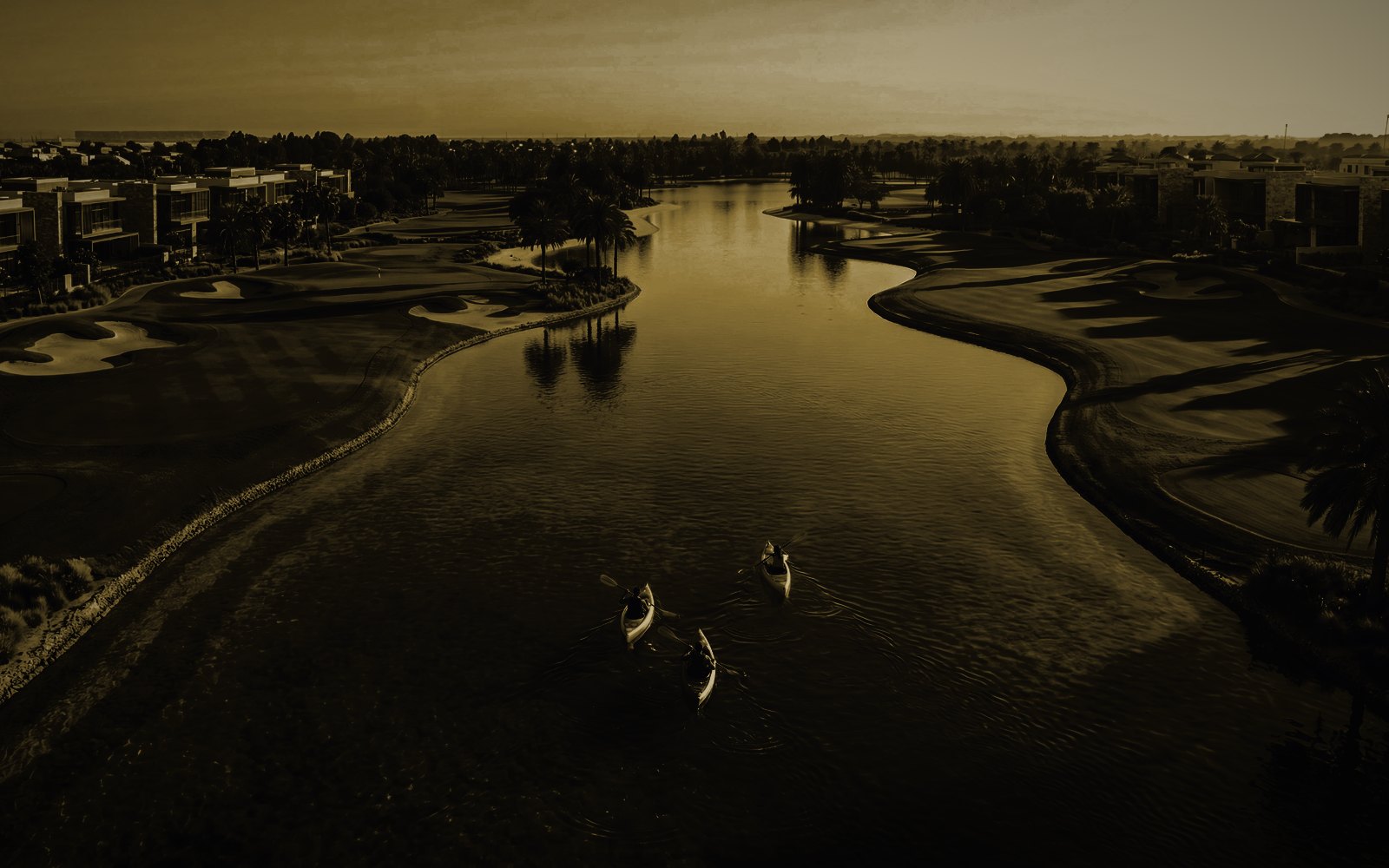
Villas on the course The 18-hole championship course runs along the villas: for some plots the fairway begins right behind the fence. -
Golf and town How the course meets the town hub: housing sits between water and fairways rather than in a separate enclave. -
Northern zone The private half of the plan: large villas in clusters along the canals. This is where the luxury format is declared. -
Resort quarter One of the declared five-star complexes with branded living — hotel service laid over residences. -
Museum of the UAE A cultural landmark on a historic site: the 1968 talks held here began the Union. The museum is built by the state, not by the developer. -
Inside the museum The inner hall under its timber vault. Objects like this fall to AD Ports — the state takes on everything that is not housing or offices. -
Universities Two universities — one leaning to artificial intelligence, one to architecture and engineering — plus a research and development centre in the same cluster. -
Hospital A 200-bed hospital in the central zone — again part of the state half of the project rather than the developer half. -
Community centres Three public centres for the district: everyday services and somewhere to meet. The frame shows a majlis pavilion on the water.
What the project is
Who is building it, and on whose land
Mira Hills is built by two parties. Mira Developments is the master developer: the land under the project was bought outright by the company — a AED 2.47bn deal with AD Ports Group, announced a year earlier. The master community infrastructure — everything that is not residential buildings or offices — is taken on by AD Ports Group itself, the emirate's state company. The split runs exactly along that line: schools, the hospital, the museum and bringing water to the lagoons are the state's; residences, villas, offices and the commercial hub are the developer's. Stated investment in the project is around AED 55bn, delivered in phases to roughly 2035.
In format it is closest to Dubai Hills: one large territory with a mall, schools and golf inside it, divided into a more public part and a private one. The public part holds the malls, the commercial hub, offices, townhouses and villa communities. Higher up the plan sits the private zone: large villas, golf courses, the luxury format.
Where it is
The project sits between the two emirates, and that is its main argument. The address is Al Mamoura next to Ghantoot, right on the E11. Yas Island is around fifteen minutes away, Masdar City about twenty, Al Raha Beach twenty-five. Al Maktoum airport is about twenty-five minutes, Abu Dhabi airport the same; the centres of both emirates are roughly forty minutes each. Al Jurf, the beachfront community, is ten minutes away.
The neighbourhood matters for a second reason: the emirate is developing an entertainment cluster on this same stretch of coast. The presentation stated that a casino will appear on this territory, but there has been no official announcement from the state and, per the project representative, one should be expected after the Ras Al Khaimah venue opens. That is an expectation, not a confirmed fact, and you cannot build a yield model on it.
What is inside
The stated content: a championship 18-hole golf course with a clubhouse, a network of lagoons and eight private beaches — four by the villas and four by the residences. The lagoons are not for swimming; swimming happens on the separate beaches, and it is AD Ports that brings the water. The central park is around 5m square feet, plus urban forests and green zones.
The social part is set out in detail: three schools, eight nurseries, two universities leaning towards artificial intelligence, architecture and engineering, and a 200-bed hospital. Then two museums, including the UAE Museum being built by the state, an arena, a mall with an indoor ski slope, three community centres, five-star hotels and The Cube commercial hub. The residential blocks are designed car-free: parking moves out to the entrances and the upper level is pedestrian, with walkways and water misting.
On housing the developer states more than 7,200 apartments and more than 1,900 villas and townhouses. Apartments run from studios to three bedrooms, villas from three to six and above; townhouse plots start at 30×15 metres and villa plots reach 55×40. The payment schedule is announced separately for each phase.
How the developer works
Mira Development builds the same way in every country it operates in, and the presentation reduces that to four points. First, branding: fashion houses and brands stand behind the projects, and that is primarily about standardising the finish, the appliances and the construction itself. Second, full fit-out: furniture, appliances, curtains, tableware — the finish is not bare walls but a completed interior. Third, service: concierge, valet parking, weekly cleaning, and Mira Home as the in-house management company. Fourth, a five-year repair warranty instead of the one year standard in Dubai: if a pipe leaks within that period, the developer pays.
What is actually on sale now
The first phase is a sale of plots, not of finished housing. Land goes at AED 325 per square foot. The smallest plot released is number 109, AED 22m. For a sense of scale: plot no. 28 is 180,000 square feet of GFA, which fits roughly 40–50 villas, or around 25 in a branded villa format such as Bentley. You cannot buy land for a single house: this is a master community, not a subdivision for private building, and the developer's standards bind everyone who builds here.
Mira is launching its own projects on this land too — in November, including Bentley villas modelled on Bentley Home in Dubai.
Three ways in
First — simply buy the land. The buyer, more often a construction company, takes a plot and builds its own project on it. Freedom is almost total, with one constraint: the master community standards, below which nothing may drop.
Second — a joint venture. The investor pays for the land, the developer builds and sells. Per the project representative the horizon is around 3.5 years, the investor's share in that structure is 30%, and the return figure cited at the presentation is on the order of 50% on the money invested — roughly 15–16% a year.
Third — the investor pays for both land and construction. Then they take all the income, and all the project risk with it: the developer works here as contractor and seller for a fixed fee.
What to compare the price against
The developer's own guide for the sale price of the finished product is AED 1,600–1,700 per square foot, and from AED 1,800 for Mira's own projects. The comparison offered at the presentation is Alghadeer by Aldar: a neighbouring master community in much the same location on the border of the two emirates, selling today at around AED 1,600 per foot. It is the only coherent benchmark nearby, and the entire economics of the deal rests on the gap between AED 325 per foot of land and AED 1,600–1,800 per foot of finished space.
Why the sources disagree
The project presentation gives 55 million square feet and five kilometres along the axis — that describes the territory. The developer site gives a different number, 2,760,060 m², and that is GFA, the built-up area rather than the size of the site. Broker cards often put those 30 million feet in the "total area" column, which is how the impression arises that the project is half the size. They are different quantities and both can be right at once.
Unit counts run the same way: the developer states 7,200+ apartments and 1,900+ villas and townhouses, while aggregators carry 14,000 apartments plus 1,700 villas and 1,000 townhouses — nearly double. While the project is in its first phase, trust the developer site and recheck any aggregator number before putting it into a model.
Who it suits, and who it does not
This is not a "buy an apartment and let it" story. The entry threshold is AED 22m for the smallest plot, the horizon is three and a half years with no rental flow in the meantime, and the outcome depends on what gets built on the neighbouring plots: in a master community the exit price is set by the whole surroundings at once, not by your building alone. It suits a developer with their own construction capacity, and an investor taking a share in the project deliberately and with a lawyer.
Anyone looking for a finished square metre in Abu Dhabi with understandable rent is better served by Saadiyat or Al Reem: there are completed buildings there, real rates and secondary liquidity. Land in a new masterplan is a different product with a different risk, and comparing the two on one yield figure is not valid.
Work through a plot for your brief
I will send the current plot list with sizes and prices, run the economics on your structure — buying land, a joint venture or the full cycle — and say plainly where the weakest point in that model is.
Ask a question
Telegram is the fastest way — I answer personally.
Message on Telegram