Dubai Land Sales Hit AED 125 Billion in Seven Months: 8% of Deals, 39% of the Money
Between January and July 2026, Dubai saw 7,981 land plot transactions worth AED 125 billion — 8% of all property deals but 39% of total market value. Here’s why developers are buying land faster than they’re building, and what it means for an apartment buyer.
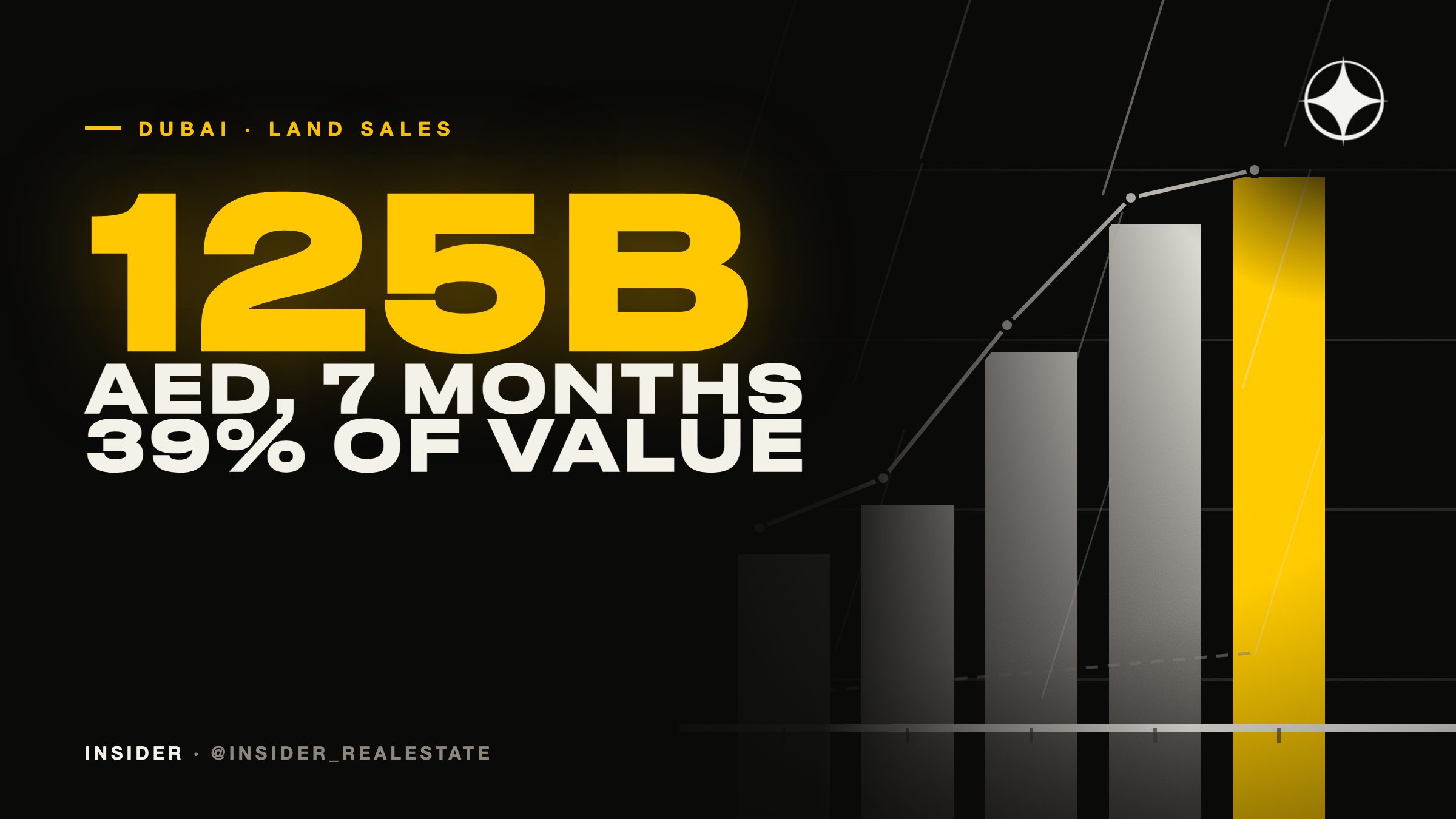
While buyers count price per square metre in finished towers, Dubai's developers are busy with something else — buying land. Over the first seven months of 2026, the emirate saw 7,981 land plot transactions worth AED 125 billion (about $34 billion). This isn't about what's being built today. It's about what will start construction tomorrow — and at what prices it will sell in three to four years.
The headline numbers
- AED 125 billion invested in land between January and July 2026.
- 7,981 transactions for plots — about 8% of all 99,900 property transactions in the period.
- 39% of total market value (AED 321 billion across all property types — apartments, villas, buildings and plots).
- ~1,140 deals a month worth around AED 17.8 billion — a steady pace, not a spike.
- ~AED 15.7 million — the average ticket size for a land deal, roughly five times the market-wide average.
Data: Dubai Land Department (DLD), January–July 2026.
Why 8% of deals carries 39% of the money
This imbalance is the most interesting part of the report. Eight percent of transactions absorb almost four-tenths of all the money in the market, because what's being bought isn't apartments — it's the raw material for them. A single land deal is a future residential complex of hundreds of units, and its price is comparable to selling an entire floor of a finished building.
Talk to a licensed broker: 📲 +971 50 120 32 64 on WhatsApp, @dubai_oleg on Telegram
The practical point is simple: the land market is a leading indicator. Apartment transactions show what the market thinks of itself today. Land transactions show where it's putting its money for the next three to five years. When developers keep building their land bank at a steady pace for seven months straight, they're not positioning for "one more good quarter" — they're positioning for the next supply cycle.
The flip side reads just as clearly. Land bought in 2026 turns into apartments in 2029–2030. That's future supply, and it will weigh on prices — not now, but then. Anyone buying off-plan today with a resale planned around handover should be watching this number more closely than the current growth charts.
Top 10 areas by land value
- 1. Me'aisem 2 — AED 10.4 billion, 544 deals (about AED 19 million per plot on average).
- 2. Al Yalayis 5 — AED 7.14 billion, 907 deals (about AED 7.9 million). The busiest area by deal count.
- 3. Al Ruwayyah 1 — AED 6.3 billion across just 3 deals — about AED 2.1 billion each.
- 4. Palm Jebel Ali — AED 5.7 billion, 140 deals (about AED 41 million).
- 5. Umm Suqeim 1 — AED 4.6 billion, 30 deals (about AED 153 million per plot).
- 6. Al Yalayis 1 — AED 4 billion, 177 deals.
- 7. Me'aisem 1 — AED 3.2 billion, 229 deals.
- 8. Sheikh Mohammed Bin Rashid Gardens — AED 3 billion, 119 deals.
- 9. Palm Jumeirah — AED 2.4 billion, 44 deals (about AED 55 million).
- 10. City of Arabia — AED 2.25 billion, 20 deals (about AED 112 million).
Together, the top ten account for about AED 49 billion — nearly 40% of the entire land total. The remaining 60% is spread across dozens of sectors.
Three conclusions visible only in this table
First: these are cadastral sectors, not "areas." Me'aisem, Al Yalayis and Al Ruwayyah are names from the DLD registry, not the marketing names a project later sells under. The same plot will resurface a year later advertised as an attractively named residential community. Searching for "an apartment in Al Yalayis" is pointless — what to search for are the projects announced on that land.
Second: the land market has split into two layers. On one side, mass subdivision: 907 deals in Al Yalayis 5 and 544 in Me'aisem 2, at an average ticket of AED 8–19 million. These are plots for townhouses, villas and mid-scale residential projects, bought by both mid-tier developers and private individuals. On the other side, trophy lots: three deals in Al Ruwayyah 1 worth AED 6.3 billion, and 30 deals in Umm Suqeim 1 worth AED 4.6 billion. These are large development sites and premium waterfront land, priced in the hundreds of millions per lot.
Third: the coastline is back in play. Palm Jebel Ali ranks fourth with AED 5.7 billion, and Palm Jumeirah ninth — even though physical plots there are scarce. Umm Suqeim, with 30 deals worth AED 4.6 billion, tells the same story: waterfront land sells in small numbers, at high prices. This isn't about volume — it's confirmation that the premium coastal segment hasn't gone anywhere.
Who's buying: AED 125 billion into land versus AED 113.7 billion in developer revenue
The land report doesn't name buyers, but a second figure sits alongside it — developers' half-year results. The UAE's top ten developers sold AED 113.7 billion worth of property between January and June 2026:
- Modon — AED 23 billion. The UAE-wide leader, but selling mostly in Abu Dhabi rather than Dubai.
- Emaar — AED 22.4 billion across the UAE, excluding overseas projects.
- DAMAC — AED 16 billion.
The top three together account for AED 61.4 billion, or 54% of the whole top-ten's sales. The gap widens after that: fourth-placed Aldar sold AED 9.5 billion, almost two and a half times less than third place.
The comparison is worth sitting with. Over seven months, AED 125 billion went into Dubai land — more than the UAE's entire top ten developers earned from six months of sales. The two figures cover different geographies and different companies, so they can't simply be netted against each other. But the order of magnitude is clear: the land market is comparable, in money terms, to the entire sell side of the industry. That answers the "who's buying" question — not private individuals picking up a villa plot, but structures planning construction years out and paying for that plan now.
The southern corridor: where the money is actually going
Mapping the land deals shows the growth concentrated not in established districts but in three new corridors.
- Dubai South and the Al Maktoum expansion zone. The Al Maktoum Airport expansion is valued at AED 128 billion — comparable to Dubai's entire seven-month land turnover. Around it, an "airport – logistics – jobs – housing" chain is forming, and developers are buying residential land ahead of the airport reaching full capacity. Across already-delivered Dubai South projects, 94.5% of 5,698 units have sold.
- Wadi Al Safa. This group of sectors is mass subdivision for villas and townhouses. In Wadi Al Safa 5, 96.4% of 8,216 villas have sold: demand is outpacing supply, which is exactly why land nearby is moving in bulk.
- The Jebel Ali coastline. Palm Jebel Ali's AED 5.7 billion across 140 deals is part of the same southward shift, just in the premium segment.
What ties all three together is geography — they sit south and south-west of the city's current centre of gravity. Dubai's growth over the last twenty years ran along Sheikh Zayed Road; the 2026 land money says the next wave of growth will be centred on the second airport.
Timeline: when this reaches the market
There's a predictable gap between buying a plot and putting up a billboard, and it maps onto specific dates.
- 2026 — land acquisition. What's visible in the DLD report today.
- 2027–2029 — off-plan launches. Design, approvals with the master developer and the DLD, and escrow setup take one to two years. This is the window when the wave of launches funded by today's AED 125 billion will appear.
- 2029–2031 — handovers. Completed keys, and the first wave of resales.
The practical implication of that timeline is simple: a 2026 off-plan buyer won't be competing with today's neighbours, but with projects that don't exist yet. Their land was bought this year, and they'll reach the market right around the time your building is handed over.
What this means for an apartment buyer
There's no direct line from "land was bought" to "apartments got more expensive." But there are three practical consequences.
- Watch where land is being bought near your property. Active land buying in a sector means construction outside your window for years to come — dust, machinery, blocked access — and, at the same time, future infrastructure and area growth.
- Count future supply, not just current demand. If 900 plots changed hands in your sector over six months, hundreds of competing units will appear there by the time you resell. That's exactly how a "great off-plan deal" turns into a long time on the market.
- "Buying at the land level" isn't a universal strategy. A plot genuinely costs less per square metre than a finished project, and that's exactly what developers are paying for. But land has no rental income, while it does carry holding costs, obligations to the master developer, and a construction-plan requirement. For an investor without a contractor and a five-year horizon, that's not a "cheap entry" — it's frozen capital. A version of the same idea that does work is buying into early phases in areas where institutional capital is just arriving: Dubai South, Wadi Al Safa, the southern Jebel Ali corridor.
- Scarce locations behave differently. Where land is physically limited — the coastline, established villa districts — there's simply nowhere for new supply to come from. That's the only real protection against a dilution effect.
Frequently asked questions
Can a foreigner buy land in Dubai? Yes — in freehold zones, on the same basis as an apartment. But a development plot isn't a passive purchase: it comes with approvals, timelines, a contractor and obligations to the master developer. Without a construction plan, land is frozen capital with holding costs attached.
Is land safer than an apartment? It doesn't depreciate and needs no renovation, but it doesn't generate rent either. Its only source of return is appreciation. For an investor that means a long horizon and zero cash flow along the way.
Is AED 125 billion a lot? It's a steady pace — about AED 17.8 billion a month, without sharp spikes. That steadiness matters more than the absolute figure: it points to planned developer activity, not a speculative rush.
Does this mean prices will rise? It means supply will rise. What happens to prices will be decided by demand in 2029–2030, not by today's land deals.
Bottom line
The DLD's land report is a rare case where dry statistics answer the question "what's next" directly. AED 125 billion over seven months, and 39% of total market value, mean developers are confident in the next cycle — and are paying for that confidence in cash, ahead of time.
The practical takeaway for a buyer: watch not just today's price per square metre, but how much land has been bought around your future property. The first number tells you what you're paying. The second tells you who you'll be competing with when it's time to sell.
Video on this topic
The same subject on the English channel — each clip has a written version of its own.
 19:45
19:45 Oceano on Al Marjan Island: the Luxe Developers project and the island being built around it
A walkthrough of Al Marjan Island as it is being built: current infrastructure, the resort plots still under construction, and the architectural vision for the hotels going up around Oceano.
WatchIn the news
Other write-ups on the site about the same thing.
Gulf Land Property Developers: what you are paying for in a villa, land or building
A developer building a villa community in Dubailand. Villa pricing splits into plot and structure, and the two behave completely differently over time.
Land Department registration does not make a developer reliable: eight questions first
Every developer selling off-plan in Dubai has a registration and an escrow account. That is not an achievement, it is the condition of entry — and buyers read it as a guarantee.
A plot for $34m: how to think about the return on land in Dubai
A 2,277 m² plot on Jumeirah Bay sold for $34m; the previous owner had bought it at $9.9m — a 242% gain. Land behaves differently from an apartment, in four specific ways.
Scope Investment: a 2022 tower, and the first wave of resales
A Dubai Marina tower completed a few years ago. Buildings at this age go through a predictable event that shapes their prices — and it is a buying opportunity if you can see it.
Gulf General Investments Company: a first-generation Marina tower, twenty years on
A diversified investment group whose Dubai Marina tower completed in 2006. What the district’s earliest buildings offer, and the systems that come due at that age.
Credo Investments: what a view is worth, and how to keep it
A developer with a small Downtown Dubai building from 2017. View premiums are large, real and frequently temporary — and whether yours survives is a matter of public record.
Below market in Dubailand right now
From the daily off-market feed. Availability and price are confirmed on request.
All below-market listings →