
Escrow in Dubai: where an off-plan payment actually sits, and how to check it
Off-plan money does not go to the developer. It goes to an account opened for one project, at a bank, under supervision, and is released against verified construction. What escrow protects against — and the three risks it leaves entirely with you.
The single most common question from a first-time off-plan buyer is the right one: I am paying for something that does not exist, so what stops the money disappearing? The answer in Dubai is a specific piece of machinery that has been in place since 2007, and it is worth understanding properly — both because it works, and because it does not cover what most buyers assume it covers.
What the arrangement actually is
- The account belongs to the project, not to the company. A developer selling off-plan registers the project and opens an escrow account at an approved bank dedicated to that development. Buyer instalments go there.
- Money is released against progress, not against a request. Drawdowns are tied to construction actually completed and verified, rather than to the developer's cash needs elsewhere.
- Funds from one project cannot finance another. That is the whole point of the structure and the reason it was introduced.
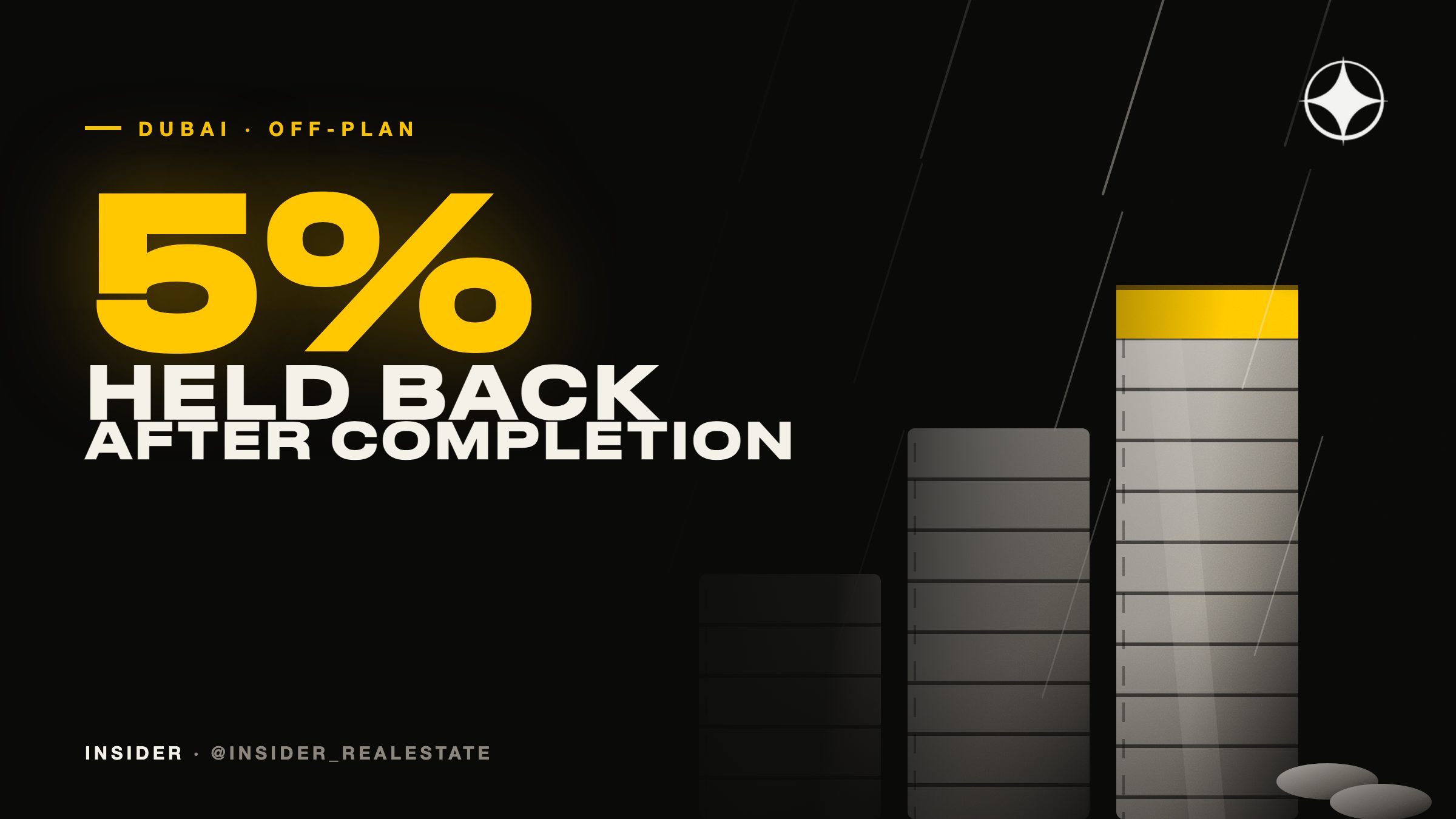
- A retention is held back after completion — 5% of the project's escrow, released a year after the building is completed and units are registered. It exists so that there is money left when defects appear.
- Your own purchase sits in a public register too. The preliminary contract is entered in the interim real estate register — the Oqood entry — which is what makes your interest visible to the state rather than only to the seller.
The checks that take ten minutes
- Read the account name on the payment request. It should name the project, not the developer's trading entity. This is the highest-value line in an off-plan purchase and almost nobody reads it.
- Treat changed bank details in an email as fraud until proved otherwise. Confirm any change by telephone on a number you already had, not on the number in the email. This is the oldest theft in international property and it still works.
- Check the completion percentage on the Land Department's escrow register rather than accepting a figure from a sales update. The two frequently differ, and only one of them is evidence.
- Confirm your contract is registered and that the reference matches your unit. An unregistered off-plan sale is the largest single red flag available in this market.
- Keep the check running. Escrow verification is not a step at the beginning; it is something to repeat on every payment request for the life of the plan.
Three things escrow does not do
- It does not guarantee a date. Escrow protects the money, not the schedule. Delivery risk — the building completing a year late — is untouched by it, and on this market that is the risk that actually costs people money.
- It does not guarantee quality. Nothing in the escrow mechanism inspects a finished apartment. That is what a handover inspection is for, and it is a separate exercise with a separate provider.
- It does not protect the value. If three other schemes in your district hand over the same year, your apartment meets a hundred near-identical units on the resale market plus whatever the developer has left. Escrow has no view on that.
If a project stops
The framework has an answer for the worst case: a stalled development can be cancelled by the regulator, and a dedicated judicial process exists to wind the project up and deal with what remains in the escrow account for the benefit of the buyers. It is a real protection and a slow one. Recovering a deposit through a liquidation is not the same experience as having bought from a developer who finishes buildings, which is why the record of completed projects remains a better safeguard than any account structure.
The way to hold both ideas at once
Escrow moved the principal Dubai off-plan risk from "will the money vanish" to "will this be finished on time, and what will it be worth when it is". That is a genuine improvement and it explains why insolvency is no longer the thing to lose sleep over. But it also means the due diligence that matters has shifted: the useful evidence is the developer's delivered buildings, how they look five years on, whether handover dates held, and what else completes nearby in your year. The escrow account is the floor under the transaction. It was never the reason to do the transaction.
Talk to a licensed broker: 📲 +971 50 120 32 64 on WhatsApp, @dubai_oleg on Telegram
Based on Dubai's escrow legislation for property development, the interim register framework and the Land Department's published project register.
Video on this topic
The same subject on the English channel — each clip has a written version of its own.
 1:38Binghatti Hills at Arjan: the volume play, examined10 September 2025
 1:31Binghatti Haven in Dubai Sports City: cheap for a reason, or cheap for a good reason?9 September 2025
 28:23Peninsula Four The Plaza by Select Group: what you are actually buying2 March 2025
 8:01Island Park at Dubai Creek Harbour: an Emaar tower that is almost finished9 August 2024


In the news
Other write-ups on the site about the same thing.

A property dispute in Dubai: where each kind actually goes
A rent argument, a service-charge argument and a developer argument go to three different places, and almost all of them are decided on paperwork rather than on merits. Which forum handles which, and the file you need before you get there.

Land Department registration does not make a developer reliable: eight questions first
Every developer selling off-plan in Dubai has a registration and an escrow account. That is not an achievement, it is the condition of entry — and buyers read it as a guarantee.

Snagging in Dubai: the inspection that belongs before the signature, not after it
Handover is a sequence, and there is exactly one point in it where you have leverage. What a snag list finds, why the good inspectors are booked out when handovers cluster, and how long a developer stays liable once you have signed.

186 new developers appeared in Dubai in seven months — about 25 a month
The inflow makes sense from the developer’s side. From the buyer’s side it says the opposite thing, and a licence in the Land Department register is not the answer to it.

The developer raised the price the day before signing: how that risk works
A broker and a developer had agreed a specific unit, the buyer had confirmed and sent documents, the deposit meeting was booked. The day before, the price went up. Why this happens with new entrants, and how to close the gap.

How to check a Dubai developer: go and inspect one of their finished buildings
Developer marketing here is exceptional — renders, showrooms, immersive galleries. None of it tells you what you will receive. The only method that works, and specifically which building to visit.