
Property in Montenegro for a foreigner: what you can buy and what needs a company
A short list of countries where a foreigner buys on almost the same terms as a local. “Almost” is the key word, and the line runs through the land rather than the building.
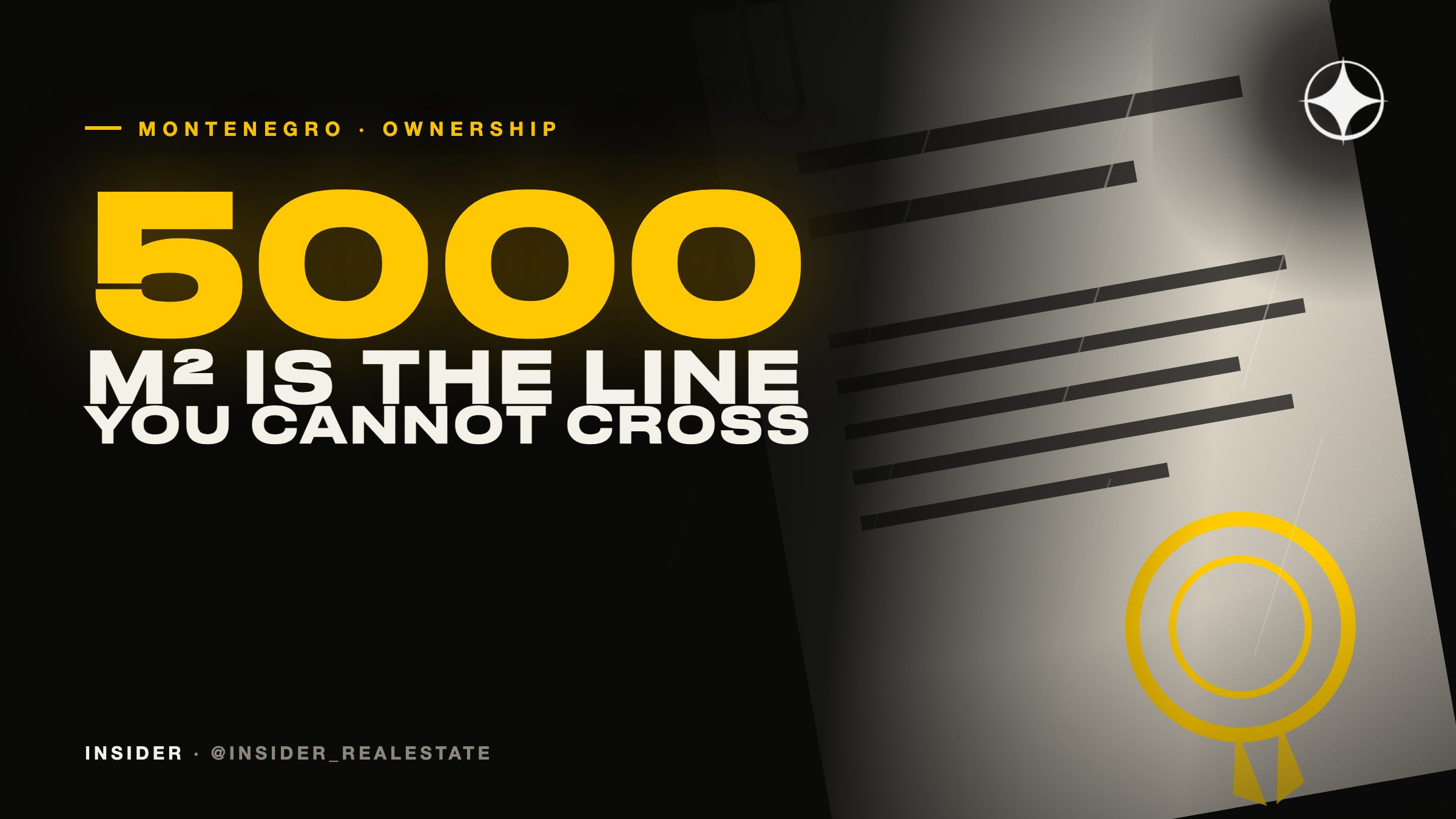
Montenegro belongs to the short list of countries where a foreigner buys property on almost the same terms as a local resident. "Almost" is the key word: the line where the rights diverge runs not through the type of property but through the land beneath it — and it is that line buyers trip over when they compared listings but did not read the law.
What a foreigner buys in their own name
An apartment, a unit in a complex, a house with a plot, commercial premises, an office — all of it is registered to a foreign individual without permissions and without a local partner. Citizenship is not required, nor is residency: the purchase comes first, status is a separate story. There is no limit on the number of properties.
- Apartments — unrestricted, the simplest case: the land under the building belongs to all owners in shares, and the question of its transfer does not arise.
- A house with a plot — permitted, as long as the plot stays below the statutory area threshold.
- Commercial — permitted, including premises for letting and a tourism business.
What is closed to an individual
- Agricultural land — unavailable regardless of area.
- Forest and forest land — unavailable.
- A plot over 5,000 m² — a foreigner cannot register it in their own name even when built on.
- Land in the border strip — a separate prohibition tied to the border regime.
- Cultural heritage of special significance and natural resources — not available to foreigners at all.
The workaround is lawful and well known: a Montenegrin company (DOO) counts as a domestic legal entity and owns land on general terms, and its founder may be a foreigner. Registration takes weeks rather than months and costs a fraction of the transaction. But it is not free: the company acquires its own reporting, its own accountant and its own taxation — costs an individual does not have at all.
Talk to a licensed broker: 📲 +971 50 120 32 64 on WhatsApp, @dubai_oleg on Telegram
How a transaction works
The sale contract in Montenegro is executed by a notary, and that is not a formality: the notary checks title documents, capacity and encumbrances, and without notarisation the contract has no force. Transfer is recorded by an entry in the property cadastre — before that entry the buyer is not the owner, however much they have paid.
- The cadastre extract (list nepokretnosti) is the first document to read: it shows the owner, charges and disputes.
- Building permit and occupancy certificate — on the coast, legalising what was built "as a fact" drags on for decades, and a property without documents is bought together with somebody else's problem.
- The deposit (kapara) is standard practice, but the terms of its return are written into the preliminary contract rather than assumed.
What this means in practice
- Ask about the land, not the house. The plot's area and category decide whether the transaction is in your name or a company's — the first question about anything outside an apartment block.
- A company is an instrument, not a loophole. It is legal and common, but it adds permanent costs; setting one up for a single apartment is pointless.
- Check documents before the deposit. A notary protects the form of the transaction, not whether the property suits you.
Video on this topic
The same subject on the English channel — each clip has a written version of its own.
 4:15Lamborghini villas in Meydan: half the price of Ellington, and why26 January 2024
 13:04The best townhouses in Dubai under USD 600,000: Nshama Town Square7 October 2023
 13:00Socio by Emaar in Dubai Hills: buying a whole floor, and skipping the 2% commission4 October 2023
 12:00XXII Carat on Palm Jumeirah: 22 Mediterranean villas compared with Raffles and Zabeel Saray20 September 2023
Related reading
Other write-ups on the site about the same thing.

Property in Georgia for a foreigner: what you can buy and what the constitution forbids
One of the simplest markets on this list. No permissions, no limit on the number of properties, registration in a day — and exactly one restriction, written at the highest level.

Where a foreigner can own land: ownership against long lease
Buildings and land are treated differently in most of the world. The word on the contract decides what you actually hold, and it is the first question in any unfamiliar jurisdiction.
Budva, Tivat and Kotor: three different property markets in Montenegro
The coast runs about three hundred kilometres, but a foreign buyer almost always chooses between three points — and the markets differ enough that a calculation does not transfer.

Owner taxes in Montenegro: purchase, ownership, letting, sale
Rates here are below European levels, and that creates a false sense that there are no taxes at all. There are — they are simply small, and each of the four points has its own rule.

Property in Turkey: TAPU, military clearance and a mandatory valuation
One of the most open markets in the region and simultaneously one of the most procedural. Buyers usually learn about the filters at the moment one of them trips.
Bali districts: Canggu, Ubud, Uluwatu and Sanur — four different markets
Bali is sold as one place, but the island long ago split into several markets with different economics. A villa in Canggu and one in Ubud are different businesses.