
The New Silk Road: what a trade corridor does to the cities on it
The old Silk Road linked China to the Mediterranean by caravan. Its modern version runs on railways, ports and logistics hubs. China's Belt and Road Initiative, launched in 2013, became the largest infrastructure programme in history — hundreds of billions of dollars committed across the routes, with credible estimates well past a trillion. The aim is prosaic: shorten the path from Chinese factories to European consumers and hold influence along the whole supply chain.
What the programme is, structurally
Two strands. The overland "belt" is a network of rail corridors and border crossings running west across Central Asia. The maritime "road" is a chain of ports, terminals and free zones around the Indian Ocean and up through the Gulf and the Red Sea.
Very little of it is a single project. It is a label applied to hundreds of separate investments — a terminal here, a rail link there, an industrial park attached to both — financed through a mix of Chinese state lending and local partners.
That structure is why it is hard to assess as a whole and easy to assess locally. What matters for any given city is not the initiative but the specific asset built in it.
Talk to a licensed broker: WhatsApp +971 50 120 32 64 · Telegram
Why the UAE sits well on it
Geography, first: the Gulf is on the maritime route between Asia and Europe, and the UAE has spent forty years building the port and free-zone capacity to service it. Jebel Ali is the largest man-made port in the world and the region's biggest container terminal.
Policy, second. Free zones with foreign ownership, straightforward customs and a functioning legal system are exactly what a logistics operator needs, and they existed here before the initiative did.
And connectivity, third: sea, air and now rail meet in the same corner of the emirate — Jebel Ali port, the Al Maktoum airport under construction, and Etihad Rail running through. Few places offer all three on one site.
How a trade corridor reaches housing
Through employment, almost entirely. A terminal or an industrial park creates jobs across a wide band — warehouse staff, logistics managers, engineers, the regional offices of companies that need to be near their cargo.
Those people live within a short commute, because nobody drives across a city to a shift in an industrial zone. That is why rental demand in Jebel Ali, Dubai Investment Park, Discovery Gardens and Al Furjan is steady in a way that fashionable districts are not.
The effect is slow and unglamorous. It does not produce headlines or price spikes; it produces tenants who are still there in five years.
What it does not do
It does not make an industrial district prestigious. Freight traffic, warehousing and round-the-clock terminals are not amenities, and no amount of trade volume changes that.
It does not produce capital growth on its own. Districts in the logistics belt are yield instruments: low entry price, steady rent, slow appreciation. Anyone modelling a doubling there is modelling the wrong thing.
And it is not immune to politics. Trade corridors are geopolitical assets, and the volumes moving through any given route depend on decisions made far from the port.
The concentration risk worth naming
Districts that live off a single type of employer have thin rental markets. If a major free-zone tenant reduces headcount, it shows up immediately in both achievable rent and time-to-let.
That is the honest counterweight to the yield numbers, and it is the reason I would not build an entire portfolio in that belt however good the percentages look.
The mitigation is boring: buy where the tenant base draws on several employers rather than one, and check what is actually operating nearby rather than what is announced.
How to read the news flow
Corridor announcements are noise for a property buyer. Volumes through the port, occupancy in the free zones and the pace of industrial land takeup are signal.
Those numbers move slowly and are published rather than promised, which makes them a far better guide than any strategic partnership headline.
If they are rising, the southern belt gets more tenants and the yield thesis holds. If they flatten, the districts stay exactly what they are today — which is still a functioning income asset, just not a growth story.
The version of this that is investable
Not the corridor. The housing that serves it: existing, let, cheap to enter, in the belt around Jebel Ali and Dubai South.
Underwrite it on current rent, check the service charge carefully because it eats a large share of a small income, and accept that appreciation will be modest.
That is an unexciting conclusion for a subject this large, and it is the correct one. Trade corridors build cities over decades; they do not reprice apartments over quarters.
Frequently asked
Does Belt and Road make UAE property more valuable?
Indirectly and slowly, through employment rather than prestige. Ports, free zones and industrial parks create tenants for the districts around them — Jebel Ali, Dubai Investment Park, Discovery Gardens. It supports rental demand rather than capital growth.
Which districts benefit most?
The logistics belt in the south-west: Jebel Ali, Dubai Investment Park, Al Furjan, Discovery Gardens and Dubai South. All are low entry price with high percentage yields, and all carry the same risk — a tenant base drawn from one type of employer.
✍️ Message me on WhatsApp for a free consultation — off-market stock, payment plans and honest numbers on any of the projects covered here.
✅ Subscribe on YouTube — investment, property, business and relocation in the UAE and beyond.


In the news
The same subject in writing — analysis and news related to this video.
RTA's Latifa Bint Hamdan Corridor: 12km of New Road for AED 2 Billion
A new artery will directly link six highways and halve the drive from Umm Al Sheif to Emirates Road. Who it affects: Nad Al Sheba, Al Barari, Dubai Hills, Majan, Living Legends.
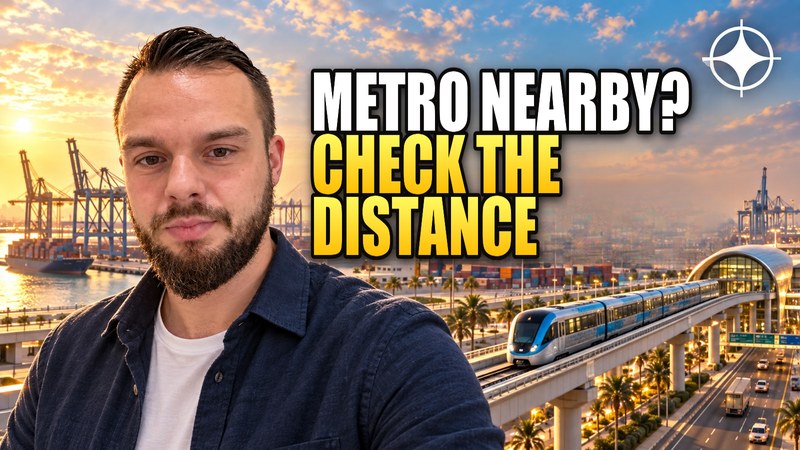
Jebel Ali: the transport corridor and what it means for housing — check the distance to the metro
A port, a free zone and residential clusters along the main highway and the metro line. Here what counts is not the district but the distance to a specific station.
Dubai in Julius Baer’s most-expensive-cities ranking: 7th in 2025, and what changed in 2026
Dubai climbed five spots to 7th place among the world’s most expensive cities in Julius Baer’s 2025 report. In the 2026 edition it dropped to 14th — not because it got cheaper, but because of the dirham’s dollar peg.