
The Dubai service charge: who approves the rate, and how to check it before you buy
There is no annual property tax in Dubai. There is a service charge, it is the largest permanent cost of ownership, and it is approved building by building — which means it can be checked before you sign rather than discovered afterwards.
Buyers arriving from Europe or North America hear "no property tax" and stop asking about recurring costs. That is the wrong place to stop. Dubai has no annual property tax and no personal income tax, but every apartment carries a service charge, it runs for as long as you own the property, and across a ten-year hold it is the single largest difference between two otherwise identical purchases.
The useful part is that the number is knowable in advance. It is not set by whoever is selling you the flat.
What the charge is actually made of
- The building. Cleaning, security, lifts, insurance, the management company. This is the part most buyers picture when they hear the phrase.
- Your share of the master community. Roads, landscaping, lighting of common ground. In gated communities this layer can exceed the charge for the building itself, which is why two towers with similar specifications can sit far apart on cost.
- The reserve fund for capital works — lift replacement, the roof, the facade — on a cycle of ten to fifteen years.
- Cooling, almost always as its own line. This is the one to read closely. In some buildings it sits inside the charge; in others it is metered on top. The annual difference runs to multiples, and a comparison that ignores it compares nothing.
Who approves it
- The rate is approved by RERA within the Land Department, building by building, and it moves from year to year.
- Since 2019 the money does not sit with the management company. Owners' contributions go into a separate escrow account for that building under the Mollak system. One building's funds cannot be spent on another — a structural answer to the oldest complaint in strata ownership anywhere.
- The approved figure is published. The Land Department maintains a service charge index, and the rate for a specific address is visible in its own app rather than only in the seller's spreadsheet.
- So the question to ask is not "what is typical" — the spread between segments is threefold to fivefold and varies inside a single district. The question is what it is in this building, at this address.
Order of magnitude, for a first screen only
- Mid-market stock starts at roughly nine dollars per square metre a year.
- Branded and serviced residences are a multiple of that, and hotel-operated buildings higher again — up to around $88 per m² in ordinary stock, and $97–119 where a hotel operator runs the building.
- Villas are levied differently — normally on plot area rather than built area — and running one often comes out three to four times cheaper than an apartment of comparable size, because with an apartment you are also paying for the tower's shared infrastructure.
The reserve fund, and why the cheapest charge is often the expensive one
The reserve fund is not refunded when you sell. What has accumulated belongs to the building, not to you, and passes with the apartment to the next owner. That produces a rule most resale buyers have backwards: a building with an honestly funded reserve beats one whose charge is lower precisely because no reserve is being collected. The second is cheaper every year until the year the lifts have to be replaced — and then it arrives as a special levy, on whoever owns the flat that year.
Talk to a licensed broker: 📲 +971 50 120 32 64 on WhatsApp, @dubai_oleg on Telegram
The charge has gone up. What can actually be done
- Find the line it went up for. Under the 2019 joint-ownership framework the building is run by a company appointed by the developer under RERA supervision, and the budget goes through approval. An increase almost always traces to one item — insurance, cooling, repairs — and an owner is entitled to the breakdown.
- Arguing with the total gets nowhere. What works is a joint approach to RERA by owners where the spend is not substantiated.
- Model it as rising. A projection that holds the charge flat for ten years is not a projection.
What it does to the yield
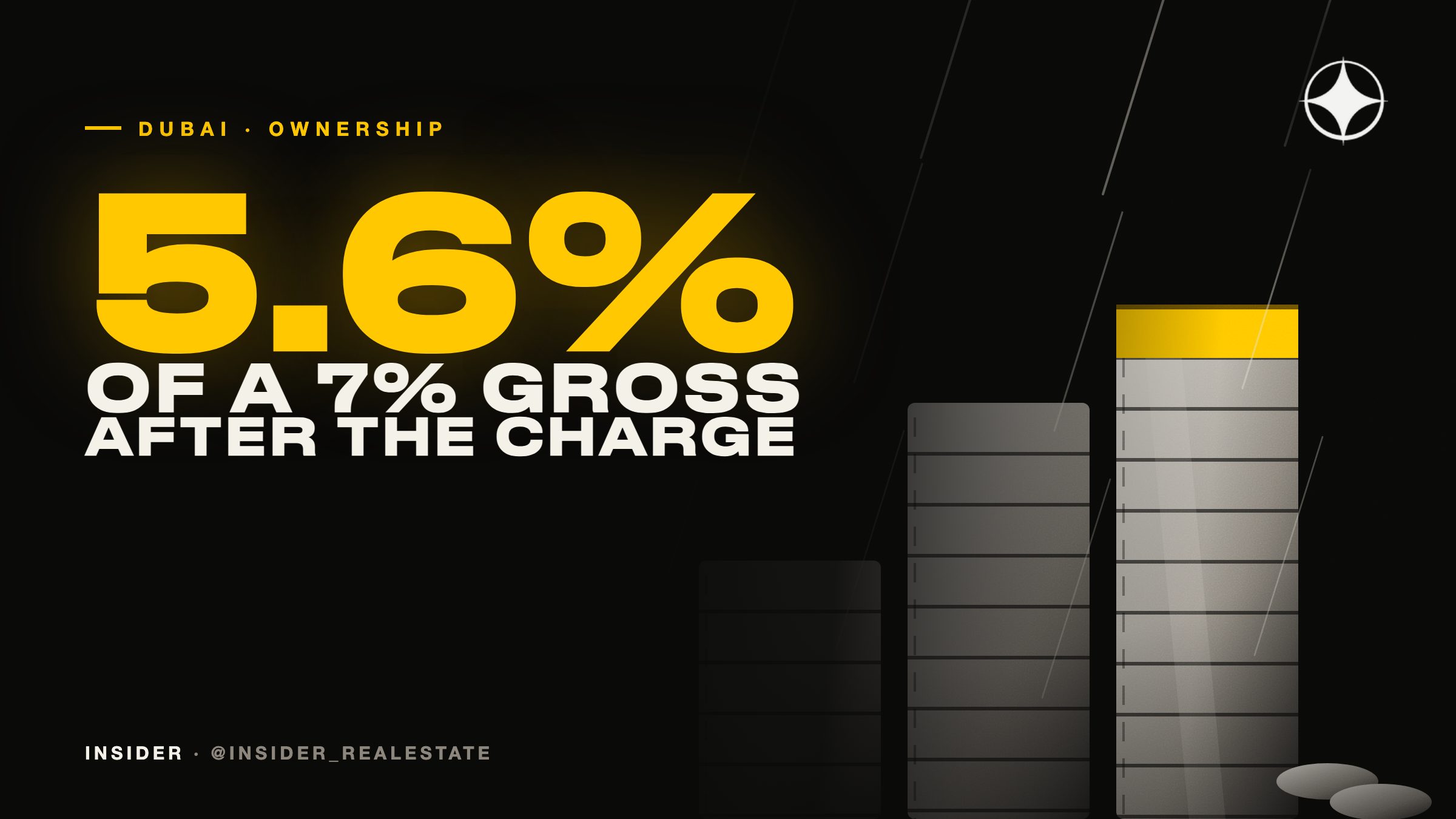
Harder than people assume, because the charge runs whether the flat is let or empty. Take the annual rent, subtract the charge, the cooling, management and the void months, and divide by the purchase price including transaction costs. If the charge takes a fifth of the rental stream, a 7% gross yield lands near 5.6% before anything else goes wrong. That arithmetic is why a modest address with a low charge frequently beats an expensive building with a rooftop pool over a long horizon.
Based on the Land Department's published service charge index and the joint-ownership rules in force since 2019.
Video on this topic
The same subject on the English channel — each clip has a written version of its own.
 1:38Binghatti Hills at Arjan: the volume play, examined10 September 2025
 8:54Address Sky View: the twin towers with the bridge, reviewed properly31 May 2024
 1:31Binghatti Haven in Dubai Sports City: cheap for a reason, or cheap for a good reason?9 September 2025
 11:44Dubai Hills ready apartments: the park, the schools and a 6–7% long-let yield23 September 2023

In the news
Other write-ups on the site about the same thing.

What a Dubai apartment costs to run: the bills that are not the service charge
Cooling, DEWA, internet, insurance and the appliances inside your own walls sit outside the service charge entirely. The list of what an owner pays after the purchase, and the one line that separates a villa from a flat.

Villanova: townhouse economics are not apartment economics
A family townhouse community in Dubailand. Comparing its yield with an apartment’s in the usual way produces the wrong answer, for five specific reasons.

DEWA and the cooling account: the bills that do not follow the title deed
Electricity, water and cooling are separate accounts with separate providers and separate deposits, and none of them moves automatically when the property does. What to close, what to open, which deposit comes back, and why an empty apartment still runs a bill.

The first year after handover: the title deed, the association, and the bills that start
Keys are the beginning of a different set of obligations. The title deed, the service charge that runs whether or not you moved in, the utility accounts and their deposits, the owners association — and the one warranty clock that expires while you are still furnishing.

Dubai Festival City: a district where one company owns everything around you
A waterfront quarter with a mall, hotels, schools and homes under a single owner. Single ownership buys predictability and creates dependence.

Dubai Festival City: who decides what you pay
A district under a single owner is maintained better than most. It also means the standard, and the charge that pays for it, are set by someone else.