
Off-plan and ready: two Dubai markets counted as one
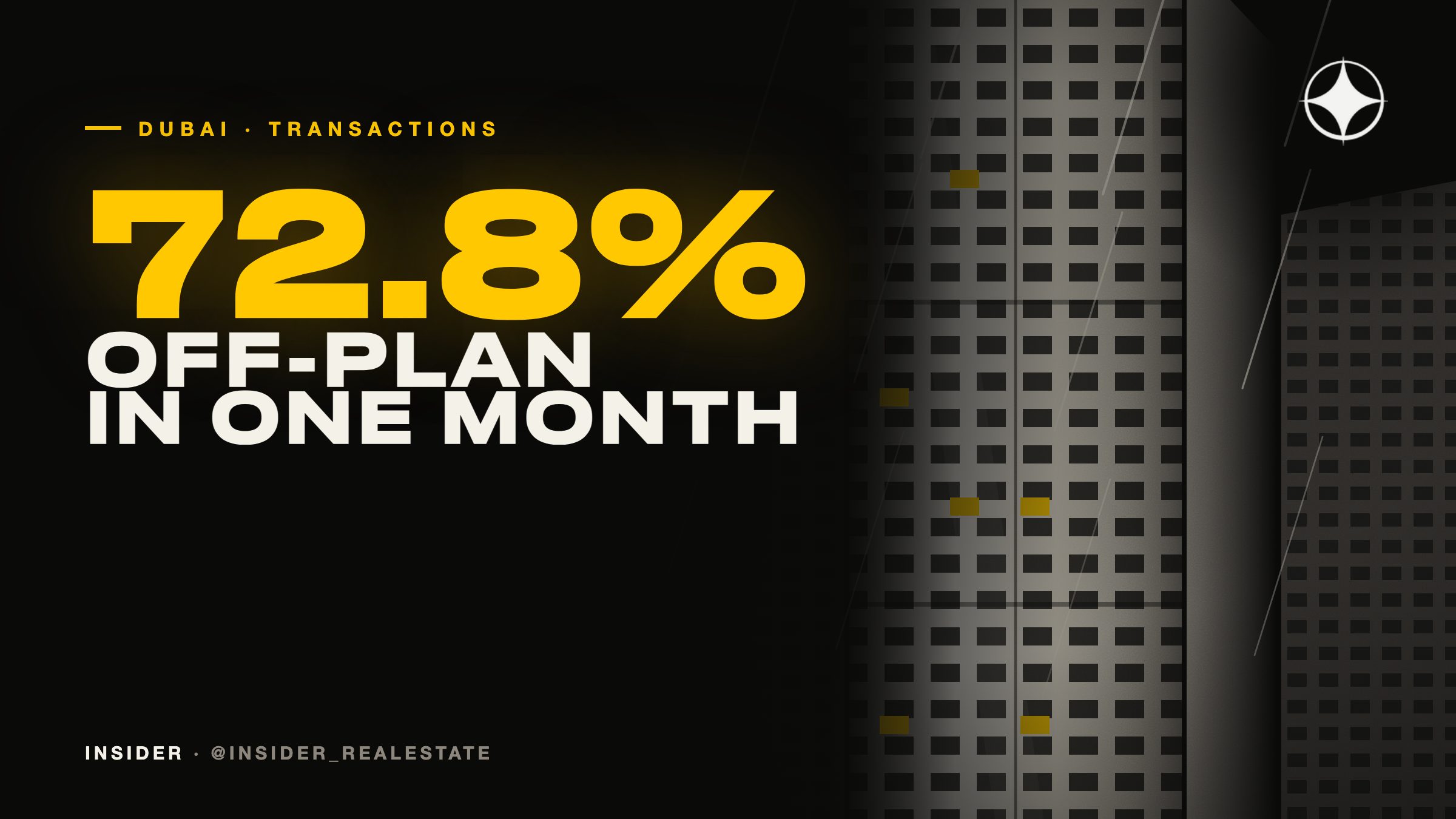
In July 2026 nearly three quarters of Dubai residential transactions were off-plan. The two halves moved in opposite directions that month — and any headline that adds them together is describing developer launches, not the housing market.
Dubai publishes a transaction count every month, and it gets quoted as a single number. In July 2026 that number was 13,021 residential deals. Split the way the market actually works, it was two very different things stacked on top of each other:
- Off-plan: 9,475 registrations — 72.8% of the month. Down 1.1% on the previous month and down 45.3% year on year.
- Completed property: 3,546 transactions — 27.2%. Up 11.4% on the previous month and down 26.4% year on year.
Month on month, one half rose by double digits while the other fell. A combined figure for that month says the market was roughly flat, which is true of the total and true of neither part.
Why the off-plan share dominates the count
An off-plan registration happens when a buyer signs with a developer and the contract goes onto the register. A completed-property transaction happens when an existing home changes owner. Dubai is building at a rate that produces far more of the first than the second — so the headline count is mostly a measure of how much developers sold last month, not of how much housing changed hands.
Talk to a licensed broker: 📲 +971 50 120 32 64 on WhatsApp, @dubai_oleg on Telegram
That has a direct consequence. A developer pausing launches, or bringing a big release forward, moves the national transaction count by more than anything happening in the resale market. When the count falls 45% year on year on the off-plan side and 26% on the ready side, those are two separate stories: the first is about the launch calendar and buyer appetite for new contracts, the second about the depth of the secondary market.
The two halves do not even share a geography
This is the part that surprises people. In the same July, the districts with the largest share of completed transactions were Jumeirah Village Circle at 14.4% — around 510 of the 3,546 — then Dubai Marina at 6%, Business Bay at 5.3%, Downtown at 4% and Dubai Hills Estate at 3.3%.
The largest shares of off-plan registrations that month went to clusters: one scheme in Dubai South took 21% of all off-plan registrations, roughly 1,990 of the 9,475, followed by City of Arabia at 7.6%, Jebel Ali Industrial Second at 5%, and the Dubailand Residence Complex and Jebel Ali Downtown at 4.7% each.
Not one name appears on both lists. The places where Dubai buys new contracts and the places where Dubai buys existing homes are, in a given month, almost disjoint sets.
Three traps in this data
- A cluster is not a project. A 21% share belongs to a masterplan with dozens of buildings and several handover dates. Reading it as the performance of one tower inside it is a category error, and it is how "our project took a fifth of the Dubai market" sentences get written.
- Clusters inside one district do not add up. Two of the July off-plan entries sit inside Dubailand at 7.6% and 4.7%, but they are different schemes with different prices and timelines. Adding them describes nothing you can actually buy.
- A registration is not a completed sale of a home. Off-plan registrations include contracts on property that will exist in three years. Counting them alongside resales as "the market" blends today with 2029.
What to ask of any Dubai transaction figure
- Off-plan, ready, or both? If the source will not say, the figure cannot be used.
- Count or value? Nine and a half thousand off-plan registrations at mass-market prices and three and a half thousand resales are not comparable in money, and a league table by count ranks something different from a league table by value.
- Against what? Month on month and year on year gave opposite signs for completed property in July 2026 — up 11.4% and down 26.4%. Both were true.
- Whose market is it? If you are buying a finished flat, the off-plan number is background noise. If you are buying off-plan, the resale number tells you what your exit will look like.
Figures: ValuStrat's residential market review for July 2026, read 24 August 2026 — 9,475 off-plan registrations and 3,546 completed-property transactions, with district and cluster shares as published for that month. Deal counts derived from published shares are rounded to the nearest ten; the underlying shares carry one decimal place and no more precision than that.
Video on this topic
The same subject on the English channel — each clip has a written version of its own.
 1:38Binghatti Hills at Arjan: the volume play, examined10 September 2025
 28:23Peninsula Four The Plaza by Select Group: what you are actually buying2 March 2025
 1:31Binghatti Haven in Dubai Sports City: cheap for a reason, or cheap for a good reason?9 September 2025
 8:01Island Park at Dubai Creek Harbour: an Emaar tower that is almost finished9 August 2024


In the news
Other write-ups on the site about the same thing.

Billions in transactions: what the headline number is actually counting
Every few weeks Dubai reports another record total of property transactions. The figure is real, but it is not a measure of how many homes were sold, how much they cost, or whether the market rose. Here is what it does measure.

Deal count or money: why two Dubai developer rankings disagree
Over January to July 2026 one developer signed 8,411 transactions and took AED 7.5bn; another signed 2,768 and took AED 8bn. Both topped a league table. Which table you are reading decides which company looks like the leader.
Index points, asking prices and what was actually paid: three numbers, one confusion
An index of 219.2. An asking price of AED 1,397 a foot. A registered sale price. These are three different kinds of number about the same market, and none of them converts into another.

A discount to market: what the number is measured against, and when to distrust it
A badge saying "20% below market" is only as good as the comparison behind it. Here is exactly what ours is measured against, the three things no algorithm can see, and the cases where a real discount is still not a bargain.
Average or median: how to read the price of a Dubai district
The average price of a district is one of the least useful numbers published about Dubai. It moves when the mix of what sold moves, even if no property changed price — and a handful of penthouses can carry it on their own.

The Dubai average that describes nobody: villas and apartments in one figure
In July 2026 the blended residential index was down 1.6% over the year. Underneath it, villas were flat and apartments were down 4.2%. The blended figure was accurate and told a buyer of either nothing at all.