
Billions in transactions: what the headline number is actually counting
Every few weeks Dubai reports another record total of property transactions. The figure is real, but it is not a measure of how many homes were sold, how much they cost, or whether the market rose. Here is what it does measure.
Transaction totals are the most repeated statistic about Dubai and the least informative. They are large, they are rising, and they are almost never accompanied by the denominator that would let anyone interpret them. A total in billions tells you the size of a flow of money. On its own it says nothing about prices, about how many homes exist, or about whether the market is healthy.
Three things are needed before such a number becomes usable.
One: the denominator
A money total divided by a transaction count gives an average ticket, and the average ticket is where the information is. For 2024, roughly 180,000 transactions worth about $142bn were registered in Dubai — a record at the time. That works out to an average of a little under $800,000 per transaction.
Talk to a licensed broker: 📲 +971 50 120 32 64 on WhatsApp, @dubai_oleg on Telegram
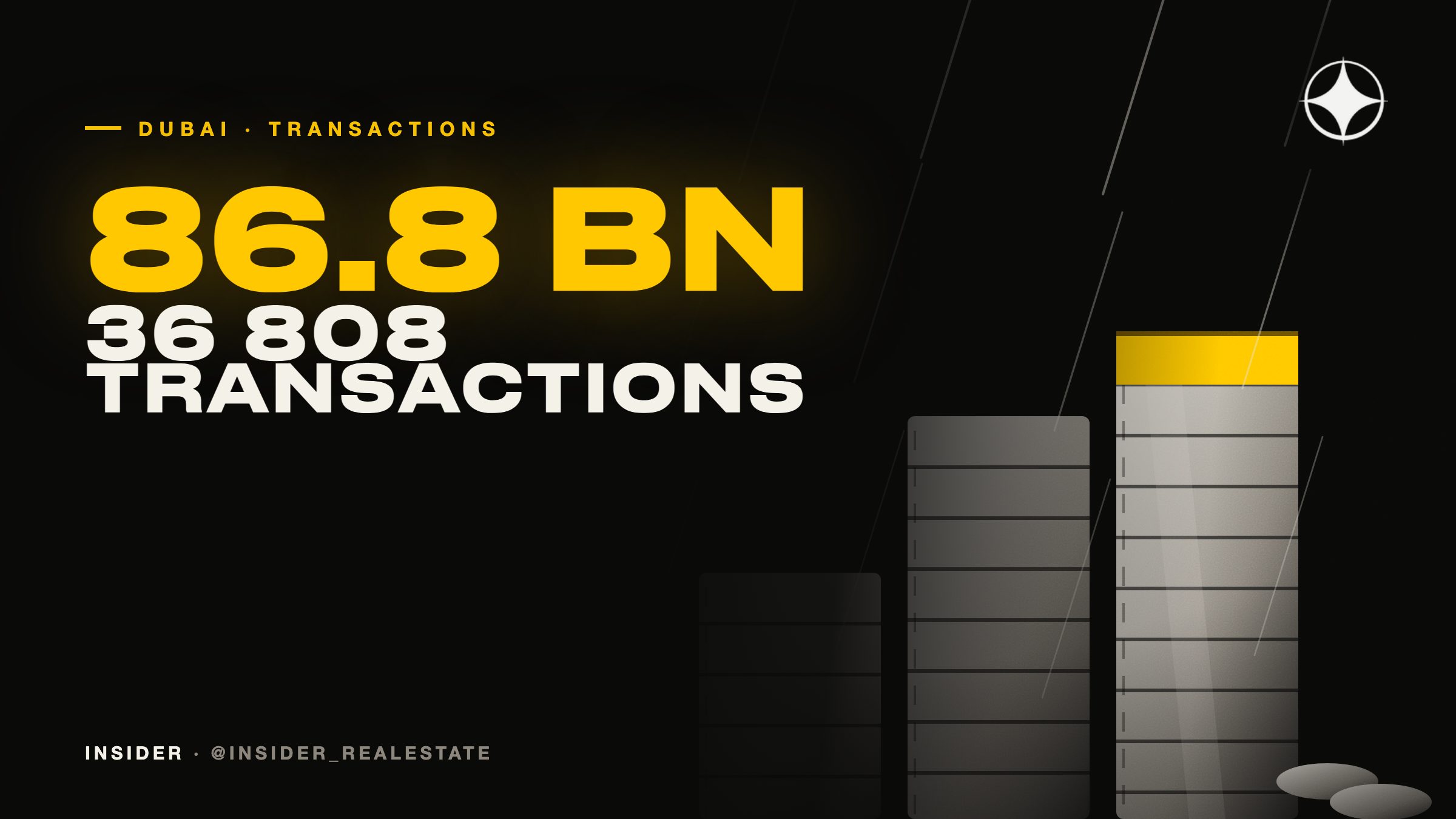
Compare that with a narrower cut. Over January to July 2026 the ten largest developers recorded 36,808 transactions worth AED 86.8bn, an average of about AED 2.4m. The two figures are not in tension; they are different populations. The first includes everything registered; the second only new-build sales by the largest ten sellers.
Which is the point. A headline total without a count cannot be compared with anything, including its own previous year, because you cannot tell whether the increase came from more deals, dearer deals, or a widened definition of what gets counted.
Two: what is inside the total
"Property transactions" is a wider category than "homes sold", and the difference is not small. A published total can include land plots, commercial premises and offices, gifts and transfers between related parties, and off-plan contracts on property that does not exist yet.
The last one matters most for interpretation. In July 2026, 9,475 of the month's 13,021 residential transactions — 72.8% — were off-plan registrations. Those are contracts signed now for homes completing in future years, and their money is paid over an instalment schedule rather than at registration. A total that mixes them with resales is adding today's completed purchases to future commitments and reporting the sum as this month's activity.
So the first question of any billions figure is not "how much" but "of what": residential only or everything, sales only or all transfers, new contracts or changes of ownership.
Three: what a total cannot tell you
- It is not a price signal. Value can rise while prices fall, if volume rises faster — and it can rise purely because the mix shifted towards larger or more expensive property. In the twelve months to July 2026 the blended residential price index was down 1.6% year on year; a rising money total over an overlapping period would not have contradicted that.
- It is not a supply or demand figure. One masterplan taking 21% of a month's off-plan registrations moves the total on its own. A single large scheme is not a market trend.
- It is not comparable across cities. Different registries count different things, and transfer taxes and registration practice differ. A "Dubai versus London" comparison of transaction value is usually a comparison of two definitions.
- It is not a return. None of the money in that total is yours, and none of it describes what a specific property did.
The numbers that do answer a buyer's question
If the question is "should I buy here", the transaction total is close to useless and four other figures are not: the price index for your segment and district with its period stated; the transaction count for the market you are actually in, off-plan or resale; the achieved rent for your building rather than a district average; and the running costs that turn a gross yield into a net one.
On that last point, the arithmetic is unglamorous and it is where most projections fail. Gross yields quoted for Dubai housing typically run 5–8%; the net commonly lands 1.5 to 2.5 percentage points lower once the service charge, letting commission, management and void periods are taken out. And the investment base is not the price — the 4% Land Department fee, fit-out and furniture belong in it too. Worked properly, a $1,000,000 apartment let at $75,000 with $5,000 of costs returns about 6.7% on roughly $1,050,000 invested, not 7.5% on the price.
None of those numbers will ever be a headline. All of them are the ones that decide the outcome.
Figures: 2024 transaction volume and value, yield arithmetic and cost components from this site's English buyer's FAQ, with the periods stated there; the July 2026 off-plan and residential transaction split and the annual index change from ValuStrat's review for that month, read 24 August 2026; the January–July 2026 top-ten developer totals from a consolidated developer report for that period.
Video on this topic
The same subject on the English channel — each clip has a written version of its own.
 36:55
36:55 The Biltmore Residences Dubai: brand history, the numbers, and what you can actually earn
From the first Biltmore in Los Angeles to Tbilisi to Dubai, the Millennium hotel chain behind it, and then the part that matters: the statistics and an honest calculation of what a Biltmore Residences unit earns.
WatchIn the news
Other write-ups on the site about the same thing.

Deal count or money: why two Dubai developer rankings disagree
Over January to July 2026 one developer signed 8,411 transactions and took AED 7.5bn; another signed 2,768 and took AED 8bn. Both topped a league table. Which table you are reading decides which company looks like the leader.

Off-plan and ready: two Dubai markets counted as one
In July 2026 nearly three quarters of Dubai residential transactions were off-plan. The two halves moved in opposite directions that month — and any headline that adds them together is describing developer launches, not the housing market.
Index points, asking prices and what was actually paid: three numbers, one confusion
An index of 219.2. An asking price of AED 1,397 a foot. A registered sale price. These are three different kinds of number about the same market, and none of them converts into another.

A discount to market: what the number is measured against, and when to distrust it
A badge saying "20% below market" is only as good as the comparison behind it. Here is exactly what ours is measured against, the three things no algorithm can see, and the cases where a real discount is still not a bargain.
Average or median: how to read the price of a Dubai district
The average price of a district is one of the least useful numbers published about Dubai. It moves when the mix of what sold moves, even if no property changed price — and a handful of penthouses can carry it on their own.

The Dubai average that describes nobody: villas and apartments in one figure
In July 2026 the blended residential index was down 1.6% over the year. Underneath it, villas were flat and apartments were down 4.2%. The blended figure was accurate and told a buyer of either nothing at all.