
The Dubai average that describes nobody: villas and apartments in one figure
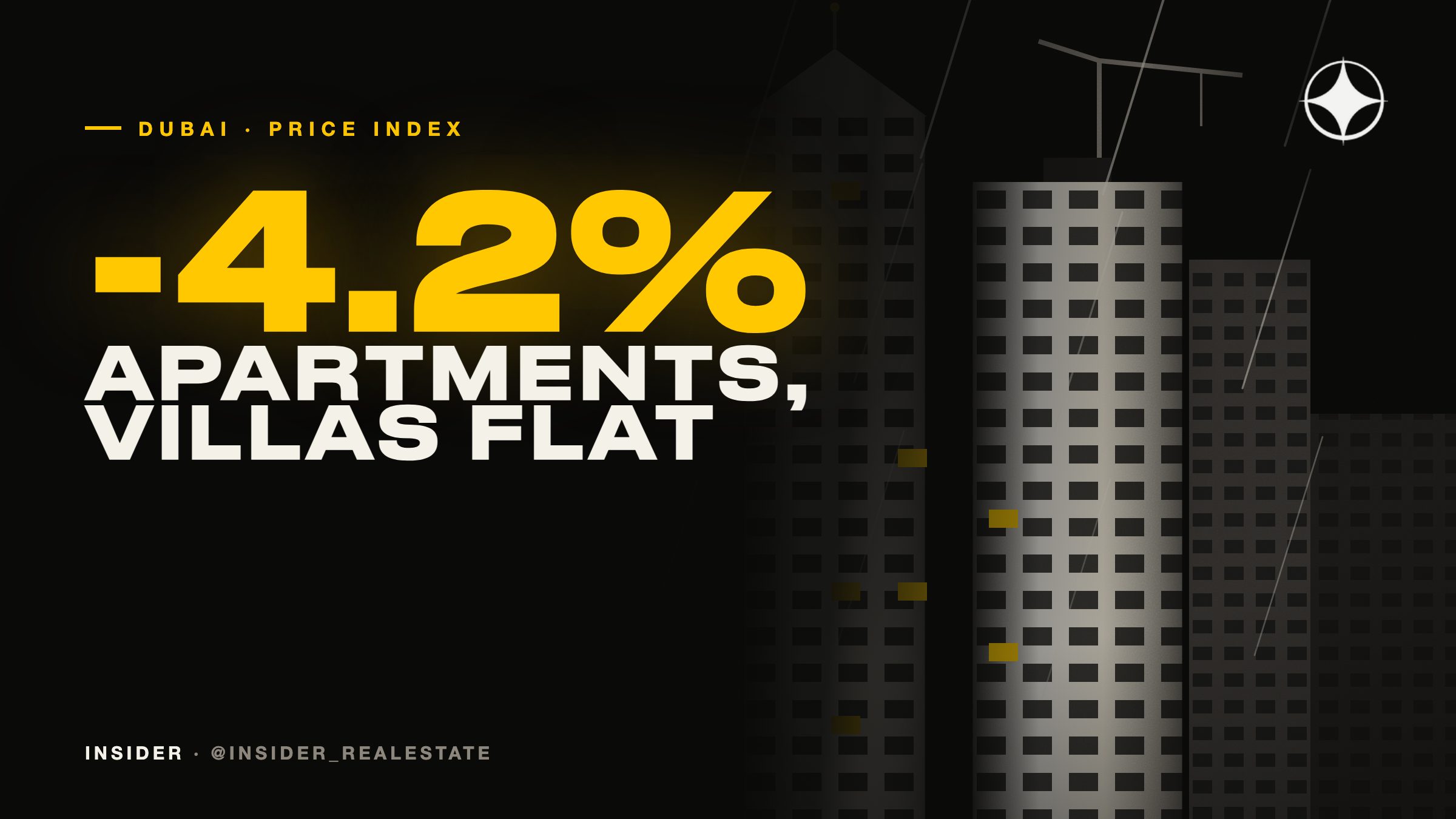
In July 2026 the blended residential index was down 1.6% over the year. Underneath it, villas were flat and apartments were down 4.2%. The blended figure was accurate and told a buyer of either nothing at all.
The most quotable number about the Dubai market is usually the one that covers all of it. In July 2026 that number was a residential price index of 219.2, down 0.3% on the month and 1.6% over the year. It is an accurate figure, correctly computed, and it applies to no property anyone is actually buying.
Because the same month, split into its two halves, looks like this:
- Villas and townhouses: index 292.5, down 0.4% on the month, unchanged over the year.
- Apartments: index 168.7, down 0.2% on the month, down 4.2% over the year.
A villa owner reading "down 1.6%" is reading something worse than his year. An apartment owner reading it is reading something considerably better than his. The blended figure is the average of two markets that have stopped moving together, and an average only describes a population when the population is one thing.
Talk to a licensed broker: 📲 +971 50 120 32 64 on WhatsApp, @dubai_oleg on Telegram
Why the two segments separated
They have different supply. Land inside the established villa communities is finite and most of it is built on; new villa stock arrives at the edges of the city rather than inside them. Apartment supply is elastic in a way villa supply is not — a tower adds several hundred units to one plot, and towers keep completing.
They also have different buyers. The villa market skews towards people buying somewhere to live, often with families and often with a longer horizon. The apartment market carries most of the investment flow, which is more sensitive to yield, to payment plans and to what the next twelve months of completions look like.
Whatever the cause in a given year, the consequence for reading figures is permanent: one number across both segments will always be a weighted mixture of two behaviours, and the weighting is not published alongside the headline.
The same split shows up in the asking price
In the same month the average asking price was around AED 2,039 per square foot for villas and AED 1,397 for apartments — villa space listed at roughly 46% more per foot. That gap is worth holding onto for a separate reason: it means the blended "average price per square foot of Dubai housing" moves whenever the mix of villas and apartments in the sample moves, even if not a single price changes.
Note also that these are asking prices, which is what sellers want rather than what buyers paid. That distinction is a subject of its own, and it is the reason an asking-price average and a registry average for the same month can differ without either being wrong.
Below the segment, the same problem again
Splitting Dubai in two is an improvement, not a solution, because each half splits again by district. In the same July, within villas, one community was up 15% year on year, another up 9.1%, another up 7.1% — while two others were down 7.2% and 5.2%. Within apartments, three districts were up between 5% and 6%, and three were down between 8.4% and 19%.
So the honest description of that month is not "Dubai fell 1.6%". It is: villas held their level while apartments gave up ground, and inside both, individual districts moved across a range of roughly thirty-four percentage points from best to worst.
What to do with this as a buyer or an owner
- Never act on a blended figure. Find the one for your segment first, then for your district, then — if you can — for your building.
- Do not let a blended figure reassure you either. A flat market average can sit on top of a district that has fallen by double digits.
- Check that a quoted "average price per foot" holds its mix constant. If villas entered or left the sample, the average moved for reasons that have nothing to do with prices.
- Read segment figures before deciding what to buy, not after. "Dubai property" is not an asset class you can own; a villa in one community and a studio in another are two different investments that happen to share a city.
- Ask whose price it is. Asking, valued, or transacted — three different numbers, and only the last one is money that changed hands.
Figures: ValuStrat's monthly residential price index for July 2026, base January 2021 = 100, read 24 August 2026 — blended 219.2, villas 292.5, apartments 168.7, with average asking prices of AED 2,039 and AED 1,397 per square foot respectively.
Video on this topic
The same subject on the English channel — each clip has a written version of its own.
 4:15Lamborghini villas in Meydan: half the price of Ellington, and why26 January 2024
 13:04The best townhouses in Dubai under USD 600,000: Nshama Town Square7 October 2023
 23:03What USD 150,000 actually buys in Bali: Parq, Mirah and Alex Villas4 April 2024
 9:41Trump Golf Villas in Oman: what USD 2.3 million buys 20 minutes from Muscat24 October 2025
 12:00XXII Carat on Palm Jumeirah: 22 Mediterranean villas compared with Raffles and Zabeel Saray20 September 2023
In the news
Other write-ups on the site about the same thing.
Index points, asking prices and what was actually paid: three numbers, one confusion
An index of 219.2. An asking price of AED 1,397 a foot. A registered sale price. These are three different kinds of number about the same market, and none of them converts into another.

Two reports, one market: what a Dubai price index actually measures
One index says Dubai housing rose 8.9% over the year. Another says it fell 1.6%. Both are correct, and the reason is not spin — it is that they measure different things over different periods against different starting points.

Billions in transactions: what the headline number is actually counting
Every few weeks Dubai reports another record total of property transactions. The figure is real, but it is not a measure of how many homes were sold, how much they cost, or whether the market rose. Here is what it does measure.

Deal count or money: why two Dubai developer rankings disagree
Over January to July 2026 one developer signed 8,411 transactions and took AED 7.5bn; another signed 2,768 and took AED 8bn. Both topped a league table. Which table you are reading decides which company looks like the leader.

A discount to market: what the number is measured against, and when to distrust it
A badge saying "20% below market" is only as good as the comparison behind it. Here is exactly what ours is measured against, the three things no algorithm can see, and the cases where a real discount is still not a bargain.
Average or median: how to read the price of a Dubai district
The average price of a district is one of the least useful numbers published about Dubai. It moves when the mix of what sold moves, even if no property changed price — and a handful of penthouses can carry it on their own.