
Dubai Rolls Out 735 Electric Buses: The UAE’s Largest Fleet Renewal
RTA is switching city buses to electric power: 735 vehicles through 2026, a 370km range, and 32 charging stations at 360kW across five depots. What the shift means for rents in neighbourhoods without a metro line.
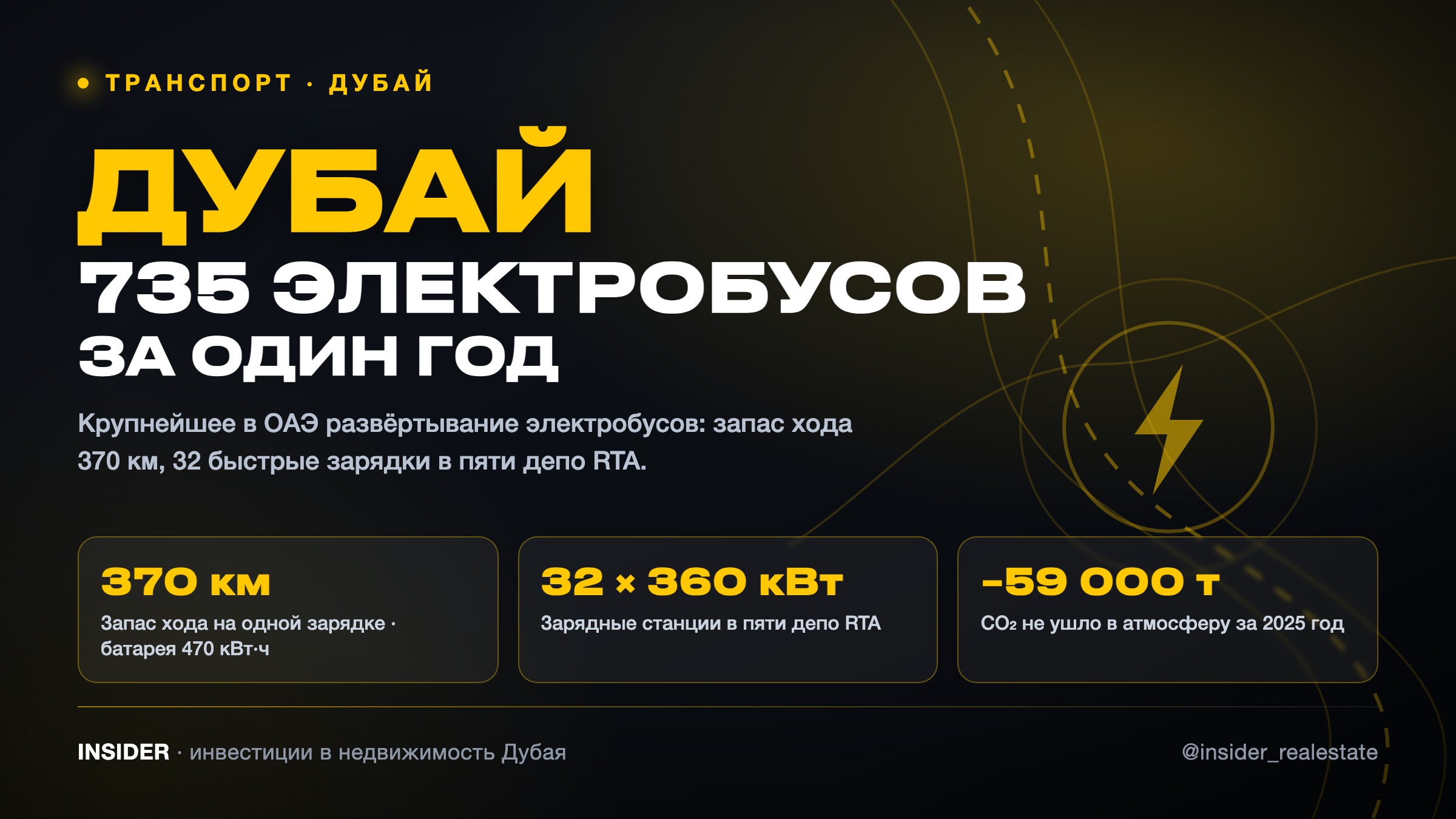
Dubai's Roads and Transport Authority (RTA) has begun the largest bus-fleet renewal in the emirate's history: 735 Euro 6-compliant vehicles are joining routes through 2026, and inside that order sits the UAE's largest-ever purchase of electric buses. It's easy to read as an environmental story, but underneath it's an infrastructure one: the city is upgrading ground public transport quality in exactly the districts where there's no metro, and none coming for years. That's already a question of rental value and liquidity.
What was actually ordered, and how much
The first batch of 250 buses has already been delivered, including 40 fully electric vehicles — the first and largest purchase of its kind in the country. The rest arrive in waves through the year, with the full contract covering 735 vehicles of varying capacity.
- Range of up to 370km on a single charge. The key figure: enough to run a full day's route schedule and return to the depot without a mid-day top-up. The inability to cover a full day's mileage was, for years, the main argument against electric buses in a hot climate.
- A 470 kWh battery. Capacity built with headroom for air conditioning, which in Dubai eats a significant share of energy and usually wrecks the rated range.
- 32 charging stations at 360kW are already installed across five operating depots: Al Quoz, Al Ruwayyah, Lehbab, Business Bay and Jebel Ali. The infrastructure went in ahead of the bulk of the fleet — a rare case where the chargers aren't playing catch-up.
- Euro 6 standard for the non-electric part of the order — even the diesel share of the fleet is being upgraded to the strictest current emissions norm.
The first electric vehicles are already running — including on route F13. The trial isn't happening on a showcase tourist route; it's on an ordinary feeder line that carries people to metro stations.
Talk to a licensed broker: 📲 +971 50 120 32 64 on WhatsApp, @dubai_oleg on Telegram
The numbers behind the headline
The fleet renewal sits inside the Public Transport Zero-Emission Strategy for 2050: by mid-century, every bus, taxi and limousine in the emirate is meant to run on electricity or hydrogen. The interim target is a 30% emissions cut by 2030, and current momentum suggests it isn't just a slogan.
- −12% in public-transport greenhouse-gas emissions in 2025 versus 2024.
- −44% against the 2022 baseline — the emirate's transport sector has nearly halved its carbon footprint in three years.
- Over 59,000 tonnes of CO₂ avoided in 2025 alone.
- Over 95% satisfaction among both drivers and passengers with the new vehicles — a figure that matters practically: if electric buses lost out to diesel on comfort during summer, the program would have slowed on its own.
The program is tied into the D33 economic agenda and the UAE's national climate-neutrality goals — meaning it's funded as a priority, not left to whatever's left over, and doesn't depend on any single department's mood.
One important clarification: this isn't "the first fully electric network"
The story often gets summarised as "Dubai launched the first fully electric public transport network." That's not accurate, and the difference matters. This is the largest deployment of electric buses inside an existing network in the UAE, and a staged conversion of the fleet — not a finished network with no combustion-engine vehicle left in it. A full transition is a mid-century horizon, and RTA's own strategy states it that way. For an investor, that's actually more useful: the timeline is clear, the milestones are clear, and there's something concrete to check reality against.
Why a bus changes the price of a square foot
Dubai has a well-established hierarchy: housing next to a metro station commands a premium, and housing 20 minutes by bus from a metro station is noticeably cheaper. That gap isn't really about distance — it's about the quality of the second leg of the trip. An old diesel bus with no reliable schedule turns 20 minutes into a gamble, and tenants vote with their wallets for the metro option.
Fleet renewal strikes at exactly that gap. A new vehicle means a different frequency, working air conditioning, a quieter cabin, and — most important — reliability: an electric bus is less likely to drop out of schedule for a mechanical reason. Feeder routes into the metro get a real chance to stop being the weak link.
The practical takeaway: districts along the routes being upgraded are a case where the improvement arrives with no increase in entry price. A metro line gets built over years and gets priced in ahead of time; a bus fleet renewal happens quietly and barely registers in a property's price at the time of purchase.
Where to look for the effect first
- Neighbourhoods around the five depots. Al Quoz, Al Ruwayyah, Lehbab, Business Bay, Jebel Ali — vehicles roll out onto routes from there first, and that's where the highest-frequency routes concentrate.
- Feeder routes to the metro. An "F" in the route number means it feeds a station. These are the lines that actually decide whether an apartment is "walking distance to transport" in practice, not just in the listing.
- Industrial and logistics zones. Jebel Ali and Al Quoz also carry heavy commuter flows. Better staff transport there feeds straight into demand for mid-market rental housing.
- Districts with no metro at all. There, the bus isn't a supplement — it's the primary transport, and any improvement is felt hardest.
What it means for a landlord
Transport access is the second most important line in a listing after location itself, and the first thing a tenant checks in person. Fleet renewal hands an owner an argument that used to belong only to properties near a metro station: "the station is a predictable number of minutes away, not a gamble."
Worth separately noting: tenants without a car. The cost of owning a car in Dubai keeps rising — parking, insurance, Salik tolls. Every step that makes a car-free life realistic widens the pool of potential tenants for a given apartment, and electric buses work directly toward that.
What an investor should watch
- Timing. Delivery is spread across all of 2026 in waves. Don't expect the whole fleet in your district to turn over at once — check which routes fall in the next wave.
- Horizon. Transport upgrades get priced in by the market over one to two years — slower than a metro line, but they also cost a buyer nothing on entry.
- Property type. Studios and one-bedrooms for rent in metro-free districts benefit most — that's where the share of car-free tenants is highest.
- Check it yourself. Before buying, ride the route to the nearest metro station during the morning rush. Five minutes in the RTA app and one real trip tell you more about liquidity than any brochure.
FAQ
Is 735 electric buses a lot for Dubai? For a single year, yes — it's the largest one-time purchase of its kind in the country. But it isn't the emirate's entire fleet, so the accurate description is "the largest stage of renewal," not "a complete switch."
Is the charging infrastructure enough? At this stage, yes: 32 stations at 360kW were installed ahead of time, and the 370km range lets vehicles charge overnight at the depot without taking a bus off its route during the day.
How does heat affect real-world range? Air conditioning eats into the charge, which is exactly why the battery was sized at 470 kWh. The stated 370km is calculated for local conditions, not a lab cycle.
Will fares change? No fare changes have been announced in connection with the fleet renewal. The economics of the switch rest on lower fuel and maintenance costs, not a higher ticket price.
Is this reason enough to reconsider a district? Not on its own. As an extra factor when choosing between two similar properties in metro-free districts, yes, definitely.
The bottom line
735 electric buses in a year isn't really a sustainability-report story — it's Dubai methodically closing the gap between "housing near the metro" and everywhere else. The metro network expands slowly and expensively; the bus network is expanding quickly, and almost invisibly to entry prices. For an investor, that's a rare setup: the infrastructure upgrade is already paid for by the government, but not yet priced into the apartment. That gap is exactly where above-market returns tend to show up.
Video on this topic
The same subject on the English channel — each clip has a written version of its own.

 ShortAir taxis in Dubai: what eVTOL would change, and what it would not1 September 2025
 ShortDubai 2040: the masterplan that tells you where demand goes next28 August 2025
 ShortWellness resorts: why Dubai is putting hundreds of millions into health26 August 2025
 ShortFour cities, four bets on the future: Dubai, New York, London, Tokyo4 September 2025
 ShortThe New Silk Road: what a trade corridor does to the cities on it3 September 2025
In the news
Other write-ups on the site about the same thing.
UAE Mangroves: Halfway to 100 Million Trees
The UAE has planted 51% of its target 100 million mangrove trees by 2030. The program protects the coastline from erosion — and it's the one environmental initiative that directly affects owners of waterfront property.
Dubai Opens an 820-Metre Cycling Bridge Linking Al Mamzar and Al Khawaneej
The bridge over Al Nahda stitches the Al Khawaneej and Al Warqa cycle tracks into one continuous corridor to Saih Al Salam. The emirate’s cycling network runs 636km, aiming for 1,000km by 2030 — and walkable connectivity is starting to show up in rents.
Etihad Rail Launch Schedule: How the UAE's New Railway Reshapes Housing Choices
The first Etihad Rail passenger train left Abu Dhabi for Fujairah on June 30, 2026. Here is the full station rollout schedule, ticket prices, and why the railway is redrawing where people can live and work.
Gold Line: Dubai’s Fourth Metro Line — 42km Underground, 18 Stations, Opening 2032
Dubai has approved its most expensive transport project ever: a fully underground metro line costing AED 34bn, opening in 2032. The route, and what it means for housing along it.
Flying taxis hit UAE skies in 2026: DXB to the Palm in 12 minutes, Abu Dhabi to Dubai in under half an hour
Dubai and Abu Dhabi air taxis start commercial flights in 2026: the first vertiport at DXB is finished and the capital has priced its routes. Where the vertiports are, flight times, what an Abu Dhabi to Dubai air taxi will cost and what it means for property.

UAE real estate and banks through the Iran-US conflict: a factual timeline to September 2026
From 28 February through September 2026, UAE real estate absorbed a shock, a dip and a recovery: transactions fell by roughly a quarter, then by summer had outpaced 2025. A factual timeline of the market and banking response, no political commentary.