
UAE Mangroves: Halfway to 100 Million Trees
The UAE has planted 51% of its target 100 million mangrove trees by 2030. The program protects the coastline from erosion — and it's the one environmental initiative that directly affects owners of waterfront property.
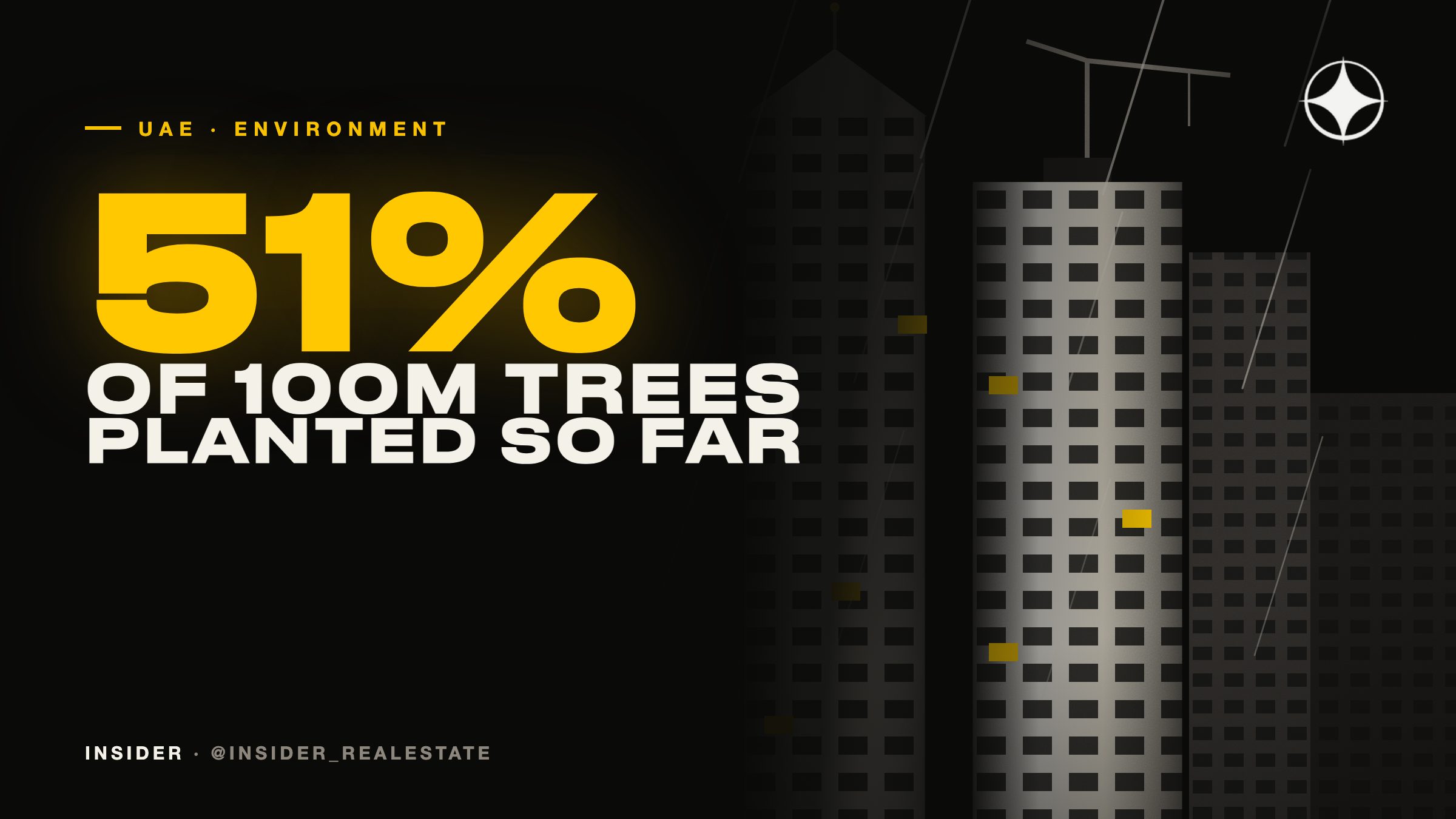
The UAE has passed the halfway mark on a goal announced at COP26 in 2021: planting 100 million mangrove trees by 2030. The country has now hit 51%. The story reads as purely environmental, and news coverage usually frames it that way, next to a photo of green coastline. But the mangrove program has a dimension that touches specific people with specific property: it's the country's only natural defence against coastal erosion.
What's been done so far
- 51% of the 100-million-tree target — past the halfway mark of the goal set for 2030.
- Drone planting. Seeds are fired into the mudflat from the air, reaching spots a boat can't navigate in shallow water and a person would sink into on foot. This is what made volumes unreachable by hand-planting possible.
- Tissue culture. Seedlings are grown in a lab rather than collected from the wild, so existing mangrove stands aren't depleted in the process.
- All seven emirates. The program is national, not Dubai-specific — the coastlines of Abu Dhabi, Umm Al Quwain and Ras Al Khaimah are involved just as much.
In Dubai, the most visible site is the Jebel Ali reserve, where the tree count runs into the tens of thousands.
Why the country wants mangroves
A mangrove tree grows in salt water, anchored by its roots in mudflats. Everything else follows from that.
Talk to a licensed broker: 📲 +971 50 120 32 64 on WhatsApp, @dubai_oleg on Telegram
- Coastal protection. The root system absorbs wave energy and holds the soil in place. A mangrove-fronted coastline erodes more slowly — it's the cheapest coastal defence there is, and it needs no maintenance.
- A fish nursery. Juveniles grow up among the roots; mangrove stands underpin the Gulf's coastal food chain.
- Carbon. Mangroves sequester it several times more efficiently than land forest of the same area, mostly through seabed sediment — hence the initiative's official name, the carbon-sequestration project.
- Biodiversity. Flamingos, herons, crabs — the reason people kayak through the mangrove parks in Abu Dhabi and Umm Al Quwain.
What's in it for a property owner
To be clear: planting mangroves doesn't raise the price of a Marina apartment tomorrow. But the program has two effects worth understanding if you own property.
The first is coastline stability. The entire UAE coast is sand and silt, and any reclaimed or waterfront plot lives in a constant balance between deposition and erosion. A mangrove belt is the one variable in that equation that works on its own and doesn't need annual sand replenishment. For waterfront projects, that's a question of the community's operating costs decades out — and it eventually lands in the service charge.
The second is the mangrove park as a neighbourhood amenity. This has already happened in Abu Dhabi: boardwalks through the stands, kayak routes, birdwatching points. A natural area within walking distance is a rare asset in a country where “green” usually means a watered lawn and a water bill. Areas that gain a park like this get something that can't be built later on a rush schedule — a mangrove forest has no fast-track option; a tree grows on its own timeline.
How this connects to the bigger picture
The mangrove program sits alongside the same line of work as electrifying public transport, cycling bridges, and expanding protected areas. What they share is being long-horizon projects with a publicly stated deadline and interim progress reports. The 51% figure exists precisely because of that — the country is reporting against a schedule, not just announcing targets.
For an investor, that's the real signal. A commitment that gets a regular progress percentage published is different from one that gets mentioned once every five years. You can price in the first kind. Not the second.
Based on data from the UAE Ministry of Climate Change and Environment and reports on the national carbon-sequestration project.
Video on this topic
The same subject on the English channel — each clip has a written version of its own.

 ShortDubai 2040: the masterplan that tells you where demand goes next28 August 2025
 ShortWellness resorts: why Dubai is putting hundreds of millions into health26 August 2025
 ShortFour cities, four bets on the future: Dubai, New York, London, Tokyo4 September 2025
 ShortThe New Silk Road: what a trade corridor does to the cities on it3 September 2025
 ShortThe Jebel Ali coast: Dubai's last big stretch of undeveloped shoreline2 September 2025
In the news
Other write-ups on the site about the same thing.
Dubai Opens an 820-Metre Cycling Bridge Linking Al Mamzar and Al Khawaneej
The bridge over Al Nahda stitches the Al Khawaneej and Al Warqa cycle tracks into one continuous corridor to Saih Al Salam. The emirate’s cycling network runs 636km, aiming for 1,000km by 2030 — and walkable connectivity is starting to show up in rents.
Dubai Rolls Out 735 Electric Buses: The UAE’s Largest Fleet Renewal
RTA is switching city buses to electric power: 735 vehicles through 2026, a 370km range, and 32 charging stations at 360kW across five depots. What the shift means for rents in neighbourhoods without a metro line.
Etihad Rail Launch Schedule: How the UAE's New Railway Reshapes Housing Choices
The first Etihad Rail passenger train left Abu Dhabi for Fujairah on June 30, 2026. Here is the full station rollout schedule, ticket prices, and why the railway is redrawing where people can live and work.
Gold Line: Dubai’s Fourth Metro Line — 42km Underground, 18 Stations, Opening 2032
Dubai has approved its most expensive transport project ever: a fully underground metro line costing AED 34bn, opening in 2032. The route, and what it means for housing along it.

UAE real estate and banks through the Iran-US conflict: a factual timeline to September 2026
From 28 February through September 2026, UAE real estate absorbed a shock, a dip and a recovery: transactions fell by roughly a quarter, then by summer had outpaced 2025. A factual timeline of the market and banking response, no political commentary.

Dubai Land Department Launches the Initial Registration Platform
DLD has merged project management, deal registration and Escrow accounts into one AI-driven platform. SPA registration time has dropped from 30 minutes to under 5 — here is how it works and what changes for buyers and developers.