Dubai Opens an 820-Metre Cycling Bridge Linking Al Mamzar and Al Khawaneej
The bridge over Al Nahda stitches the Al Khawaneej and Al Warqa cycle tracks into one continuous corridor to Saih Al Salam. The emirate’s cycling network runs 636km, aiming for 1,000km by 2030 — and walkable connectivity is starting to show up in rents.
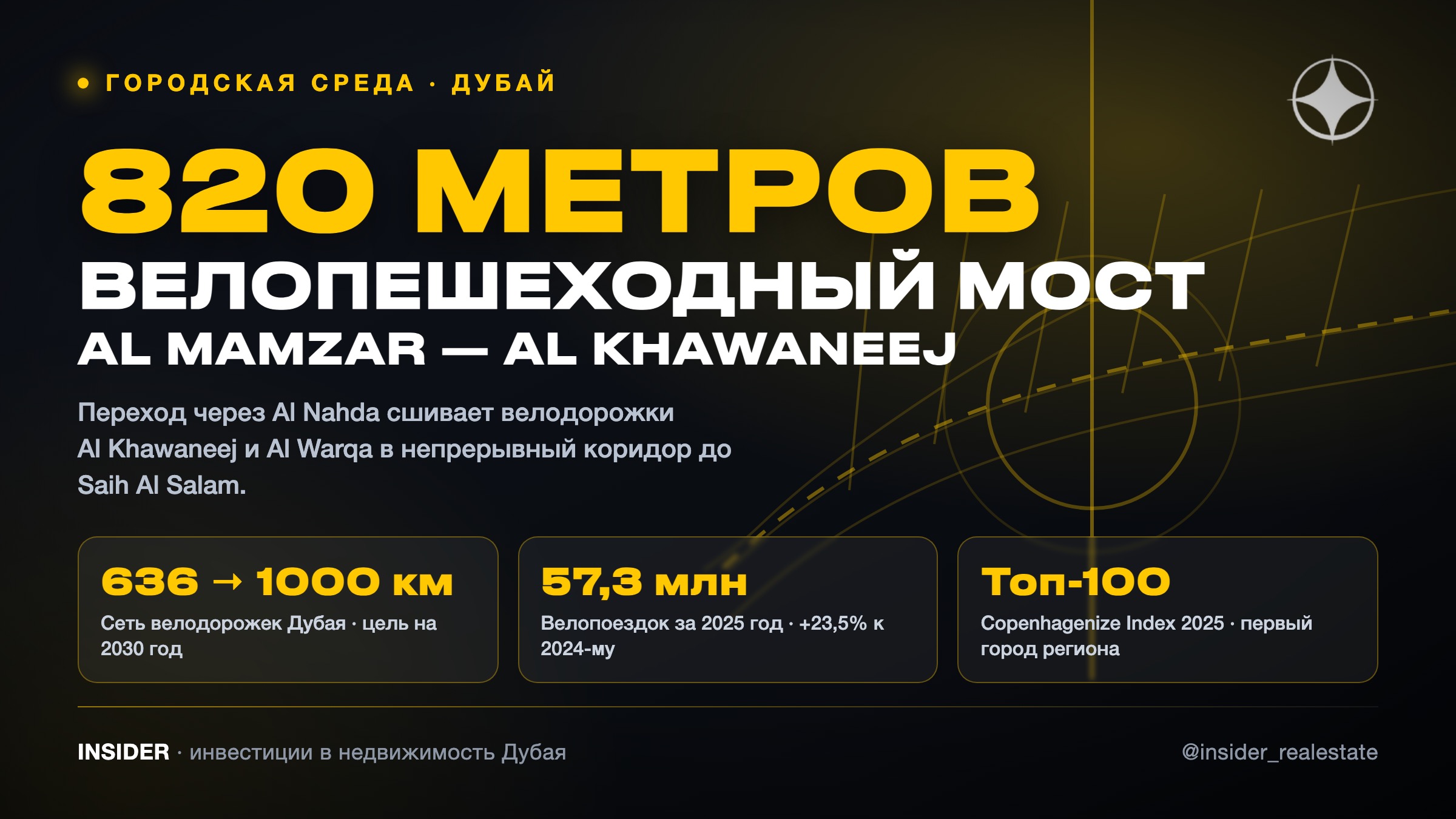
On 30 July 2026, the RTA opened an 820-metre cycling and pedestrian bridge connecting Al Mamzar and Al Khawaneej across Al Nahda. Next to multi-billion-dirham road projects, it looks modest — but crossings like this solve a problem no highway ever does: they make neighbouring districts actually neighbours. For the property market, that means two areas that were, until yesterday, separated by a road no pedestrian could cross now start competing with — and complementing — each other.
What was actually built
- 820 metres long. Not a street crossing — a full-length corridor designed for pedestrians and cyclists together.
- Links Al Mamzar and Al Khawaneej via Al Nahda. Three densely populated districts that, until now, had only a road connection between them.
- Connects into the existing network. The bridge feeds directly into the Al Khawaneej and Al Warqa cycle tracks, and through them onto the route to Saih Al Salam — this isn't a standalone structure, but the missing link that closes a continuous corridor.
- Opened 30 July 2026. Already operating, not just announced for a future date.
The key word is "continuous." A broken cycle track doesn't function at all — one stretch where you have to dismount and dash across eight lanes zeroes out the value of every other kilometre. The bridge removes exactly that kind of gap.
Context: the network this bridge plugs into
This is part of a systematic program, not an isolated improvement. By the end of 2025, Dubai's cycle track network reached 636km, with a target of 1,000km by 2030. In March 2026, RTA delivered 13 of 15 planned cycle tracks, totalling 162km.
Talk to a licensed broker: 📲 +971 50 120 32 64 on WhatsApp, @dubai_oleg on Telegram
- 22.3% of the emirate's residents have access to cycling infrastructure — a figure RTA tracks separately because it's the real measure of connectivity, not just a headline length.
- 57.3 million cycling trips in 2025, up from 46.6 million in 2024 — a 23.5% increase in a year. People are using the infrastructure, and demand is outpacing supply.
- 85% of cyclists report being satisfied with the quality of the infrastructure.
- Top 100 in the Copenhagenize Index 2025 — Dubai became the first Middle Eastern city to make the global bike-friendliness ranking.
Four more large cycling and pedestrian bridges are under construction in parallel: 816 metres over Sheikh Mohammed bin Zayed Road, 719 metres over the Dubai–Al Ain Road, 528 metres over Sheikh Zayed Road, and 501 metres over Al Khail Road. The logic is the same everywhere — stitching the city back together across the highways that historically cut it apart. RTA Director-General Mattar Al Tayer frames the goal as improving road safety and sustainable mobility for all road users.
Why walkable connectivity is a money question
In cities built around the car, property gets valued by drive time. But as development densifies, a different measure starts to matter more — what's reachable without a car in 10–15 minutes. That single measure determines two things at once: the size of the tenant pool, and how well demand holds up in a downturn.
The mechanics are simple. An eight-lane highway between two districts effectively makes them separate markets: a resident of Al Mamzar won't walk to a park or school in Al Khawaneej even if it's a kilometre away in a straight line. Add a crossing, and the neighbouring district's infrastructure suddenly becomes yours — its parks, its schools, its shops fall inside your walking radius. The property itself hasn't changed at all.
The market tends to price this in with a lag of a year or more. Residents' routines shift first, then listing descriptions catch up, and only then does price follow.
What it means for specific districts
- Al Mamzar. A waterfront district with a park and beach that had long been considered a quiet dead end. The bridge plugs it into Al Khawaneej's recreational loop and onward to the Saih Al Salam route.
- Al Nahda. A dense, relatively affordable district on the border with Sharjah. It gains a direct walking route in both directions — a real quality-of-life upgrade with no change in rent.
- Al Khawaneej and Al Warqa. Low-rise villa and townhouse communities aimed at families. For them, cycling connectivity is a direct selling point — a child can get to school or a park without a parent driving.
Al Nahda is worth flagging separately: it borders Sharjah, and any improvement to the urban environment here reinforces the cross-border commuting flow we've covered in connection with infrastructure projects in the neighbouring emirate.
How to use this when choosing a property
- Check the walking radius, not the distance on a map. Open a map in walking mode and see what's genuinely reachable in 15 minutes. Before the bridge opened and after are two different sets of points.
- Look at what's planned, not only what's built. Four more bridges are still under construction. A property near a future crossing is bought at a "pre-reform" price.
- Factor in the segment. Walkable cycling connectivity matters more for the family segment and for car-free tenants, less for the premium segment with a driver.
- Think in a two- to three-year horizon. Soft infrastructure like this gets priced in more slowly than a metro line, but the risk is lower too — the asset is already built and operating.
FAQ
Does the bridge really change behaviour in the summer heat? Peak cycling usage drops in summer, but the 23.5% annual growth figure is measured across the whole year, heat included. Most of the traffic falls in the morning, evening and winter months — seven to eight months of comfortable use.
Does this affect purchase price, or only rent? Rent and leasing speed move first; price follows through yield. Tenants react to a changed environment faster than buyers do.
Is it worth waiting for the other bridges before buying? The same logic applies as with any infrastructure: the market prices it in during the visible construction phase. Waiting for the formal opening means buying at the new price.
How do you check whether a specific address falls inside the network? RTA publishes a cycle-track map and its expansion plan toward 1,000km by 2030. Check the address against that, not against a project presentation's promises.
Does this apply to commercial property too? Yes, differently: foot traffic is a direct revenue driver for street retail and food outlets along the new routes.
The bottom line
An 820-metre bridge is a small number next to billion-dirham road budgets, but its effect is specific and measurable: two districts stopped being separated. Dubai is methodically stitching its broken cycling and pedestrian network into one connected loop — 636km today, 1,000km by 2030, four more major bridges under construction. For an investor, the rule is simple: look not only at what's near a property today, but at which gap in the network gets closed in the next two years. That's where price hasn't caught up to reality yet.
Video on this topic
The same subject on the English channel — each clip has a written version of its own.

 ShortDubai 2040: the masterplan that tells you where demand goes next28 August 2025
 ShortWellness resorts: why Dubai is putting hundreds of millions into health26 August 2025
 ShortFour cities, four bets on the future: Dubai, New York, London, Tokyo4 September 2025
 ShortThe New Silk Road: what a trade corridor does to the cities on it3 September 2025
 ShortThe Jebel Ali coast: Dubai's last big stretch of undeveloped shoreline2 September 2025
In the news
Other write-ups on the site about the same thing.
UAE Mangroves: Halfway to 100 Million Trees
The UAE has planted 51% of its target 100 million mangrove trees by 2030. The program protects the coastline from erosion — and it's the one environmental initiative that directly affects owners of waterfront property.
Dubai Rolls Out 735 Electric Buses: The UAE’s Largest Fleet Renewal
RTA is switching city buses to electric power: 735 vehicles through 2026, a 370km range, and 32 charging stations at 360kW across five depots. What the shift means for rents in neighbourhoods without a metro line.
Etihad Rail Launch Schedule: How the UAE's New Railway Reshapes Housing Choices
The first Etihad Rail passenger train left Abu Dhabi for Fujairah on June 30, 2026. Here is the full station rollout schedule, ticket prices, and why the railway is redrawing where people can live and work.
Gold Line: Dubai’s Fourth Metro Line — 42km Underground, 18 Stations, Opening 2032
Dubai has approved its most expensive transport project ever: a fully underground metro line costing AED 34bn, opening in 2032. The route, and what it means for housing along it.

UAE real estate and banks through the Iran-US conflict: a factual timeline to September 2026
From 28 February through September 2026, UAE real estate absorbed a shock, a dip and a recovery: transactions fell by roughly a quarter, then by summer had outpaced 2025. A factual timeline of the market and banking response, no political commentary.

Dubai Land Department Launches the Initial Registration Platform
DLD has merged project management, deal registration and Escrow accounts into one AI-driven platform. SPA registration time has dropped from 30 minutes to under 5 — here is how it works and what changes for buyers and developers.
Below market in Al Khawaneej right now
From the daily off-market feed. Availability and price are confirmed on request.
All below-market listings →