
Rent or buy in Dubai? A worked mortgage-vs-rent calculation for 2026
On a AED 1.4m ($381,000) one-bedroom in Dubai Hills, we compare the actual mortgage payment at a 4.5% rate with market rent for the same unit, including every upfront fee — and show why the real answer depends on how long you plan to hold.
"Rent or buy" is a different question in Dubai than it is in London or New York. Rent here is paid a year in advance, and a mortgage is available to a non-resident buyer, but on stricter terms than to a resident with a local visa. What follows is not a universal answer but one worked example, with every assumption stated openly. Change the price, the rate or the holding period and the conclusion changes with it — treat this as a method, not a ready-made recommendation.
The setup
We take a one-bedroom apartment in Dubai Hills, about 64 sqm (689 sqft), priced at AED 1,400,000 (roughly $381,000 at the 3.6725 dirham peg). Dubai Hills is used here as a representative mid-budget district; a full district-by-district and bedroom-count price breakdown is covered in our guide to Dubai apartment layouts.
- The buyer is a UAE resident (holds a local residence visa and a salary account). Under Central Bank of the UAE rules, a first home under AED 5m qualifies for financing up to 80% of value — a minimum 20% down payment.
- Down payment: 20% — AED 280,000 ($76,200). This is the portion no bank will finance under any circumstances.
- Rate: 4.5% a year, 25-year term. This sits in the middle of the range UAE banks were quoting expat borrowers through 2026 — roughly 3.75–4.99% depending on the bank and the borrower's residency status.
One caveat about the rate itself. Almost no UAE mortgage is fixed for the full term: banks typically fix the rate for the first one to five years, after which the loan floats — three-month EIBOR plus a bank margin, usually 1.5–2.5 percentage points. The Central Bank's own base rate rose by 0.25 points on 17 September 2026, to 3.90%, tracking the US Federal Reserve; the mechanics of that pass-through and what it does to a monthly payment are covered separately in our review of the UAE Central Bank rate, 2024–2026. So the payment below holds for the fixed period and then moves with the interbank rate.
Talk to a licensed broker: 📲 +971 50 120 32 64 on WhatsApp, @dubai_oleg on Telegram
What owning costs
The loan: 1,400,000 − 280,000 = AED 1,120,000. At 4.5% over 25 years (300 months), the standard amortising payment works out to roughly AED 6,226 a month (≈$1,695), with most of the early payments going to interest rather than principal.
On top of the bank payment comes the service charge — something a tenant never pays, an owner always does. In Dubai Hills that typically runs AED 12–18 per square foot a year; for this unit, call it about AED 900 a month. All in, an owner is paying roughly AED 7,100 a month (≈$1,935) for the mortgage and upkeep combined, before insurance and one-off maintenance.
The monthly payment is not the whole entry budget, though. Since 1 February 2025, on Central Bank instruction, UAE banks no longer finance the Land Department transfer fee or the agent's commission — both are cash due on top of the down payment, detailed in our breakdown of Dubai mortgage costs since 2025:
| Item | Rate | Amount, AED |
|---|---|---|
| Down payment (20%) | — | 280,000 |
| DLD transfer fee | 4% | 56,000 |
| Trustee office, admin | flat | ≈ 4,000 |
| Agent commission | 2% | 28,000 |
| Bank mortgage arrangement fee | ≈1% | ≈ 11,200 |
| Total cash needed to close | ≈ 379,200 |
Buying this apartment on a mortgage means finding about AED 379,000 ($103,000) in cash before you get the keys, not the AED 280,000 people usually have in mind as "the down payment." What the bank itself asks of the borrower — income, tenure, age — is covered separately in our guide to a Dubai mortgage as a non-resident.
What renting the same unit costs
Listings for a comparably sized one-bedroom in Dubai Hills in 2026 span roughly AED 75,000–135,000 a year; for a unit this size, we take a conservative midpoint of AED 95,000 a year (AED 7,917, or about $2,156, a month). Rent is typically paid in one to four post-dated cheques for the year, plus a deposit — 5% of annual rent unfurnished or 10% furnished, so roughly AED 4,750–9,500 here. The landlord, not the tenant, pays the service charge, which is already reflected in the comparison below.
| Owning (mortgage) | Renting | |
|---|---|---|
| Monthly outflow | ≈ AED 7,100 | ≈ AED 7,917 |
| Cash needed upfront | ≈ AED 379,200 | ≈ AED 4,750–9,500 (deposit) |
On raw monthly cash flow, owning looks roughly 10% cheaper than renting — in the same order of magnitude as market-wide estimates over the past couple of years. That, though, is only half the picture.
Where the real breakeven sits
That AED 800-a-month advantage for owning is not free: it was bought with roughly AED 375,000 more capital tied up at the start than a renter ever puts down. If that extra capital were invested elsewhere at a modest 5% a year, the monthly income it could generate would roughly offset the entire monthly saving from owning. In other words, on cash-flow numbers alone, with no assumption about the apartment's price going up, renting and investing the difference can hold its own against buying.
Then there are the round-trip transaction costs if you ever reverse the position: 4% DLD fee and 2% agent commission going in, plus roughly another 2% agent commission coming out — call it 9–10% of the property's value, or about AED 125,000–140,000 in this example. That gets recovered only two ways: a long enough holding period for the monthly cash-flow edge to add up, or genuine price appreciation. Knight Frank's 2026 forecast put prime Dubai price growth at roughly 3% for the year and the mainstream market at around 1% — a reasonable planning figure, and nothing higher should be assumed without treating it as speculation.
The practical takeaway: on a short horizon — selling again in two or three years — a mortgage tends to lose to renting almost every time, because transaction costs never get the chance to amortise. On a horizon of seven to ten years and stable income, a resident's 20%-down mortgage usually wins, because the loan balance is being paid down rather than spent and gone, the way rent is. For a genuine non-resident without a local visa, Central Bank rules are stricter — a minimum 35% down payment, since the bank will not finance more than 65% of value — and that tilts the arithmetic toward renting for the first few years in Dubai.
Before running your own numbers, see what the bank itself expects from a non-resident borrower — income, tenure and paperwork: a Dubai mortgage as a non-resident, explained.
Video on this topic
The same subject on the English channel — each clip has a written version of its own.


In the news
Other write-ups on the site about the same thing.
Dubai property prices after 2008 and the pandemic: what history actually shows
Dubai prices fell roughly 45% in 2009 and barely dipped in 2020 — then both times the market recovered and pushed past old highs. We walk through both cycles with sourced numbers, and what that means for anyone timing a purchase in 2026.
Hotel-branded homes in Dubai Hills: Mallside Residences by Hilton, Address Residences and Hillcrest villas
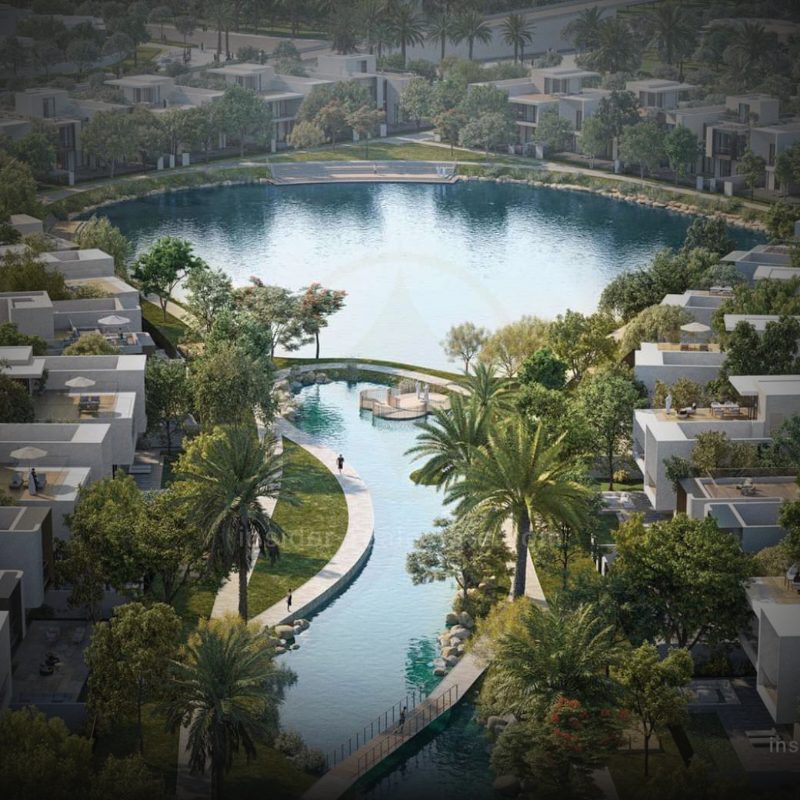
Three hotel-branded schemes in Dubai Hills: Mallside Residences with Curio Collection by Hilton next to the mall (sold out, due Q4 2026), Emaar’s Address Residences Dubai Hills (December 2024, from AED 1.9m, due Q1 2029) and the completed Address Villas Hillcrest, from AED 20.95m in our stock.

Is there a dead season in Dubai real estate? What actually happens to deals in summer
Dubai's summer market isn't a pause: DLD-based data shows summer 2024 was the year's busiest period for sales, up nearly 38% on the year before. Here's what genuinely changes in June–August — negotiating power, not deal volume — and what it means for timing.

Downtown Dubai vs Business Bay: where to live and where to buy to let
Downtown is Dubai's tourist and status core, around AED 2,433/sqft on our own data. Business Bay is the business district next door, home to 17,000+ companies, around AED 1,871/sqft. We compare lifestyle, rental economics and who should pick which.
Dubai homes over $10 million: 500 sales in 2025 and a record 296 in the first half of 2026
Knight Frank counted 500 Dubai home sales above US$10m in 2025, worth US$9.05bn, against 30 in 2020. The first half of 2026 added 296 more worth US$5.1bn, a half-year record. Where the money went and why the top of the market held up.

Master-planned vs piecemeal development in Dubai: how it shapes district prices
A district built by one master developer and a district built by dozens of unrelated companies carry very different price predictability. We break down how to tell them apart from a project brochure, and the trade-off between the two.