
UAE Economic Stability: Second in the World, Behind Only Switzerland
An international stability study ranks the UAE second worldwide, ahead of Canada, Germany and Japan. GDP per capita rivals Western Europe, and the country’s sovereign wealth funds hold trillions of dirhams in assets.
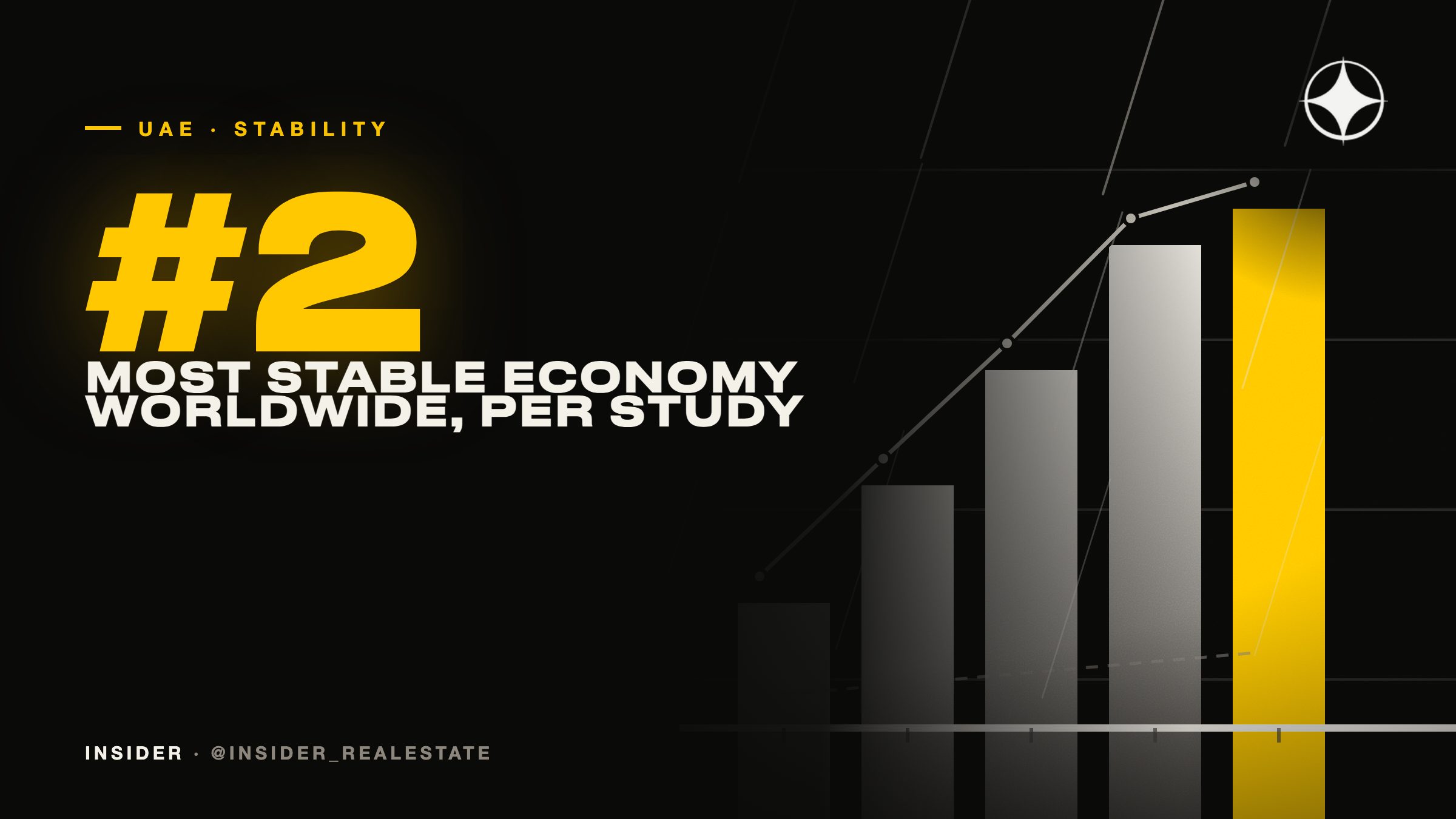
An international study of economic stability places the UAE second in the world, behind only Switzerland. The rest of the top ten is filled out by leading North American, European and Asian economies.
What the ranking measures
- Entrepreneurship and ease of doing business.
- Access to capital.
- Availability of a skilled workforce.
- Economic adaptability and competitiveness.
- A developed trading environment.
The study separately notes that GDP per capita in the UAE is comparable to leading Western European economies, and that the country holds the status of the most competitive economy in the Arab world.
A factor these rankings rarely capture
Sovereign wealth funds. The UAE is home to some of the world's largest sovereign wealth funds — the Abu Dhabi Investment Authority, Mubadala, Dubai's own investment corporation, Dubai World, ADQ and others. Together they hold assets worth trillions of dirhams.
Talk to a licensed broker: 📲 +971 50 120 32 64 on WhatsApp, @dubai_oleg on Telegram
The practical implication for real estate is direct: development programmes — islands, cultural clusters, transport, airports — are funded not from the current budget or from sales, but from capital built up over decades. That is precisely why master plans here keep moving forward even through an unfavourable cycle.
How to read rankings like this
As a description of the operating environment, not as an argument for a specific deal. A country's economic stability explains why capital keeps arriving and why the population keeps growing — it does not guarantee the return on your particular apartment. The two levels of decision are worth keeping separate.
Based on an international economic stability study and public data on the assets of UAE sovereign wealth funds.
Video on this topic
The same subject on the English channel — each clip has a written version of its own.
 19:59
19:59 Imperial Avenue: a profitable resale in Downtown Dubai
Imperial Avenue by Shapoorji Pallonji in Downtown Dubai — a full breakdown of why this project has produced good resale outcomes and how to evaluate a resale opportunity in a completed Downtown tower.
WatchIn the news
Other write-ups on the site about the same thing.
Non-Oil Sector Now 74.6% of UAE GDP; Dubai Draws $14bn in Foreign Investment
The UAE’s non-oil economy has grown to 74.6% of GDP, up 4.5%. Dubai alone attracted $14bn in foreign direct investment — up 33% year on year — and a record 1,117 new greenfield projects.
Dubai Cracks the Top 7 Global Financial Centres: What It Means for Housing
Dubai climbed four places to rank 7th on the Global Financial Centres Index, its best result ever. At the same time, the UAE posted a record AED 177.3bn in foreign direct investment. How both feed through to apartment prices.
UAE economy in 2026: PMI at 55.3 in August, GDP up 3% and Dubai private schools in the PISA global top ten
The UAE non-oil PMI rose to 55.3 in August 2026, its highest since December 2024. Real GDP grew 3% in Q1, with the non-oil share at 79.4%. Dubai private schools ranked 6th in the world for reading and 8th for maths in PISA 2025. Why the economy looks stronger than the housing mood.
D33: Dubai’s plan to double its economy by 2033, and what it means for property
D33 targets AED 32 trillion in economic activity over ten years and AED 650 billion in foreign direct investment by 2033. We unpack the numbers and why they already translate into rental demand.

Four deals with the full numbers: what Dubai property actually returned
Talk about Dubai yields is usually percentages without a denominator. Four transactions with every figure named, including costs — and one caveat that governs all of them.

Twenty-fold in fifteen years: three record Dubai deals and what is behind them
Three transactions Dubai quotes as benchmarks. Looking at them together is more useful than at any of their percentages — and what they have in common is not repeatable.