
Dubai Cracks the Top 7 Global Financial Centres: What It Means for Housing
Dubai climbed four places to rank 7th on the Global Financial Centres Index, its best result ever. At the same time, the UAE posted a record AED 177.3bn in foreign direct investment. How both feed through to apartment prices.
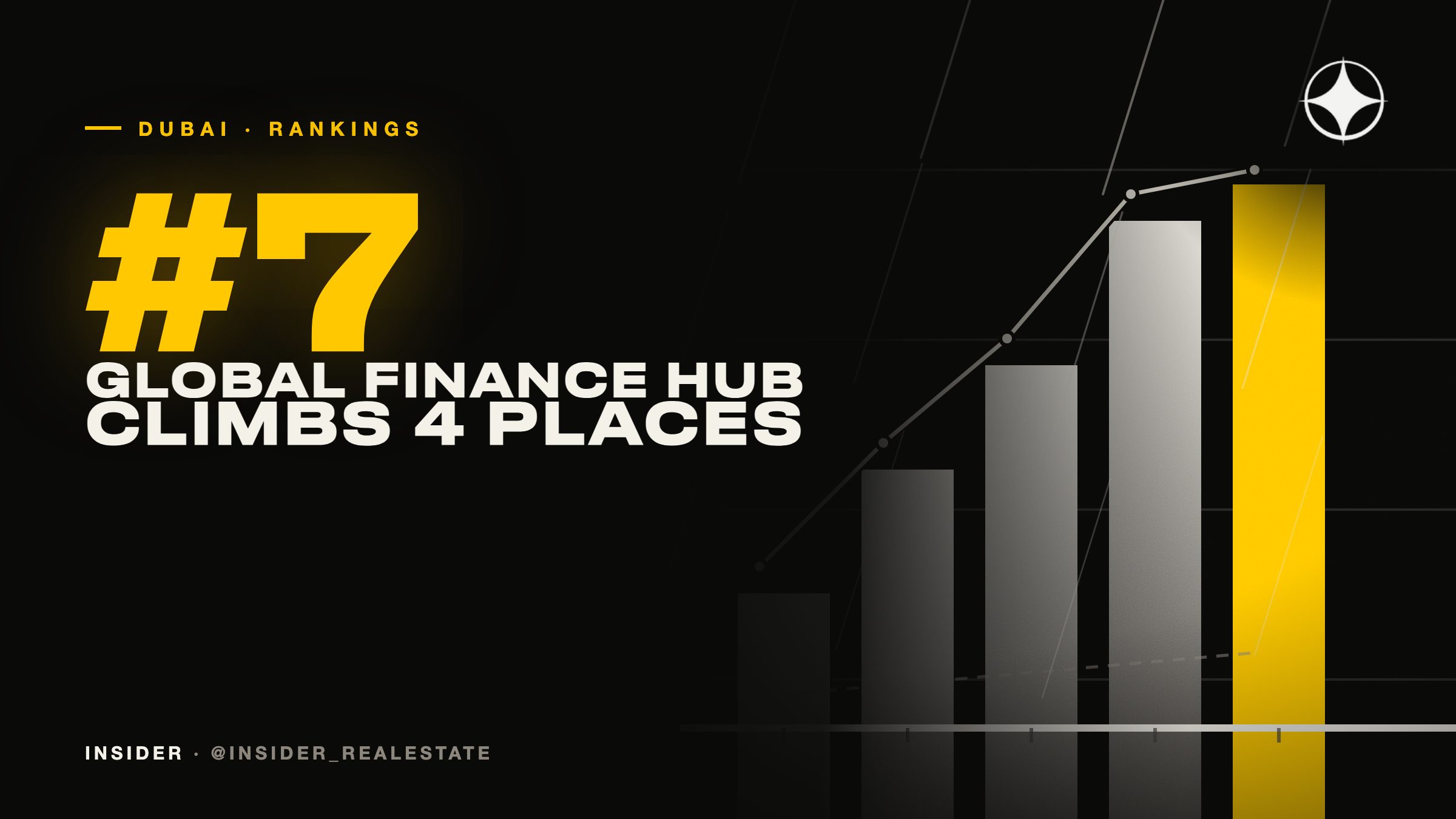
Dubai has taken seventh place on the Global Financial Centres Index, a ranking compiled twice a year by Britain's Z/Yen and China's Development Institute. The emirate jumped four places at once — its best result in the index's history — and remains the only centre from the MEASA region (Middle East, Africa and South Asia) inside the top twenty. In the same stretch, the UAE reported a record inflow of foreign direct investment. Both are easy to skim past as economic headlines, but for someone choosing an apartment in Dubai, they have a fairly concrete sequel.
What the index showed
GFCI scores financial centres on business environment, human capital, infrastructure, financial-sector development and reputation, combining hard data with a survey of industry professionals. Seventh place puts Dubai in the same bracket as London, New York and Singapore — not chasing them from far behind.
- +4 places in a single cycle — a rare jump near the top of the ranking, where positions usually shift one at a time.
- The only centre from the region in the top 20. Neither Riyadh, Doha nor Mumbai has made it in yet.
- The target is top 4 by 2033. That's written into the D33 economic agenda — so the ambition comes with a deadline and an owner, not just a wish.
The driver is DIFC, the financial free zone that runs on English common law with its own courts. Companies go there specifically for a predictable jurisdiction: a dispute gets resolved under familiar rules rather than local legislation a foreign investor can't read.
Talk to a licensed broker: 📲 +971 50 120 32 64 on WhatsApp, @dubai_oleg on Telegram
The investment record: AED 177.3bn
According to UNCTAD's World Investment Report 2026, foreign direct investment into the UAE reached AED 177.3 billion in 2025 — about $48.3bn, up 6%. That put the country ninth in the world among FDI destinations.
- AED 1.171 trillion — the cumulative stock of foreign investment at the end of 2025.
- 2nd in the world for new greenfield projects for a third straight year, with 1,562 projects in the year. Greenfield means building from scratch rather than buying a stake in an existing business — that kind of money stays for the long term and brings people with it.
- 38% of all Middle East greenfield capital spending goes to the UAE.
- AED 1.937 trillion in non-oil foreign trade in the first half of 2026, up 13.1% year on year; non-oil exports hit a record AED 452.8bn.
How the ranking reaches an apartment's price
The link here isn't mysterious, and it runs through one simple chain: a financial centre means high-paying jobs, and high-paying jobs mean rental demand in a specific price range and in specific neighbourhoods.
Every company that opens an office in DIFC brings a team with it. A fund managing director, a compliance officer, an analyst — these are tenants at AED 150,000–400,000 a year, and they choose a home based on commute time, not the prettiest view. That's what keeps steady demand in Downtown, Business Bay, DIFC, Za'abeel and, a bit further out, City Walk and Al Wasl.
The second link is the move from renting to buying. A finance professional on a two-year contract rents. The same person, still there in year five, buys — it's cheaper than renting over that horizon and comes with residency. Growth in DIFC's company count today is demand for purchases three or four years out, and it lands not in the speculative segment but in quality housing near work.
What these numbers don't mean
A financial-centre ranking isn't a price forecast. It doesn't say a Downtown apartment will rise by any specific percentage, and it doesn't cancel out the local cycle — a given district can still have oversupply, and a world-financial-centre status won't absorb it.
What it does mean is demand stability. A market resting on an inflow of companies and professionals behaves differently from one resting on flipping off-plan units between speculators. The first dips more slowly and recovers faster — worth keeping in mind when choosing between a district with jobs and a district with a promise of infrastructure.
The practical takeaway
- Watch transport links to DIFC and Downtown. That's demand backed by investor money, not developer advertising.
- Non-oil trade matters more than oil. A 13.1% rise in half a year says the emirates' economy really is diversified — the commodity-dependence risk for a homeowner is lower than commonly assumed.
- Greenfield projects mean people. Fifteen hundred-plus new businesses in a year translates into families, schools, rentals. It's the most honest indicator of future housing demand there is.
Based on data from the Global Financial Centres Index, UNCTAD and the Dubai International Financial Centre.
Video on this topic
The same subject on the English channel — each clip has a written version of its own.


In the news
Other write-ups on the site about the same thing.
D33: Dubai’s plan to double its economy by 2033, and what it means for property
D33 targets AED 32 trillion in economic activity over ten years and AED 650 billion in foreign direct investment by 2033. We unpack the numbers and why they already translate into rental demand.
Dubai GDP up 2.4% in Q1 2026: construction +8.2%, real estate +3.1%
Dubai’s economy grew 2.4% in the first quarter of 2026 to $63.2 billion. Healthcare (+17.5%), construction (+8.2%) and transport (+6.5%) led the way. A look at the structure of the growth — and what it says about the property market.
Downtown Dubai vs Business Bay: where to live and where to buy to let
Downtown is Dubai's tourist and status core, around AED 2,433/sqft on our own data. Business Bay is the business district next door, home to 17,000+ companies, around AED 1,871/sqft. We compare lifestyle, rental economics and who should pick which.

UAE real estate and banks through the Iran-US conflict: a factual timeline to September 2026
From 28 February through September 2026, UAE real estate absorbed a shock, a dip and a recovery: transactions fell by roughly a quarter, then by summer had outpaced 2025. A factual timeline of the market and banking response, no political commentary.
Brookfield, Apollo, Goldman Sachs: how global funds are moving into UAE real estate
Apollo has put $1.9 billion into Aldar’s bonds across four deals, Brookfield owns a DIFC tower and is building in Dubai Hills, and Mapletree plans $2 billion across the Gulf. We look at why the world’s largest funds are choosing Dubai.
UAE Economic Stability: Second in the World, Behind Only Switzerland
An international stability study ranks the UAE second worldwide, ahead of Canada, Germany and Japan. GDP per capita rivals Western Europe, and the country’s sovereign wealth funds hold trillions of dirhams in assets.