
D33: Dubai’s plan to double its economy by 2033, and what it means for property
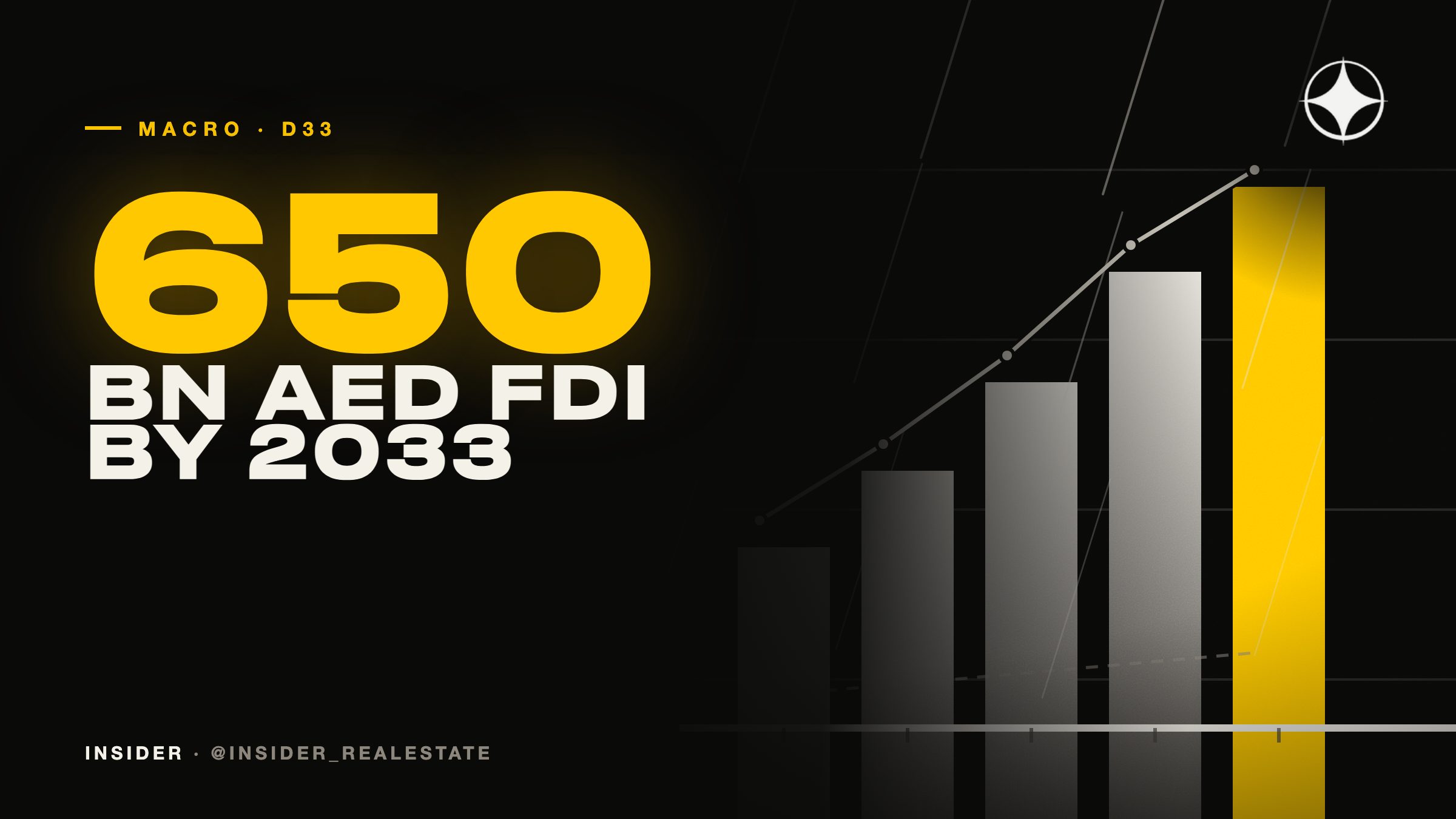
D33 targets AED 32 trillion in economic activity over ten years and AED 650 billion in foreign direct investment by 2033. We unpack the numbers and why they already translate into rental demand.
In January 2023 Dubai adopted the Dubai Economic Agenda, known as D33: a ten-year plan to double the emirate's economy and place it among the world's top three city economies. For anyone buying property here, that is not a press-release abstraction. It is an official commitment to keep pulling in companies, professionals and capital for a full decade — and that pipeline is what keeps rental demand from depending on any single sector's cycle.
What D33 actually promises
The headline target is AED 32 trillion in cumulative economic output over ten years, delivered through 100 "transformational" projects spanning trade, logistics, finance and the digital economy. The part that matters most for real estate is foreign direct investment: D33 aims to lift FDI from a historical average of AED 32 billion a year to AED 60 billion a year, reaching AED 650 billion in total by 2033.
Behind that target sits a concrete instrument: a national investment fund seeded with AED 36.7 billion (roughly $10 billion), designed to push annual FDI into the UAE as a whole from AED 115 billion to AED 240 billion by 2031, and cumulative foreign capital in the country from AED 800 billion to AED 2.2 trillion. That is a federal layer built on top of the same city-level idea.
Talk to a licensed broker: 📲 +971 50 120 32 64 on WhatsApp, @dubai_oleg on Telegram
Status as of September 2026: ahead of schedule
Independent economic commentary through 2025 and into 2026 has generally described D33 as running ahead of its interim targets rather than behind them — worth checking rather than taking on faith, since agendas of this scale often exist more on paper than in real capital flows. Here the opposite appears true: company registrations in free zones including DIFC and the pace of corporate relocations into Dubai through 2024-2026 have tracked the trajectory D33 laid out.
Less visible parts of the agenda matter too: the world's largest wholesale fruit and vegetable market, a $4.6 billion commercial transport strategy through 2030, and a push toward remote and flexible work to ease congestion. These are the line items that quietly determine where the next wave of jobs — and rental demand — lands.
What it means for a buyer or investor
The mechanism is direct: FDI and new corporate offices are not an abstraction, they are specific people that an employer either relocates or hires locally. Every new headquarters or regional office in DIFC or Business Bay creates rental demand within a 15-20 minute radius of that office — and that demand is durable, because it is tied to a corporate lease, not a tourist season.
For a property investor, this means the demand horizon in internationally-oriented districts is set by an official ten-year programme with checkable interim numbers, rather than by market sentiment alone. That is not a guarantee of price growth, but it is a structural factor worth tracking separately from the news cycle around any given neighbourhood.
The population inflow behind these figures already shows up elsewhere: Dubai issued roughly 66,000 golden visas in the first half of 2026 alone, a record pace driven largely by investors and professionals arriving under programmes like D33 — see how the golden visa actually works.
For how the financial district absorbing most of that corporate and capital inflow works, see our guide to DIFC.
Video on this topic
The same subject on the English channel — each clip has a written version of its own.


In the news
Other write-ups on the site about the same thing.
Dubai property prices after 2008 and the pandemic: what history actually shows
Dubai prices fell roughly 45% in 2009 and barely dipped in 2020 — then both times the market recovered and pushed past old highs. We walk through both cycles with sourced numbers, and what that means for anyone timing a purchase in 2026.
Is there a dead season in Dubai real estate? What actually happens to deals in summer
Dubai's summer market isn't a pause: DLD-based data shows summer 2024 was the year's busiest period for sales, up nearly 38% on the year before. Here's what genuinely changes in June–August — negotiating power, not deal volume — and what it means for timing.

Downtown Dubai vs Business Bay: where to live and where to buy to let
Downtown is Dubai's tourist and status core, around AED 2,433/sqft on our own data. Business Bay is the business district next door, home to 17,000+ companies, around AED 1,871/sqft. We compare lifestyle, rental economics and who should pick which.

Master-planned vs piecemeal development in Dubai: how it shapes district prices
A district built by one master developer and a district built by dozens of unrelated companies carry very different price predictability. We break down how to tell them apart from a project brochure, and the trade-off between the two.

Flipping villas in Dubai: buying, renovating and reselling at a premium
Buy a villa in a strong district, upgrade the interior, pool and landscaping, resell — the strategy rides on real demand for finished, high-end homes. We break down the actual cost lines, from renovation to entry and exit fees, and what genuinely moves resale value.

Rent or buy in Dubai? A worked mortgage-vs-rent calculation for 2026
On a AED 1.4m ($381,000) one-bedroom in Dubai Hills, we compare the actual mortgage payment at a 4.5% rate with market rent for the same unit, including every upfront fee — and show why the real answer depends on how long you plan to hold.