
Apartments in Switzerland bought with crypto
A Swiss development accepting cryptocurrency as payment. Fifteen seconds on screen; here is the part that matters in practice.
The payment method is not the constraint
Accepting crypto is a settlement detail. Switzerland is one of the more crypto-comfortable jurisdictions in Europe and several cantons already accept digital assets for official payments, so a developer doing the same is not remarkable.
The actual constraint on a foreign buyer in Switzerland is Lex Koller — the federal law restricting the acquisition of Swiss residential property by people abroad. Non-resident foreign buyers face quotas, permit requirements and restrictions that vary by canton, and in most of the country buying a residential apartment as a non-resident simply is not possible without one.
So the questions to ask, in order: does this property fall within a permitted category for a non-resident buyer, and what permit is required. The crypto question comes a distant third — and if the answer to the first two is no, the payment method is irrelevant.
Talk to a licensed broker: WhatsApp +971 50 120 32 64 · Telegram
Lex Koller, which almost nobody mentions
Switzerland restricts the acquisition of residential property by people abroad through a federal law commonly called Lex Koller. Non-resident foreigners generally cannot buy residential property freely.
There are exceptions: holiday homes in designated tourist zones subject to annual quotas and size limits, property purchased by holders of a valid Swiss residence permit, and commercial property, which is not restricted.
This is the single most important fact about buying Swiss residential property as a foreigner, and it applies regardless of how you pay.
Establish your eligibility before anything else. A great many crypto-marketed Swiss property offers are aimed at buyers who would not clear this hurdle.
How a crypto property purchase actually settles
In practice, almost always through conversion. The buyer transfers cryptocurrency to a regulated exchange or payment provider, which converts it to Swiss francs and settles with the notary in fiat.
True on-chain settlement of a property transfer is rare, because the land registry records ownership conventionally and the notary requires funds it can verify under anti-money-laundering rules.
So "we accept crypto" usually means "we have a conversion partner and we will accept the proceeds". That is convenient, but it is a payment-rail feature rather than a change to the transaction.
Ask who the conversion partner is, what the spread and fees are, and who bears the price risk between agreement and settlement.
The compliance side, which is where deals fail
Source-of-funds documentation is the friction point. A notary and a bank must satisfy anti-money-laundering obligations, and crypto holdings require a documented provenance trail: where the coins came from, when, and that tax has been dealt with.
Buyers who acquired crypto early and informally frequently cannot produce that trail, and the transaction fails at the compliance stage rather than the payment stage.
Switzerland is comparatively crypto-friendly at the regulatory level — Zug did not become Crypto Valley by accident — but comparatively friendly is not the same as unquestioning.
Prepare the provenance documentation before you start looking, not after you have agreed a price.
Compared with the UAE
Dubai also has developers and brokers accepting cryptocurrency, generally through the same conversion mechanism, and the UAE has built a regulatory framework for virtual assets.
The crucial difference is ownership eligibility: the UAE permits foreign freehold in designated areas with no residency requirement, while Switzerland restricts it heavily.
Add liquidity, transaction volume and the absence of personal income tax, and for a crypto holder converting digital assets into property the UAE is simply an easier jurisdiction to transact in.
Which is not an argument against Swiss property — it is an argument for being clear about why you want it, because it will not be for the yield.
The quota system for holiday homes
Where a foreign buyer can purchase, it is usually under the holiday-home exception, and that exception is administered by annual cantonal quotas. Each canton receives a fixed number of authorisations per year and allocates them.
The units available under it are also size-limited — typically capped at a defined net living area — and they carry usage restrictions: a holiday home is not a primary residence and cannot generally be let out year-round.
Some cantons and communes are effectively closed because their quota is exhausted or because they have imposed additional local restrictions on second homes.
So the question is not only whether you are eligible, but whether the specific commune has an authorisation available for the specific property this year.
Commercial property, which is not restricted
Lex Koller applies to residential property. Commercial property — offices, retail, industrial, hotels — is not restricted for foreign buyers, and that is the route most international capital actually takes into Swiss real estate.
For a buyer whose objective is exposure to Swiss property rather than a holiday home specifically, it is worth knowing that the door is open on the commercial side and closed on the residential one.
The mechanics are conventional, the market is deep, and the yields are low — Switzerland prices stability, and it prices it fully.
It is a capital-preservation market rather than a return one, and it should be evaluated on that basis rather than against a Dubai yield.
Frequently asked
Can a foreigner buy an apartment in Switzerland?
Only within the limits of Lex Koller, the federal law restricting acquisition of Swiss residential property by persons abroad. Non-residents face permit requirements and cantonal quotas, and in much of the country a straightforward residential purchase is not available to them at all. Get Swiss legal advice before anything else.
Can you buy property with cryptocurrency?
In some jurisdictions and with some developers, yes — Switzerland and the UAE both have examples. It is a settlement mechanism, not a shortcut around ownership rules, AML checks or source-of-funds documentation, which apply exactly as they would to a bank transfer.
✍️ Message me on WhatsApp for a free consultation — off-market stock, payment plans and honest numbers on any of the projects covered here.
✅ Subscribe on YouTube — investment, property, business and relocation in the UAE and beyond.


Related reading
The same subject in writing — analysis and news related to this video.
Abu Dhabi manages $1.7 trillion — more than Switzerland and the Netherlands combined
The number explains less than the structure does. There is no single pot: several independent institutions with separate mandates, and that arrangement is what makes the capital behave the way it does.

Residency in Switzerland: the lump-sum arrangement and what it does not include
Switzerland does not sell residence. It negotiates it, canton by canton, through an agreed annual tax on a notional basis — and the agreement is with a specific commune, not with a country.

Swiss boarding schools and property nearby: how they actually connect
A school comes up in almost every conversation about Swiss property. That is not accidental — but Switzerland separates three things that other countries connect.
Owner taxes in Switzerland: Eigenmietwert, wealth tax and the cantonal difference
The Swiss system surprises almost every arriving owner: the state treats living in your own house as income. The mechanism is called imputed rental value.

Property in Switzerland: Lex Koller and cantonal quotas
The only market on this list where a foreigner’s purchase is limited not by tax or by price but by a direct federal prohibition with exceptions.
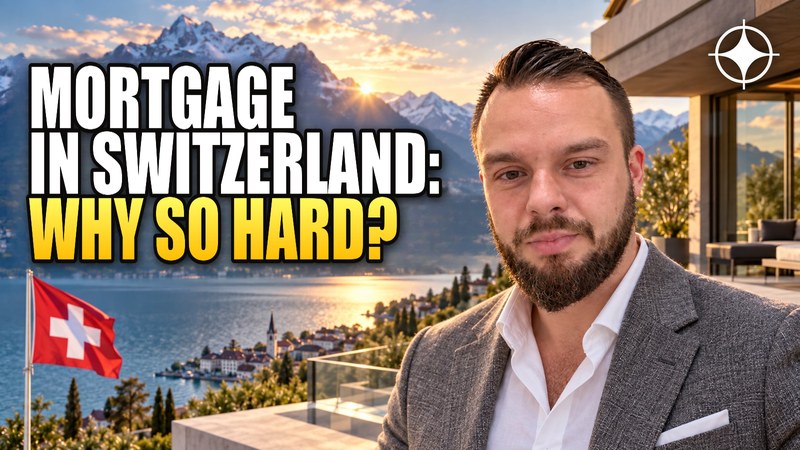
Swiss mortgage for non-residents: why a low interest rate does not mean an easy loan
Swiss rates are among the lowest in the world, but a bank lends a non-resident less and asks for more. The deposit, amortisation down to two-thirds of value, the affordability rule and the first mortgage nobody repays.