
Retail in Maritime City: Danube Oceanz compared with Nautica by Select Group
Retail units in a residential tower are sold as passive income and bought as passive income, and then the owner discovers that a shop with no footfall is not an investment, it is a service charge. This video looks at the commercial component in Danube's Oceanz project in Maritime City, explains how buying commercial in Dubai actually works, and compares what was left in Oceanz against Nautica by Select Group.
How buying commercial property in Dubai differs
Three differences matter. First, VAT: commercial property in the UAE carries 5% VAT on the sale, which residential does not. That is a real number on top of the 4% DLD transfer fee and it surprises people at the trustee office.
Second, financing. Banks lend against commercial at lower loan-to-value and higher rates than residential, and some will not lend on a retail unit in an unbuilt tower at all. Assume more cash than you would need for an apartment of the same price.
Third, the tenant. A residential unit rents to anybody who needs somewhere to live. A retail unit rents to a business that needs that specific footfall, that specific frontage and that specific size. The pool of possible tenants for a 60 square metre shop on the podium of one tower is small, and if it sits empty you are paying the service charge on it every quarter.
Talk to a licensed broker: WhatsApp +971 50 120 32 64 · Telegram
What to look at in a retail unit
Frontage and visibility from the street or the lobby, in that order. A unit tucked behind a lift core will be the last one let and the first one empty, regardless of what the floor plan says about its area.
Captive demand. In a residential tower the reliable retail tenants are the ones the residents need weekly — a small grocery, a laundry, a pharmacy, a café. Count the apartments above the shop and be honest about whether that number supports the business.
And the district. In Maritime City the resident population is still arriving. A retail unit here is a bet on the district filling in, on a longer timeline than the apartment above it. That is not a reason to avoid it; it is a reason not to model rent from year one.
Oceanz and Nautica: the remaining stock
The pattern in both projects was the same and it is the pattern in every Dubai launch. The most attractive units go to investors before public sales open. What remains in stock afterwards is the expensive end and the awkward layouts.
That is why I keep repeating the same advice: enter as early as you can into a project you have decided on, because the choice of unit is worth more than the price difference between phases. A slightly higher entry on the right stack beats a discount on the wrong one.
Between the two developers, the distinction is character rather than quality. Danube builds to a price point with aggressive payment plans and heavy amenity marketing. Select Group builds to a specification and delivers more slowly. Neither approach is wrong; they attract different tenants and different resale buyers, and you should know which one you are buying into.
Why community retail behaves differently from apartments
A retail unit does not let on square metres, it lets on footfall. Two units of identical size in the same building, one on the main pedestrian approach and one twenty metres around the corner, are not comparable assets — the first lets in weeks and the second can sit empty for years.
That makes position the dominant variable, and it is assessable only on site. Stand outside the unit on a weekday evening and count how many people walk past.
Leases are longer than residential and tenants who have fitted out a clinic, a pharmacy or a restaurant are extremely reluctant to move, which makes a well-tenanted unit a genuinely low-maintenance holding.
The counterweight is that a bad unit is far worse than a bad apartment. There is no fallback tenant pool for retail in the wrong position.
The technical checks that decide the rent
Kitchen extract is the big one. A unit that can take a commercial extract can be let to food and beverage, which pays the highest rents in community retail. A unit that cannot is limited to dry uses at materially lower rent, and retrofitting is often impossible in a completed building.
Frontage width relative to depth determines what can trade there. Wide and shallow displays well and suits most retail; narrow and deep suits storage and little else.
Servicing access, waste storage and grease trap provision all constrain the tenant list in ways that are invisible on a floor plan.
And parking directly outside, because community retail lives on quick stops and a customer who cannot park goes elsewhere.
Comparing the two projects
Both sit in Dubai Maritime City and both are selling ground-floor commercial into a district that is still forming, so the tenant base for either is a function of how many residents eventually live around them.
Nautica by Select Group carries the stronger developer covenant and the better prospect of a well-managed building, which for a commercial unit matters because the common areas and the servicing are what a tenant judges.
Danube Oceanz competes on price and on the sheer number of residents its unit mix will deliver, which for a supermarket or a pharmacy is the number that counts.
Whichever you look at, ask for the projected resident count of the building and the immediate surroundings, and price the unit on that rather than on a rent per square foot quoted from an established district.
Frequently asked
Do you pay VAT on commercial property in Dubai?
Yes — 5% VAT applies to commercial property transactions in the UAE, on top of the 4% Dubai Land Department transfer fee. Residential property is exempt. This is one of the most commonly missed line items when buyers first move from apartments to retail or office units.
Is retail in a residential tower a good investment?
It can be, when the unit has real frontage and the tower above it has enough residents to support a business. It is a poor investment when the unit is bought purely on price per square foot without asking who the tenant would be. Vacancy in retail is far more damaging than vacancy in an apartment.
Why are pre-launch prices lower than public launch prices?
Investors take the best units before public sales open, and the developer prices later phases against the demand the early phase created. The consequence is that public-phase buyers pay more for weaker stock — which is why choosing the unit matters more than timing the price.
✍️ Message me on WhatsApp for a free consultation — off-market stock, payment plans and honest numbers on any of the projects covered here.
✅ Subscribe on YouTube — investment, property, business and relocation in the UAE and beyond.


Below market in Dubai Maritime City right now
From the daily off-market feed. Availability and price are confirmed on request.
All below-market listings →

In the news
The same subject in writing — analysis and news related to this video.
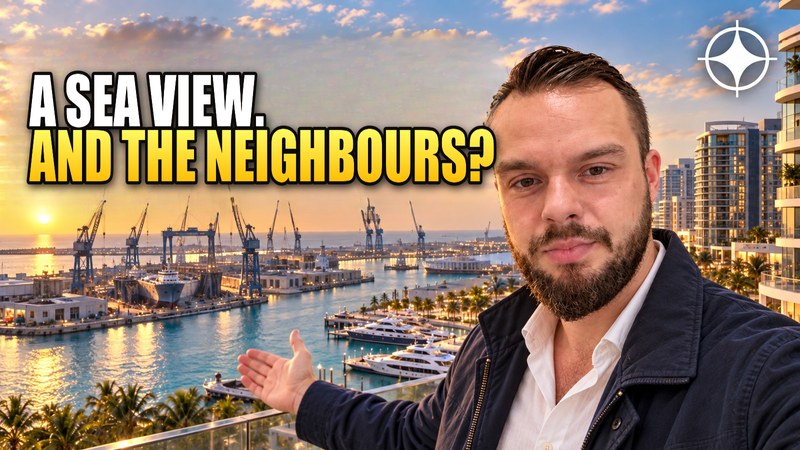
Dubai Maritime City: buying a home in the middle of the maritime industry
A peninsula between two harbours, planned as a hub for shipbuilding and ship repair, with residential towers on the same land. Here the neighbours matter more than the view.

Apparel Group: how letting actually works in Dubai
A retail group developing a tower in Dubai Maritime City. Whoever you buy from, the rules on tenancy registration, rent increases and notice are the same — and they favour a prepared landlord.

BEYOND: three projects, three Dubai districts — and three very different buyer profiles
PASSO on Palm Jumeirah, Arancia Yards in City of Arabia and Soulever in Dubai Maritime City are all built by the same developer, BEYOND, yet each draws a different kind of investor. Why one brand does not mean one buyer profile.

Russian retail brands in Dubai in 2026: a quarter of them left, and what it tells a mall-space investor
By mid-2026, 78 Russian-owned retail and F&B brands were trading in Dubai, down 27% from 107 in April. No new brand entered the market in the first half of the year, and mall leasing tightened across the board. What one cohort’s retreat says about Dubai’s retail leasing cycle.

Three things a chain tenant checks in a retail unit
A buyer of retail space looks at price per foot, location and stated yield. The tenant the unit is bought for looks at something else entirely — and their list is shorter.

Retail is growing where nobody expected: International City, JVC, Majan and Arjan
Transaction statistics on Dubai retail units give an unexpected picture: activity leads not at prestige addresses but in mass residential districts.