
The Crescent in Production City: an eighteen-year-old Damac complex, read as an income asset
A building completed in 2008 has been through its maintenance cycle, and in Dubai Production City that is the single fact worth knowing about it. This district has some of the highest gross yields in the emirate and some of its most variable building management, and those two things are related.
What the passport records
The Crescent is a multi-building complex of twenty-one storeys by Damac Properties, recorded as complete with a completion year of 2008, in Dubai Production City.
Eighteen years of operation is the defining characteristic. The lifts, the chillers, the pumps and the facade have all reached the point where either they have been maintained and renewed or they have not, and there is no third state.
A multi-building complex also means shared infrastructure across more than one block, which matters for the owners association budget and for how a charge increase is apportioned.
Talk to a licensed broker: WhatsApp +971 50 120 32 64 · Telegram
Everything else in this piece follows from those two facts: an older building in a district where older buildings are exactly where the risk lives.
The district, honestly described
Dubai Production City, originally the International Media Production Zone, is a free zone for printing, publishing, packaging and media production, with a residential cluster built around artificial lakes on part of the site. It sits off Sheikh Mohammed Bin Zayed Road near Motor City, Sports City and Jumeirah Village Triangle.
Entry prices are among the lowest in the city for stock of this vintage and gross yields are among the higher figures in Dubai. That is the argument, and for a cash-flow investor it is a real one.
The tenant base comes from the free zone itself, the surrounding business parks, and households looking for the cheapest reasonable apartment in the western half of the city. It is a price-driven market at every level, which means negotiation is expected in both directions and capital appreciation is minimal.
Roughly half the district is printing presses, packaging plants and the logistics that serve them — a working zone with shift patterns, loading bays and heavy vehicle movements, inside the same district as the apartments.
Position within the district decides the tenant
The residential cluster around the lakes is separated from the industrial half, and in the better positions that separation is genuine. In the weaker positions it is the width of a road, and the difference in living experience is large.
Air quality, noise and outlook all change with distance from the industrial side, and so does the tenant’s willingness to renew — which is the part that appears in your returns rather than in your impressions.
This is the most consequential check available here and it takes ten minutes: walk out of the building and look at what is at the end of the street. No listing photograph will tell you and no floor plan contains it.
The lakes are the district’s one differentiator and they do real work. A lake-facing unit has outlook and light, which in a market of otherwise interchangeable apartments is what gets a unit let first — and the premium for it is modest compared with an equivalent view premium anywhere central.
Why an older building can be the better buy
A 2008 completion is not a defect. It is a disclosure. Everything that a newer building will eventually have to prove about its management, this one has already proved one way or the other, and the evidence is in documents you can ask for.
Three years of service charge history, the owners association budget, and evidence that maintenance has actually been carried out rather than deferred. Those three documents describe the asset more accurately than any inspection of the apartment itself.
Occupancy in the specific building is the second signal. In a district with this much stock at this price point, visible vacancy is telling you something the listing will not.
Where the answers are good, an older well-run building at a lower entry price with a settled tenant base is a sounder income asset than a new tower whose charge has not yet been tested. Where they are bad, the discount is not a discount — it is a repair bill with a delay on it.
Underwriting it properly
Model net, not gross. Service charge, vacancy allowance, re-letting cost and a maintenance provision. The gap between the headline yield and the realised one is wider in this district than almost anywhere in Dubai, and it is wider still on an older building.
There is no metro and none planned, so the district is car-dependent and parking allocation feeds directly into achievable rent. Confirm the bay belongs to the unit rather than to the building’s pool.
Establish the realistic achieved rent for this specific complex rather than a district average. In a price-driven market with a wide spread of building quality, the district figure is a blend of outcomes you would not accept.
Resale liquidity is moderate and the buyer pool is other yield investors running the same spreadsheet, who negotiate hard. Price the exit on that basis rather than on hope.
Who this suits
A cash-flow investor working at the affordable end who is prepared to do building-level due diligence and hold long term. That is the profile the district rewards, and it rewards it consistently.
It suits poorly anyone buying without a site visit. This is the district where Dubai investors most often discover what deferred maintenance costs, and the discovery happens after completion.
It suits poorly anyone expecting appreciation. There is no supply constraint and no amenity story; the return is rent.
And it suits poorly anyone who wants the purchase to be quick. The hour spent on the charge history and the walk around the block is the part of this transaction that actually earns money.
Frequently asked
When was The Crescent in Dubai Production City completed?
The project passport records completion in 2008. It is a multi-building complex of twenty-one storeys developed by Damac Properties.
Is Dubai Production City a good yield district?
Gross yields are among the higher figures in Dubai and entry prices among the lowest, so the cash-flow case is real. The risk is building-level rather than district-level: several buildings here have had persistent service charge and maintenance problems, and that is checkable before you buy.
What was Dubai Production City called before?
The International Media Production Zone, or IMPZ — a free zone for printing, publishing, packaging and media production, with a residential cluster built around artificial lakes on part of the site.
✍️ Message me on WhatsApp for a free consultation — off-market stock, payment plans and honest numbers on any of the projects covered here.
✅ Subscribe on YouTube — investment, property, business and relocation in the UAE and beyond.


Below market in Production City right now
From the daily off-market feed. Availability and price are confirmed on request.
All below-market listings →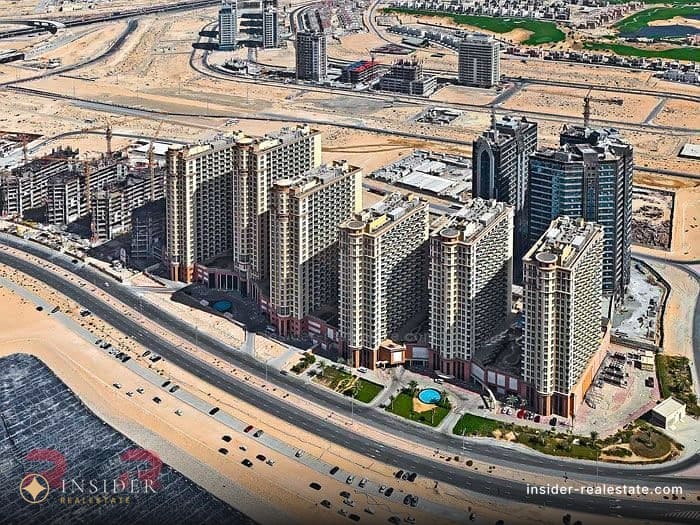
Related reading
The same subject in writing — analysis and news related to this video.
Production City: a district built around one industry
A media and printing free zone with housing around a lake. When demand rests on one industry, that is both the strength and the single point of failure.

Residence by financial independence: what you actually have to show
A whole family of permits exists for people who will live somewhere without working. What they test is not wealth but the reliability of an income stream.
No income tax in the UAE: what a property owner pays instead
No personal income tax, no annual property tax, no capital gains tax on an individual. What replaces them is a 4% fee at the start and a service charge every year — plus the question that is answered in your country of residence, not in Dubai.
Al Habtoor Group: living inside a hospitality complex
A long-established conglomerate whose Dubai residential towers sit within its own hotel and leisure complex. What a hospitality-anchored address gives a resident, and what it costs.