
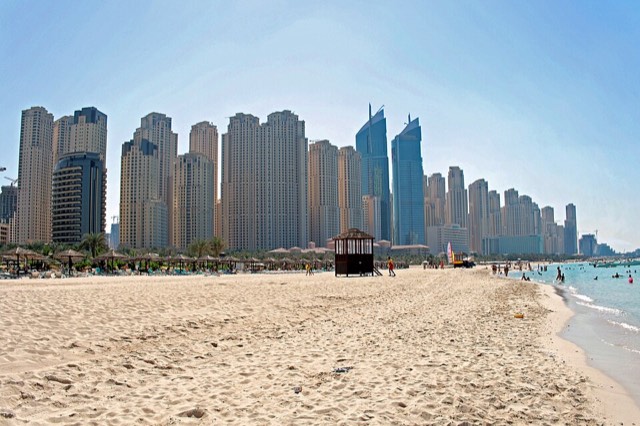
 −35% Illustrative photo
 Liwan
A dense, cheap apartment district off Dubai–Al Ain Road: high yields, thin amenity, and a tenant base that is entirely price-driven.
4 units in stock. 3 with a confirmed status: 3 ready, 0 under construction. 9th most expensive of 91 districts by median price.
- maximum gross yield
- lowest ticket size
- price-driven tenant demand
Median price $4.88M AED 17,920,000
Entry price $313K AED 1,150,000 — cheapest unit
Per square foot $209 AED 768 / sq ft, median
Ready stock 100% 3 units discounted, up to −35%
What this area is actually like
What Liwan is
Liwan is a residential district in the Dubailand region off Dubai–Al Ain Road, developed principally by Mazaya, consisting of closely spaced mid-rise apartment buildings with a small amount of townhouse product.
Density is high and the layout is tight — buildings sit close together with limited open space between them, which is a noticeable contrast to the newer master-planned communities.
It is fully delivered and heavily occupied, with a large resident population.
The yield story
Liwan produces some of the highest gross yields in Dubai, and the mechanism is simple: purchase prices are very low while rents, though also low, have not fallen proportionally.
The tenant base is price-driven households — sharers, young families on modest incomes, and workers in the surrounding areas — for whom the deciding factor is cost.
That base is large and durable. There is always demand for the cheapest reasonable accommodation in a growing city, and Liwan supplies it.
The trade-offs
Amenity is thin. Basic retail exists; for anything beyond it residents drive. There is no district centre and limited dining.
No metro, and the location off Al Ain Road puts Downtown around thirty to thirty-five minutes away off-peak.
Density and layout mean limited parking, limited open space and buildings overlooking each other.
Building quality and management vary and some buildings have had persistent service charge and maintenance problems, which in a low-rent district hurt returns disproportionately.
What to check
Service charge as a percentage of achievable rent. In a district with rents this low, a charge that would be unremarkable elsewhere consumes a large share of gross income.
The building’s maintenance record and the state of the lifts, cooling and common areas.
Parking allocation, which is genuinely scarce here.
Occupancy in the specific building. A tower with visible vacancy is telling you something.
Who it suits
A yield investor operating at the very affordable end who understands they are buying cash flow rather than an asset that appreciates, and who will do the building-level work.
It suits poorly almost everyone else: there is no lifestyle argument, no capital growth argument and no liquidity argument. The case here is arithmetic.
If the number works after the service charge, after a realistic vacancy allowance and after honest maintenance provisioning, it works. If it only works on gross yield, it does not.
The density problem, in detail
Liwan was planned at a density that assumed a different quality of public realm than what was built. Buildings sit close, the gaps between them are parking rather than landscaping, and many units look directly into the windows opposite at a distance of a few metres.
That has three practical effects. Light and privacy are poor on the lower and middle floors of internal-facing stacks, which is where most of the cheap stock is. Parking is contested, because the provision was calculated per unit and the reality is multiple occupancy. And the streets carry more traffic than their width was designed for.
None of it makes the district unlettable — demand at this price point absorbs a great deal — but it does mean that within Liwan the spread between a good unit and a bad one is unusually wide, and it is entirely visible on a site visit.
Corner units, upper floors and anything with an outlook over a road rather than into a facing window are worth paying up for here, because they let faster, hold tenants longer and sell more easily.
What the service charge actually does to the return
This is the number that decides a Liwan purchase and it is routinely ignored. Service charge in Dubai is billed per square foot largely independently of what rent the building achieves, so in a low-rent district it consumes a much larger share of gross income than the same charge would in Marina.
Work it through: take the annual charge for the unit, divide it by the annual rent, and look at the percentage. In central districts that ratio commonly lands in the low teens. In parts of Liwan it can reach a quarter or more, and at that point a headline yield in double digits has quietly become an ordinary one.
Then add what is not in the charge: void periods between price-sensitive tenants, the cost of getting a unit re-let, and the maintenance an ageing mid-market building needs that the reserve fund may not cover.
Ask for three years of charge history and the owners association budget. In buildings where collection has been poor, the charge either rises sharply or the maintenance does not happen, and both outcomes land on you.
How to buy here without regretting it
Inspect in person, without exception. Liwan is the clearest example in Dubai of a district where two buildings on the same road are different investments, and no amount of documentation substitutes for standing in the lobby on a Tuesday evening.
Prefer a building with visible occupancy and a functioning owners association over a cheaper one with neither. The discount on a badly run building is never as large as the cost of owning it.
Model the return net — after charge, after a realistic vacancy allowance, after maintenance provisioning. If it still clears comfortably, the arithmetic is genuinely good and this is a legitimate cash-flow asset.
And accept the exit for what it is: you will sell to another yield investor who will negotiate hard, so plan to hold long enough that the rent, not the resale, is the return.

The market, per the Land Department
Residential price index 167.33 Q4 2025
Quarter on quarter +3.32% QoQ
Year on year +8.9% YoY
Full year 2025 +9.81% index 162.51
This is the official index for the whole emirate, not for Liwan: the Dubai Land Department does not publish a district breakdown publicly. Treat it as background — it tells you whether the market is rising or flat while you read the prices above. Transaction data for a specific building I pull separately, on request. Source: Dubai Land Department, read 15/08/2026.
The latest read: July 2026
The Land Department index above is quarterly and emirate-wide. The monthly price index splits villas from apartments — and in 2026 that matters: a single blended figure hides the fact that the two markets have pulled apart.
Villas and townhouses 292.5 flat YoY
Apartments 168.7 −4.2% YoY
All residential 219.2 −0.3% MoM
Price per sqft 2,039 villas · apartments 1,397 AED
The month split by completion status: 72.8% of deals were off-plan, 27.2% ready homes. Ready-home volume rose 11.4% on the month, while off-plan was the only segment down both on the month and on the year (−45.3%). The practical read: there is room to negotiate on apartments and on off-plan, far less on finished villas in established communities. Index base is January 2021 = 100 — a villa reading of 292.5 means growth of 192.5% from that mark, not a premium over a 2021 peak. Monthly ValuStrat market review for July 2026, checked 24/08/2026.
Questions about Liwan
Why are yields so high in Liwan?
Purchase prices are very low while rents have not fallen proportionally. The compensation for that yield is thin amenity, high density, no metro, wide variance in building management, and effectively no capital appreciation.
Other districts
All districts →Projects in Liwan
All projects in Liwan →Liwan in the news

Liwan: at the cheap end, voids decide the outcome, not the headline yield
Dense low-rise housing at some of the lowest prices in Dubai. The number quoted in the listing is the least reliable figure in the whole market.

Liwan service charges: which lines of the building budget drive the fee
A service charge is not a price but a budget. A handful of its lines explain almost all of the difference between neighbouring buildings.
Looking at Liwan specifically?
Send me the building or the unit and I will pull the registered transaction history, the current service charge and what comparable units actually let for — before you make an offer, not after.
Ask on WhatsAppAsk a question
Telegram is the fastest way — I answer personally.
Message on Telegram