Remraam: a community with no metro and no city nearby
Low-rise apartments deep in Dubailand with their own amenities and no public transport. Car dependence is the variable that decides everything else.
 INSIDERrealestate — Home
Rates are indicative. Contracts and DLD fees are always in dirhams.
A low-rise budget community deep in Dubailand: four storeys, genuine greenery and one of the lowest entry prices in the city.
Remraam was built by Dubai Properties deep in Dubailand, next to Damac Hills and Dubai Investment Park. The scheme is low-rise: four-storey blocks arranged in groups around shared courtyards.
It splits into two clusters, Al Thamam and Al Ramth. The concept is the same in both; what differs is the vintage of each phase, the layouts and the condition of individual buildings.
Density sits well below the Dubai norm. Between the blocks there are lawns, footpaths and trees rather than parking bays — a rarity at this price point and the main reason to consider the area at all.
Inside there are pools, sports courts, play areas, supermarkets and a small parade of shops. Everything else requires a drive.
The audience is families on a budget: people who need two or three bedrooms for what a studio costs closer to the centre.
A large share of residents work in Jebel Ali, Dubai Investment Park, Dubai South and the south-western industrial belt. For them Remraam is not a compromise but the logical choice near work.
Rental demand is steady and largely detached from the market cycle: this is housing of necessity, not a discretionary purchase. People who leave tend to leave the country, not move to the next district.
Short-term letting does not exist here and never will: there is no visitor traffic and the product is not built for it.
Entry price. Remraam is consistently among the cheapest freehold addresses in Dubai, which is exactly why the percentage yield here is among the highest.
Floor area. The money that buys a compact studio in a central district buys a proper two-bedroom with storage and a balcony here.
The environment. Low-rise blocks and landscaping that has had time to grow deliver what the budget segment almost never has: quiet, shade, and somewhere a child can go outside.
Predictability. The community is finished. Construction is over, and nothing new is going to appear under your window.
The commute. There is no metro and none is planned; bus links are thin. A car is mandatory, and a family often needs two.
Distance. The drive to Marina or Downtown at peak takes substantially longer than a weekend navigation estimate suggests. Commuting to the centre daily from here wears people down.
Liquidity. The buyer pool is narrow — yield-focused investors and budget-constrained families — and a sale takes longer than in the central districts.
A ceiling on price. The district is budget by design, and expecting it to reposition upward is unrealistic: what is being built nearby is the same or cheaper.
Gross yield here looks attractive, which is precisely why it has to be calculated honestly, net of everything.
The service charge in a low-rise scheme with extensive landscaping is not as low as a buyer who came for a cheap entry price expects: lawns, pools and pathways are maintained by the owners.
Vacancy is the second factor. Demand is steady but not frantic, and a month or two between tenants has to be budgeted.
The third is condition. In the budget segment tenants choose on presentation: two identical flats in different states of repair let at different speeds and different rents.
The cluster and the phase. Al Thamam and Al Ramth were built at different times by different contractors, and both build quality and finish vary noticeably.
Three years of service-charge history: it reveals both the standard of management and how predictable the costs are.
Occupancy in the building. A dozen live rental listings in one block tells you exactly how long your own flat will sit.
The floor and the lift. Not every four-storey block has one, and for a family with a pushchair that detail decides the purchase — and it never appears in the listing.
Suits: an investor targeting percentage rather than prestige who can hold for years; a family working in the south-west; anyone who needs floor area at the lowest possible price.
Does not suit: anyone commuting to the centre daily; anyone who may need a quick exit; a landlord counting on tenants without cars.
The realistic comparison is Dubai Investment Park and Discovery Gardens: similar pricing and the same logic, a different environment.
And Liwan or Arjan, where the yield looks better on paper while density and noise are markedly higher.
The immediate neighbours are Damac Hills, Dubai Investment Park, Mudon and more Dubailand development of the same kind. They all play the same game: floor area and price against distance from the centre.
The south-western belt is being built out faster than the rest of the city, and that cuts both ways. On one side the surrounding infrastructure keeps improving — schools, clinics and retail appear in the neighbouring communities and serve everyone.
On the other, supply keeps growing, and new projects nearby compete with your flat directly, often with fresher finishes and a developer payment plan attached.
The practical conclusion: when buying in Remraam, look beyond the community at what is under construction within a couple of kilometres. Those buildings are your competition in the rental market three years from now.
These are official DLD readings for the entire emirate; a district split, Remraam included, is not made public. Use them as context for the prices on this page — registered sales for the building you pick I pull on request. Source: Dubai Land Department, read 15/08/2026.
The DLD index above comes out quarterly and does not separate segments. The monthly price index treats villas and apartments apart, which in 2026 is essential: a market-wide average conceals that the two have gone different ways.
Off-plan took 72.8% of the month's deals and ready homes 27.2%. Ready volume was up 11.4% on the month, and off-plan alone fell both month on month and year on year (−45.3%). So negotiation is realistic on apartments and off-plan, much less so on completed villas in established communities. Index base is January 2021 = 100 — a villa reading of 292.5 means growth of 192.5% from that mark, not a premium over a 2021 peak. Monthly ValuStrat market review for July 2026, checked 24/08/2026.
Low-rise apartments deep in Dubailand with their own amenities and no public transport. Car dependence is the variable that decides everything else.
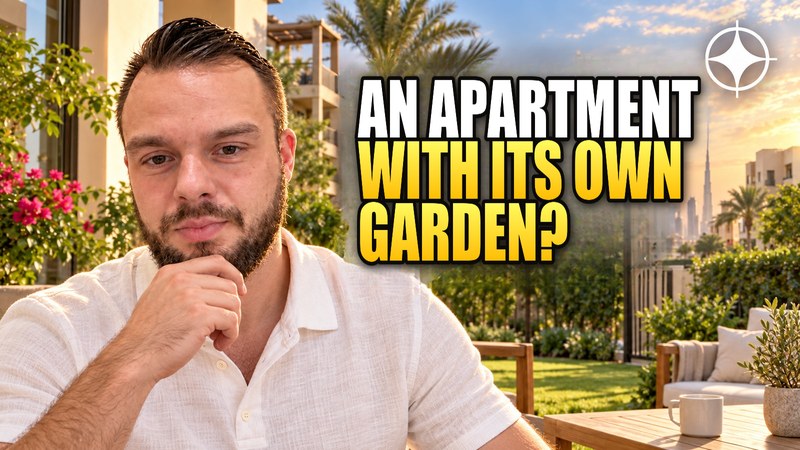
In low-rise communities, ground-floor units come with a terrace and a patch of garden. It is a format between an apartment and a house, with its own benefits and its own costs.
Tell me which building or unit it is. Before you make an offer I will bring the registered transaction history, the current service charge and the real letting prices of comparable units.
Ask on WhatsAppTelegram is the fastest way — I answer personally.
Message on Telegram