
 −7%
−7% Reem
Emaar townhouses at the gateway to Dubailand: the case where the price of an apartment in a middling district buys a house in a planned community.
12 units in stock. 12 with a confirmed status: 12 ready, 0 under construction. 60th most expensive of 91 districts by median price.
- a house on an apartment budget
- family tenants
- steady cash flow
Median price $1.09M AED 3,999,500
Entry price $762K AED 2,800,000 — cheapest unit
Per square foot $376 AED 1,382 / sq ft, median
Ready stock 100% 12 units discounted, up to −7%
What this area is actually like
What the community is
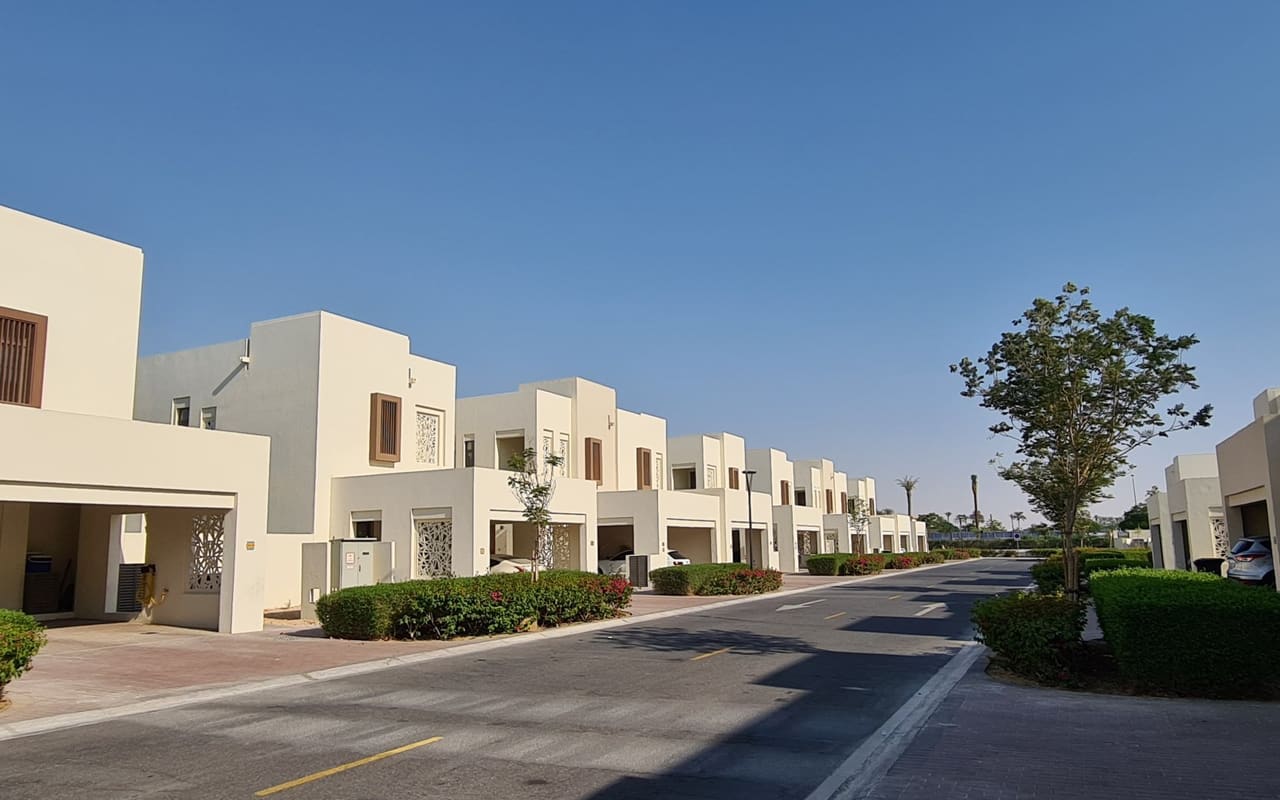
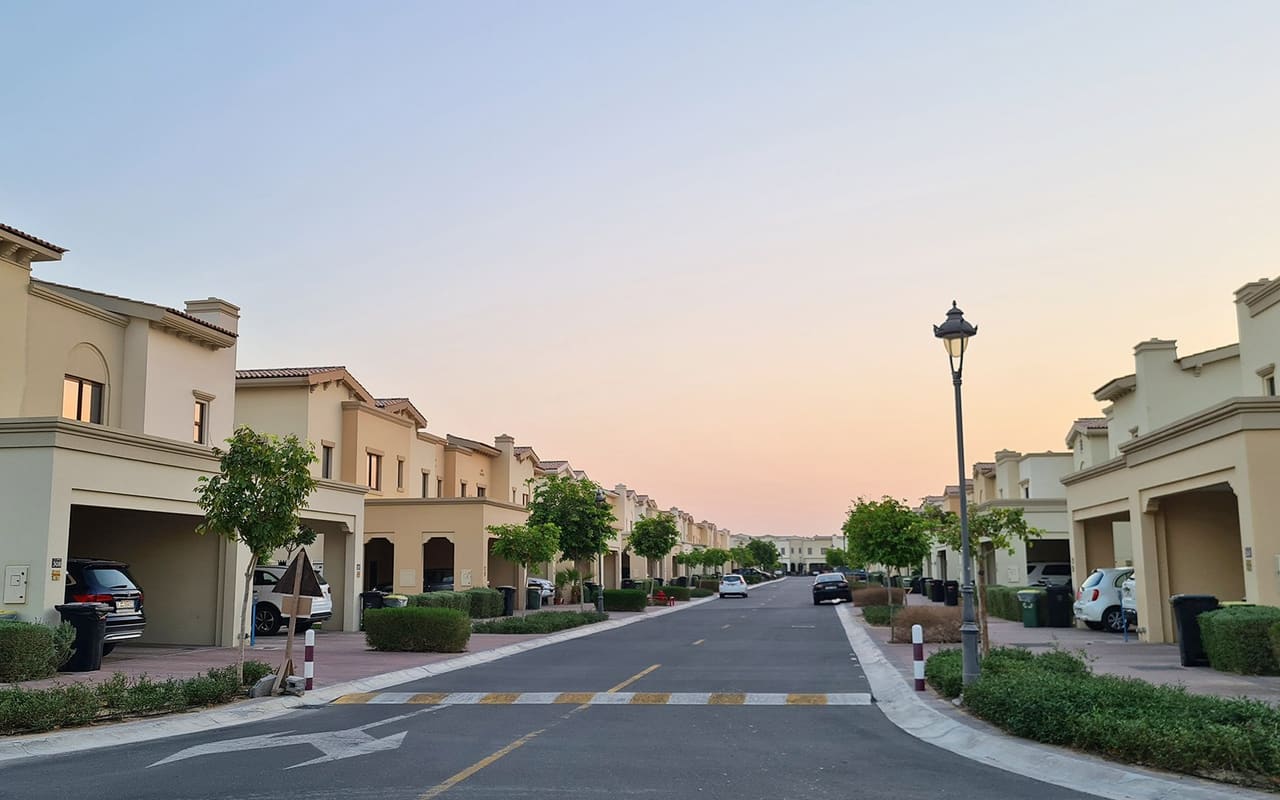
Reem is an Emaar community on the eastern edge of Dubailand, made up of the Mira and Mira Oasis phases — rows of three- and four-bedroom townhouses laid out around parks and shared pools.
It was built as a single designed community rather than assembled from separate projects, which shows in the street layout, the planting and the consistency of the housing.
At the centre sits Reem Community Centre with a supermarket, clinics, cafés and a nursery. A large central park runs through the middle.
The phases were delivered over several years and are now essentially complete, with landscaping mature enough to give the streets shade.
Why people move here
Because it converts an apartment budget into a house. Three bedrooms, a small garden and a garage for what a two-bedroom flat costs in the middle of the city is the entire proposition.
The community is genuinely designed for families — pools, parks, a nursery, and streets where children can be outside — which the price point does not usually buy in Dubai.
It is an Emaar product, and that matters to tenants and buyers in this segment: build quality and community management are predictable in a way that smaller developers' schemes are not.
And it is finished. What you see when you view is what you get; there is no phase two arriving next to your garden.
The price of the distance
Reem sits well out along the eastern edge of the city. Downtown and the Marina are both a real drive, and at peak that drive is long.
There is no metro and none planned. Every household needs a car, and most need two.
Global Village and the Arabian Ranches communities are the nearest anchors; day-to-day shopping is inside the community, anything larger is a drive.
The tenant base is therefore families for whom the space matters more than the commute — a real pool, but a specific one, and it narrows the exit.
The economics for an investor
The appeal is a house-sized rent against an apartment-sized purchase, which produces respectable percentages for the townhouse segment.
Tenancies are long. Families who move into a community like this for the schools and the space do not relocate for marginal savings, so turnover and void periods are low.
The costs are house costs: garden, air conditioning for two floors, and a service charge that covers parks and pools rather than a lobby.
Liquidity is moderate. The buyer pool is families and yield investors; it is real but not deep, and a sale takes longer than in the central apartment districts.
What to check before buying
The phase. Mira and Mira Oasis were delivered at different times and the maturity of the landscaping differs noticeably between them.
The position within the row. End units, park-facing units and units backing onto a road are three different products at three different rents.
The service charge history and what it covers — in a community with this much shared landscaping it is not a trivial line.
And the commute, driven at the hour you would actually drive it. This is the single factor that decides whether the community works for a given household.
Who it suits
A family that needs a house and cannot reach the price of Arabian Ranches or Mudon, and whose work is not in the centre.
An investor who wants a townhouse yield with long tenancies and is comfortable with a moderate exit.
It suits poorly anyone commuting daily to Downtown or DIFC, anyone without a car, and anyone counting on rapid capital growth — this is a rental-income community.
It also suits poorly a buyer who wants a recognisable address; Reem trades on product, not on name.
What to compare it against
Mudon and Town Square — the same idea at a similar price, closer in for Mudon and with more retail in Town Square.
Arabian Ranches — the benchmark of the segment, materially more expensive and far more established.
The Valley and Damac Hills 2 — cheaper and further out, with less mature communities around them.
Each of these is covered with median prices and current stock composition in the areas section.
Living here day to day
The community runs on its own centre: a supermarket, a pharmacy, a couple of clinics, a nursery and a handful of cafés, which covers the ordinary week without leaving.
The central park is the piece residents actually use. In a townhouse community where private gardens are small, shared green space is not decoration — it is where the community happens.
Schools are the standing question. There are options within a reasonable drive rather than inside the community, and for most households here the morning school run is the fixed point the rest of the day is arranged around.
Weekends tend to be spent elsewhere: Global Village and the Arabian Ranches retail are the nearest draws, and anything larger means a proper drive into the city.
More on Reem
Written breakdowns of subjects the English channel has not filmed.
- Reem: an Emaar community that converts an apartment budget into a house
Three bedrooms, a garden and a garage for what a two-bedroom flat costs in the middle of the city. The whole proposition, and the drive that pays for it.
The market, per the Land Department
Residential price index 167.33 Q4 2025
Quarter on quarter +3.32% QoQ
Year on year +8.9% YoY
Full year 2025 +9.81% index 162.51
These are official DLD readings for the entire emirate; a district split, Reem included, is not made public. Use them as context for the prices on this page — registered sales for the building you pick I pull on request. Source: Dubai Land Department, read 15/08/2026.
The latest read: July 2026
The quarterly Land Department index is one number for the whole emirate. The monthly one counts villas and apartments separately — and in 2026 that is the point, because a blended average masks how far the segments have diverged.
Villas and townhouses 292.5 flat YoY
Apartments 168.7 −4.2% YoY
All residential 219.2 −0.3% MoM
Price per sqft 2,039 villas · apartments 1,397 AED
What this means for Reem
- +4.7% year on year — villas and townhouses, Mira. That outpaces its own segment: villas and townhouses emirate-wide are flat over the year. Which is why it is named in the monthly review at all — the list usually holds only the extremes. The figure is for that community, not the whole district: within Reem the spread across buildings and completion years is wider than the gap between districts.
The month split by completion status: 72.8% of deals were off-plan, 27.2% ready homes. Ready-home volume rose 11.4% on the month, while off-plan was the only segment down both on the month and on the year (−45.3%). The practical read: there is room to negotiate on apartments and on off-plan, far less on finished villas in established communities. Index base is January 2021 = 100 — a villa reading of 292.5 means growth of 192.5% from that mark, not a premium over a 2021 peak. Monthly ValuStrat market review for July 2026, checked 24/08/2026.
Other districts
All districts →Projects in Reem
All projects in Reem →
Reem in the news
ADGM on Al Reem Island: 190 asset managers, 276 funds and what it means for Abu Dhabi rentals
ADGM has covered Al Reem Island since 2023. By H1 2026 it had 13,974 active licences, 190 asset managers (+23%), 276 funds (+32%), AUM up 54% and 49,027 people working in the district. Why that matters for Al Reem landlords.
Al Reem Island apartments: Radisson Residences and Rixos Al Reem, branded homes next to Abu Dhabi’s financial centre
Al Reem now has two branded schemes: the world’s first standalone Radisson Residences (phase one, AED 1.2bn, sold within a day; phase two with 437 furnished units in September 2026) and 386 Rixos residences by East & West, one-bedrooms from about AED 2.1m, completing Q1 2029.
FIDA: Abu Dhabi’s new financial cluster, and what it means for Al Reem Island real estate
Abu Dhabi has launched FIDA, a cluster for fintech, insurance and digital assets targeting AED 56 billion in added GDP and 8,000 jobs by 2045. We look at how it extends ADGM and who it matters to.

Abu Dhabi rent freeze: why Al Reem and Al Maryah are outside it
Since 2 June 2026 Abu Dhabi has cut the permitted annual rent rise from 5% to 0% for homes, offices and industrial units, until further notice — still in force in September. ADGM communities on Al Reem and Al Maryah islands are excluded and follow their own rules.
Al Reem and Al Maryah: Radiant Garden from AED 548,000 and St. Regis Residences by ADGM
Two neighbouring Abu Dhabi islands, two different entry strategies: Radiant Garden on Al Reem starts from AED 548,000 with a late-2026 handover, while St. Regis The Residences on Al Maryah is a Marriott-branded tower priced from AED 4.6 million, due in 2028.
Riviera Residences on Al Reem Island: a pearl facade by Herzog & de Meuron
Mered has entered Abu Dhabi with a 240,000 sqm waterfront project on Oval Bay, designed by Swiss firm Herzog & de Meuron, complete with a private marina. Handover is set for March 2029; deep-foundation works began in spring 2026.
Al Maryah Island expansion: Aldar and Mubadala to build out the north side for AED 60bn+
Aldar (60%) and Mubadala (40%) will develop the last major plot on Al Maryah: 1.5m sqm of space, 450,000+ sqm of Grade A offices, 3,000+ homes and three new bridges, with a GDV above AED 60bn. What it means for Al Reem and Saadiyat owners.

Reem: where a townhouse and a villa actually differ
A family townhouse community. The shared wall is the obvious difference; the four that matter are financial.
Reem townhouse cost of ownership: what it really costs over ten years
The purchase price is only the start. A townhouse carries costs an apartment does not, and over a long horizon they add up to a noticeable sum.
Looking at Reem specifically?
Tell me which building or unit it is. Before you make an offer I will bring the registered transaction history, the current service charge and the real letting prices of comparable units.
Ask on WhatsAppAsk a question
Telegram is the fastest way — I answer personally.
Message on Telegram