
A developer share index is not house prices: how not to confuse two markets
When the index falls, headlines turn it into “the Dubai property market is falling”. In some weeks of 2026 the index dropped 17% — and not one apartment moved by 17%.

A real estate sector index trades on the Dubai Financial Market, aggregating the shares of listed developers: Emaar, Deyaar, Union Properties, Dubai Investments and others. When the index falls, the news regularly turns it into "the Dubai property market is falling". That is a substitution.
What the index shows and what it does not
It shows the mood of stock market investors towards developer shares. It reacts instantly — to geopolitics, to results, to rumour.
It does not show the prices of apartment transactions. Those are recorded by the Land Department, and the data arrives with a lag of four to eight weeks.
Talk to a licensed broker: 📲 +971 50 120 32 64 on WhatsApp, @dubai_oleg on Telegram
In some weeks of 2026 the index fell 17% on regional tension, then recovered the fall almost entirely on reports of de-escalation. Not one apartment in Dubai got 17% cheaper or 17% more expensive over those days.
Why developers have a buffer
- Most projects are sold during construction, and the money arrives on a payment schedule regardless of the share price.
- Contracts are signed and building continues. A fall in the share price does not affect performance of those contracts.
- The financial results confirm the scale. For 2025 the emirate's largest developer reported sales of AED 80.4bn and declared dividends of AED 8.8bn — around $2.4bn.
How to use it
The index is useful as a barometer of anxiety, not as an indicator of prices. If you are assessing the housing market, look at transaction counts and average prices in the register; if you are assessing developer shares, look at their reporting and dividend policy. Those are two different decisions and should not be mixed.
Video on this topic
The same subject on the English channel — each clip has a written version of its own.
 55:13Land plots and joint ventures in Dubai: how investors and developers split the profit9 October 2026
 51:14AI in Dubai real estate: what changes for brokers, investors and developers3 October 2026
 19:59Imperial Avenue: a profitable resale in Downtown Dubai13 January 2024
 36:55The Biltmore Residences Dubai: brand history, the numbers, and what you can actually earn14 July 2023
 19:45Oceano on Al Marjan Island: the Luxe Developers project and the island being built around it14 August 2026
In the news
Other write-ups on the site about the same thing.
One developer, 28.5% of the market: what concentration costs and what it buys
Almost every third dirham spent on Dubai property in March 2026 went into one company’s projects. Concentration rose not because the leader improved but because the buyer got cautious.

The record that never happened: how to read Land Department transaction data
A widely reported record month for off-plan office sales turned out to contain deals closed six months earlier. Registration date and transaction date are not the same thing, and the gap distorts every monthly headline.
Dubai Property Market H1 2026: Record January, Cooler Summer
January delivered AED 72.5 billion in turnover — more than Dubai’s entire market in 2020. By June, volumes had returned to typical levels. Here’s the month-by-month breakdown of deal count and price per square foot.
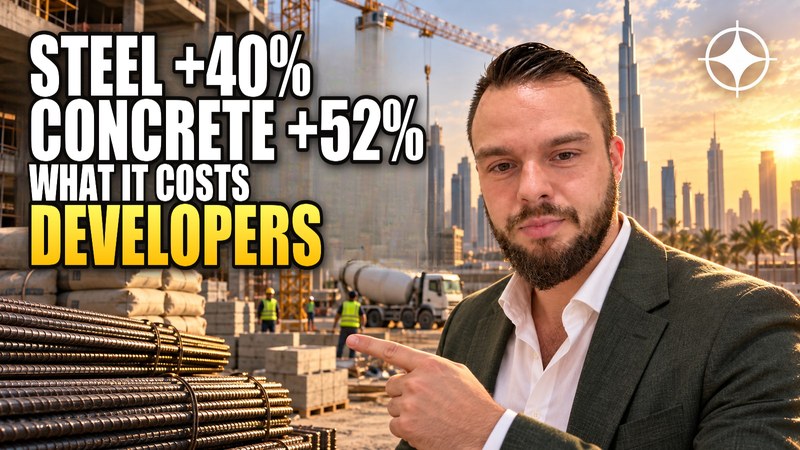
Steel up 40%, concrete up 52%: what building actually costs Dubai developers now
“Prices cannot fall because construction is getting dearer” is heard constantly. The cost figures are real. The conclusion drawn from them is not — and the reason is that land, not materials, drove the market.

Vida Residences +117%: what the Dubai Marina project statistics actually show
The largest developer’s return to Dubai Marina prompted a look at its earlier projects there. The valuable number in that statistic is not the growth percentage.

Is almost everyone in Dubai a construction worker? 2025 data: construction is 18.7% of the workforce
Dubai Statistics Center data for 2025: construction employs 879,000 people, or 18.7% of the workforce. Trade is the largest employer with 892,000. The rest work in services, logistics, manufacturing, tech and finance. What that means for housing demand.