
Land and joint ventures in the UAE: how development money is actually made
There is a widespread assumption that development is about construction. By the classical definition it is about increasing the value of a plot — and building is only the riskiest of several ways to do that. Understanding the difference is what separates an investor in a joint venture from a passenger in one.
What a joint venture is here
One side brings the land or the capital; the other brings the licence, the design, the delivery and the sales machine. Profit is split on terms agreed before anything is built.
For a capital partner it is the way into the highest-margin part of the market without becoming a construction company. For a landowner it is the way to realise a plot's value without selling it at land price.
It is also, structurally, a partnership: your return depends on somebody else executing. The diligence is therefore on the partner first and the site second — track record, delivered projects, and what happened on the ones that went wrong.
Talk to a licensed broker: WhatsApp +971 50 120 32 64 · Telegram
Where the value actually comes from
Holding while the district matures. No construction risk at all — just time, holding costs and a view on where the city is going.
Consents and zoning. Obtaining permissions, changing use or raising the permitted density adds value without pouring a cubic metre of concrete. This is the highest return per unit of risk in the whole chain.
Design and packaging. A plot with a scheme, approvals and a feasibility study sells to a developer for more than a bare plot, because you have removed their uncertainty.
Building. The largest headline margin and by far the largest execution risk — cost inflation, contractor failure, sales-rate assumptions and the eighteen months during which nothing comes back.
Where investors lose money
By assuming permissions are a formality. Plot ratio, height, access and utilities are decided by authorities on their schedule, and a plot that cannot carry the density in your model is a different asset from the one you paid for. Verify permitted use in writing before purchase.
By not defining who funds an overrun. The single most common source of joint-venture disputes is a cost increase arriving after the units are sold, with no agreed mechanism for who covers it.
By ignoring the exit. A part-built project with a stalled partner is the hardest asset in this market to sell. Agree in advance what happens if either side wants or needs out.
Frequently asked
Can a foreigner buy land in Dubai?
Yes, in the freehold zones, with title registered at the Land Department. The practical differences from buying an apartment are that a plot produces no income until something is built and that it carries holding costs and a development clock.
What return does a development joint venture target?
Higher than a completed rental asset, because you are taking planning, construction and sales risk on top of market risk. Any specific percentage quoted before feasibility is marketing; the honest number comes out of a costed scheme on a specific plot.
Is this suitable for a first purchase abroad?
No. It suits an investor with a multi-year horizon, tolerance for a period of zero income, and either development expertise or a partner whose delivery record can be checked project by project.
✍️ Message me on WhatsApp for a free consultation — off-market stock, payment plans and honest numbers on any of the projects covered here.
✅ Subscribe on YouTube — investment, property, business and relocation in the UAE and beyond.


In the news
The same subject in writing — analysis and news related to this video.

Ready or off-plan in Dubai: the four differences that actually decide it
Not a matter of taste. When the money leaves you, when income starts, how a bank treats it and how you get out again are four different answers, and together they point at one option or the other for almost every buyer.
Mr. Eight Development: an off-plan villa on an island still being made
A developer building villas on the Dubai Islands. A house bought off-plan on new land combines two kinds of waiting, and they resolve on different timetables.

Jumeirah Garden City off-plan: Mayfair Gardens by Majid Developments hands over in autumn 2026
Mayfair Gardens, Majid Developments’ first Dubai building, has 64 homes (24 studios, 40 one-bedrooms) launched in 2024 from AED 875 000. Handover slipped from Q2 to September 2026. What the delay means, and what to check before you sign the handover papers.
Bukadra: valuing a district where nothing has completed yet
New ground by the canal where the first projects are under construction and no building is occupied. The usual checks do not apply — so check different things.
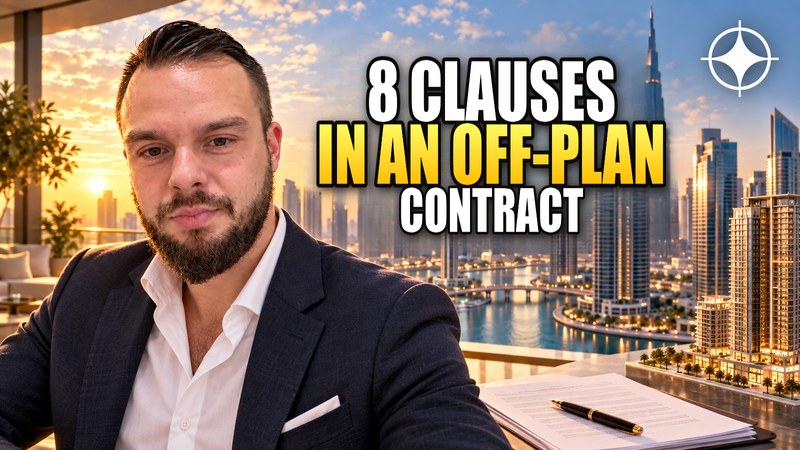
Orion Real Estate Development developer profile: eight clauses to read in a Dubai off-plan contract
The developer of a Business Bay tower. Off-plan purchase agreements are signed almost unread, yet eight of their provisions decide nearly everything — here they are.

HMB Homes Real Estate Development: the three years between contract and keys
A developer building in Discovery Gardens. Off-plan buyers do the work before signing and nothing afterwards — and the period in between is where problems are still cheap to catch.