
Trump's Gaza Resort Plan and the Real Estate Logic Behind It
Even now that Donald Trump runs a whole country rather than a development company, one of the ideas on the table for settling the conflict in Gaza is, at its core, a real estate plan. The concept involves building high-end resorts on part of the current conflict zone and resettling the Palestinian population — some remaining, some relocating — on the logic that economic activity centred on resorts reduces the incentive to keep fighting.
A settlement plan built on resort development
The proposal, as described, would see luxury resorts built on the side of the current conflict zone, with a resettlement component for the Palestinian population — some staying in place, others moving elsewhere. The underlying logic offered for this approach is straightforward: where people are earning a living from tourism and hospitality, the argument goes, they are less inclined to sustain conflict.
It's a controversial framing precisely because it treats a geopolitical and humanitarian crisis through the lens of a development brief — location, resort concept, resettlement logistics — rather than through the usual language of ceasefires and negotiated borders.
It's the kind of proposal that will almost certainly be revisited and revised many times, in response to shifting political conditions on the ground, before it takes any concrete, buildable shape — if it ever does at all. Treating it as a finished plan rather than an early-stage concept would be reading far more certainty into it than currently exists.
Talk to a licensed broker: WhatsApp +971 50 120 32 64 · Telegram
Why this fits a lifelong pattern
What makes this plan notable from a real estate perspective isn't whether it succeeds politically, but how naturally it reflects the way Trump has approached problems throughout his career: identify a location, propose a resort or luxury development, and let the resulting economic activity do the heavy lifting. It's the same instinct that shaped golf-anchored developments from Scotland to Oman, just applied at a geopolitical scale.
Whether or not one agrees with using real estate development as a conflict-resolution mechanism, it illustrates just how deeply the development mindset runs through Trump's decision-making, well beyond his own company's balance sheet.
Regardless of how the plan itself is ultimately judged, it's a rare case where a real estate concept has been placed at the very center of an active international negotiation, rather than being treated as a downstream consequence of one — which is precisely what makes it worth understanding on its own terms, separate from the underlying politics.
The Middle East connection runs deeper than this one plan
This isn't an isolated idea dropped into a foreign policy vacuum. The Trump family's business interests in the Middle East predate his first presidential term — golf-anchored villa developments in Dubai, for instance, were already under construction before he first took office, and ties to Qatari and Saudi capital, along with investment flowing into properties like Mar-a-Lago, go back a long way.
Seen against that backdrop, a resort-centred plan for Gaza looks less like a one-off idea and more like an extension of a relationship between the Trump business world and the region that has been building for well over a decade.
It's also a plan that will be judged almost entirely by outcomes rather than intentions — whether the resettlement is genuinely voluntary, whether the resorts materialise as described, and whether the underlying conflict actually recedes, none of which can be assessed yet from the proposal alone.
What it signals for regional real estate more broadly
For investors watching the wider Middle East, the relevant takeaway isn't the specific plan itself but what it signals about how closely political capital and property development are intertwined at the top levels of regional decision-making. Dubai has already demonstrated, over two decades, that stability and purposeful large-scale development can transform a market's investment profile.
Whether a resort-based approach can do something similar in a conflict zone is a genuinely open question, but the fact that it's even being proposed underlines how much weight is placed on real estate development as a tool of regional strategy right now, not just as an investment class.
It's also worth being clear-eyed about how unusual it is for a real estate development concept to be proposed as a tool for resolving an active conflict at all. Post-conflict reconstruction and resort development are common enough as separate ideas — rebuilding after a ceasefire, or building tourism infrastructure once an area is already stable — but proposing the development itself as part of the mechanism for reaching that stability is a genuinely different sequencing, and it's one that has drawn scrutiny and skepticism from many quarters precisely because it inverts the usual order of politics first, development second.
Dubai itself is often cited as the reference case for this kind of thinking: a market that transformed from a modest trading and fishing economy into a global tourism, finance and real estate hub within a few decades, largely through sustained investment in infrastructure, hospitality and free-zone development rather than through natural resource wealth alone. Whether that trajectory can be replicated in a very different political and security context is a separate question, but it's clearly the kind of precedent that shapes how these resort-led proposals get pitched in the first place.
Frequently asked
What is the resort plan being discussed for Gaza?
One proposal involves building high-end resorts on part of the current conflict zone and resettling the Palestinian population, with the reasoning that resort-driven economic activity reduces the pull toward continued conflict.
Does the Trump family have other real estate ties to the Middle East?
Yes — Trump-branded golf villa developments in Dubai predate his first presidential term, and the family's business ties to Qatari and Saudi capital, along with investment in assets like Mar-a-Lago, go back many years.
✍️ Message me on WhatsApp for a free consultation — off-market stock, payment plans and honest numbers on any of the projects covered here.
✅ Subscribe on YouTube — investment, property, business and relocation in the UAE and beyond.


In the news
The same subject in writing — analysis and news related to this video.

Kerzner International: when the hotel operator is the name on your home
The operator behind Atlantis and One&Only, with residences attached to its resorts. What an operator-led residence gives, what it costs annually, and where the value sits.

Jumeirah Group: buying onto a resort island that is being built for you
A hotel group creating a new resort destination with residences on it. Purpose-built islands have advantages a normal waterfront does not — and one structural dependency.

IFA Hotels & Resorts: a hospitality company that built homes on the Palm
A resort developer whose Palm Jumeirah buildings sit beside its own hotels. What sharing a site with a hotel means for daily life, service charges and governance.

Bvlgari Resort & Mansions Abu Dhabi: 90 private mansions on a horseshoe island, opening 2030
Eagle Hills and Bvlgari are building a resort with 60 keys, 30 beach villas and 90 mansions of 1,650–2,500 sqm on a private island facing Qasr Al Watan, some with docks for 25 m boats. Opening 2030. How it differs from Bvlgari in Dubai.
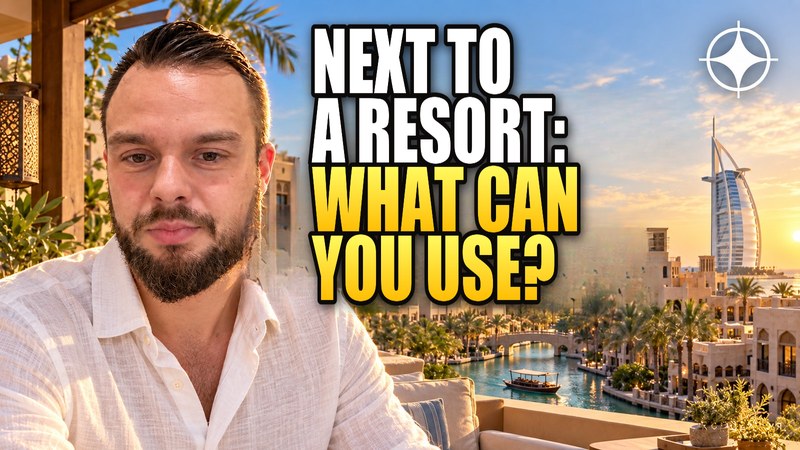
Madinat Jumeirah Living: next to a resort, but not inside it
A residential quarter opposite a major resort complex. Proximity delivers a great deal — and it is worth separating what proximity gives from what your documents give.

UAE Economic Stability: Second in the World, Behind Only Switzerland
An international stability study ranks the UAE second worldwide, ahead of Canada, Germany and Japan. GDP per capita rivals Western Europe, and the country’s sovereign wealth funds hold trillions of dirhams in assets.