 −11% Illustrative photo
 GUARANTEED ROI 10.8% FOR 10 YEARS The Heart of Europe
Apartment
AED 1,195,000 AED 1,350,000
 INSIDERrealestate — Home
Rates are indicative. Contracts and DLD fees are always in dirhams.
The offshore archipelago shaped like a world map: mostly still sand, with a small number of developed islands.
5 units in stock. 4 with a confirmed status: 4 ready, 0 under construction. 84th most expensive of 91 districts by median price.
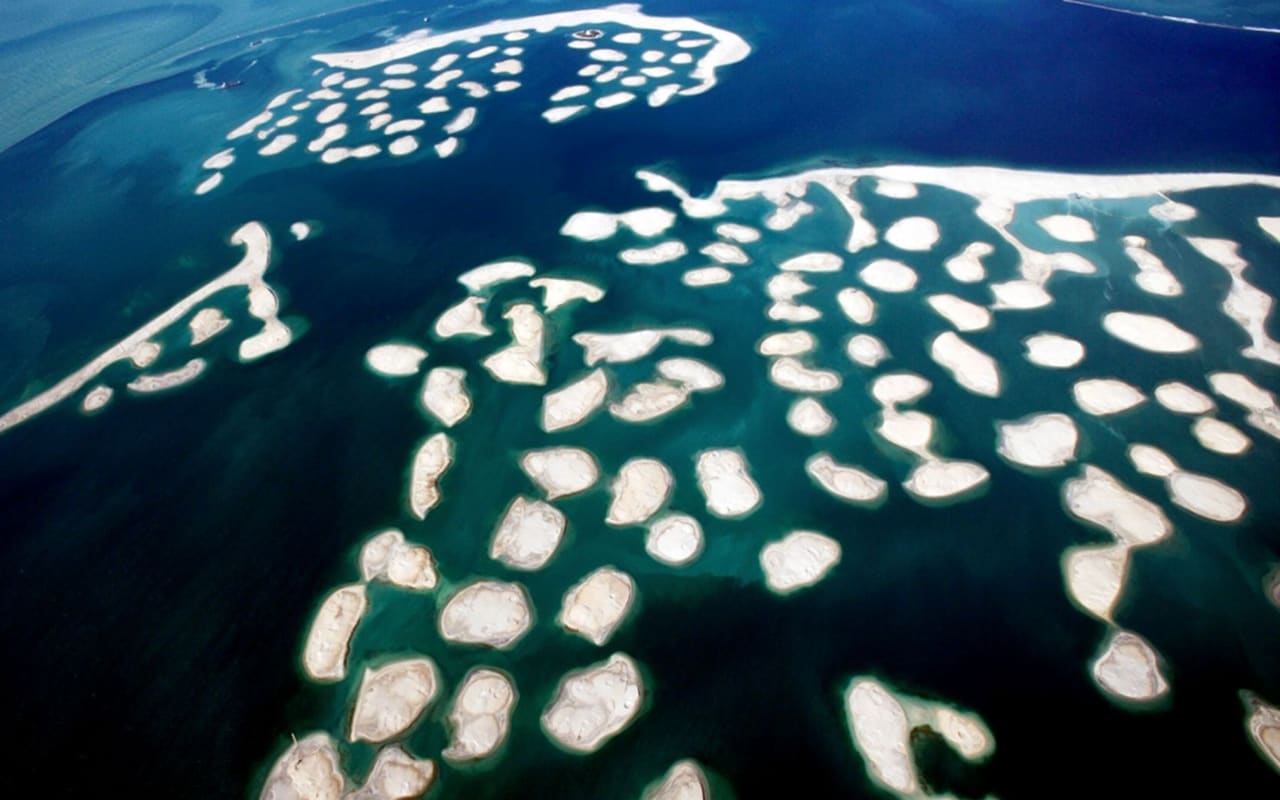
The World Islands is an offshore archipelago of around three hundred reclaimed islands arranged in the shape of a world map, four kilometres off the Jumeirah coast, built by Nakheel in the mid-2000s.
Land reclamation was completed but the financial crisis halted almost all development on the islands. For more than a decade the archipelago sat largely as empty sand.
Development has since resumed selectively, with a handful of islands developed as resorts and private estates — the Heart of Europe project being the most substantial.
The Heart of Europe is a multi-island resort development by Kleindienst comprising themed islands — Sweden, Switzerland, Germany, Main Europe and Saint Petersburg — with hotels, floating villas and beach residences.
Delivery has been protracted and phased over many years, with parts operating and parts still under construction.
It is the only large-scale development on the archipelago and effectively defines what buying on The World means today.
Access is by boat or seaplane. There is no bridge and none planned, which means every trip to and from the mainland is a scheduled marine transfer.
That single fact governs everything: it limits daily living, it limits the tenant and guest market to people willing to make the crossing, and it makes routine maintenance and servicing expensive.
Utilities, waste, water and power on an offshore island are all more complex and more costly than on the mainland, and the service charge reflects that.
This is the most speculative residential proposition in Dubai. The archipelago has a fifteen-year history of stalled development, the buyer pool is tiny, comparable transactions are almost non-existent, and resale is genuinely difficult.
Against that: it is unique, it cannot be replicated, and a completed and operating resort island is a genuinely remarkable asset.
Anyone considering this should treat it as a discretionary lifestyle purchase with a real possibility of illiquidity, not as an investment with a modelled return.
The developer’s delivery record on the specific phase, and what is actually operating today versus what is planned.
The escrow arrangement and the Dubai Land Department registration.
Marine transfer arrangements: frequency, cost, who operates them, and what happens in poor weather.
The service charge in full, including marine transport, utilities and infrastructure maintenance.
The resale history, such as it is, and how long units have taken to sell.
A buyer for whom this is a discretionary purchase, who wants something genuinely unique, and who is financially indifferent to whether it can be resold.
It suits poorly essentially everyone else, and it should never be a first Dubai property purchase or a material share of anyone’s portfolio.
The land reclamation for The World was completed in 2008, immediately before the financial crisis. Nakheel had sold islands to individual buyers and developers who intended to build on them, and when credit disappeared, almost all of those plans did too.
For more than a decade the islands sat as bare sand with no utilities, no transport and no construction. A handful of owners built; most did not, and some of the original sales unwound.
The practical legacy is that infrastructure on the archipelago is project-by-project rather than shared. There is no island-wide power, water or waste system in the way a mainland district has one — each development solves it independently.
Anyone evaluating a purchase here needs to understand which of those systems exist for their specific island and who maintains them, because the answer determines both the running cost and whether the property is habitable at all.
Kleindienst’s Heart of Europe is the only development on The World at any scale: a group of themed islands with hotels, floating villas and beach residences, delivered in phases over many years and still not complete.
Parts of it operate and receive guests. Parts remain under construction. The delivery timeline has extended repeatedly, which for buyers on payment plans has meant a long wait with capital committed.
The product itself is genuinely distinctive — there is nothing else like a floating villa with an underwater level anywhere in the region — and for the right buyer that uniqueness is the entire point.
For anyone assessing it as an investment, the relevant questions are the operator’s track record on the earlier phases, what occupancy the operating units actually achieve, and what the full annual cost of ownership including marine transfer comes to.
Every routine thing costs more on an island reachable only by boat. Maintenance crews arrive by scheduled transfer. Deliveries arrive by boat. Waste leaves by boat. Utilities are generated or piped at project scale rather than city scale.
Marine transfer itself is the largest recurring item and the one buyers underestimate: frequency, cost per crossing, who operates the service, and what happens when weather suspends it.
Insurance, salt-air corrosion and marine structural maintenance add further costs that a mainland property does not carry.
Model all of it as an annual figure before comparing anything. On a discretionary lifestyle purchase that may be perfectly acceptable; on an investment thesis it usually is not, and it is the reason this segment has never developed a functioning resale market.
This is the official index for the whole emirate, not for The World Islands: the Dubai Land Department does not publish a district breakdown publicly. Treat it as background — it tells you whether the market is rising or flat while you read the prices above. Transaction data for a specific building I pull separately, on request. Source: Dubai Land Department, read 15/08/2026.
The DLD index above comes out quarterly and does not separate segments. The monthly price index treats villas and apartments apart, which in 2026 is essential: a market-wide average conceals that the two have gone different ways.
Off-plan took 72.8% of the month's deals and ready homes 27.2%. Ready volume was up 11.4% on the month, and off-plan alone fell both month on month and year on year (−45.3%). So negotiation is realistic on apartments and off-plan, much less so on completed villas in established communities. Index base is January 2021 = 100 — a villa reading of 292.5 means growth of 192.5% from that mark, not a premium over a 2021 peak. Monthly ValuStrat market review for July 2026, checked 24/08/2026.
On the developed islands, yes, but access is by boat or seaplane only — there is no bridge and none planned. That governs daily life, servicing costs and the size of the tenant and guest market.
It is the most speculative residential proposition in Dubai: a fifteen-year history of stalled development, a tiny buyer pool, almost no comparable transactions and difficult resale. Treat it as a discretionary lifestyle purchase, not as an investment.
An archipelago of man-made islands, built out only in part. Buying here is not property in the ordinary sense, and it has to be assessed by different rules.
Almost every property decision rests on what similar things sold for. Here there is no "similar" — so the method has to change, and so does the price.
A standalone island has no city utilities, waste collection or emergency services in the usual sense. All of it is someone’s daily work and someone’s budget.
Name the The World Islands building or unit you are looking at, and I will pull its registered sales history, today's service charge and the rents comparable units actually achieve — before you offer, not after.
Ask on WhatsAppTelegram is the fastest way — I answer personally.
Message on Telegram