

Apparel Group: how letting actually works in Dubai
A retail group developing a tower in Dubai Maritime City. Whoever you buy from, the rules on tenancy registration, rent increases and notice are the same — and they favour a prepared landlord.
Not a developer in the usual sense but a huge retail conglomerate — hundreds of clothing and food outlets across the region — that only recently set up a separate development arm and built its first residential tower through it.
1 project by this developer in the catalogue. Nothing of theirs is in the discounted stock right now — nearby listings are below.
Checkable facts about the developer itself. Unlike the figures above, these are not about our stock and do not move with what happens to be listed today.
Apparel Group is, first and foremost, one of the region's largest retail operators: hundreds of clothing, footwear and food and beverage outlets under dozens of franchises and in-house brands across more than a dozen countries. Founded by Sima Ganwani Ved, the company sits within the much larger AppCorp Holding conglomerate chaired by Nilesh Ved, which beyond retail also runs healthcare and other business lines.
When the Apparel Group name appears on a residential building's signage, it is worth understanding: the retail company is not building directly — Kora Properties is, a separate development arm of the same AppCorp Holding parent structure. A buyer is dealing with a huge, financially resilient conglomerate, but with a developer inside it that still has minimal experience specifically in building housing.
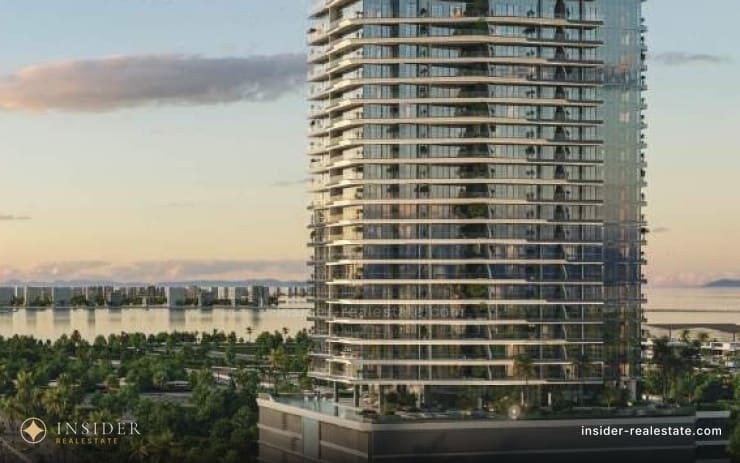
The Il Vento tower in Dubai Maritime City became this development arm's first major residential project — a high-rise on the water aiming at the premium segment. For a conglomerate with multi-billion-dollar retail turnover, this is a relatively small project by capital, but from a development-competence standpoint it is a genuine debut, requiring processes that simply did not exist within the group before.
The Maritime City location makes sense for a new development line: it is a developing coastal district near port infrastructure, not yet fully built out, growing alongside the city's waterfront — giving a developer with no housing experience a way to compete on entry price and water views rather than on reputation in a specific property segment.
The main practical upside of this origin is capital resilience. A conglomerate with retail-chain turnover is unlikely to run out of money to finish a single residential project over construction problems, unlike a small development company for which one project is the entire business. That reduces specifically the financial risk of unfinished construction that is common among small developers with no spare capital.
That said, financial resilience does not automatically translate into the same quality of construction, contractor and timeline management the conglomerate demonstrates in its core retail business. Running a store network and building a residential tower call for different competencies, and one does not guarantee the other.
The development arm has no track record yet of handing over and running housing to lean on — the entire record is limited to one project under construction. That is fundamentally different from a developer that simply has few projects: here it is literally the company's first outing in this line of business.
In that situation it makes sense to judge risk not through company history but through the specific project's transparency: whether it keeps to schedule, how regular its reporting is, the escrow account's status. Those indicators work regardless of a developer's age and matter especially where history itself is not yet available.
Kora Properties' legal structure relative to AppCorp Holding — exactly who is party to the contract and liable in a dispute, not just whose name appears in the marketing. Actual construction progress on the tower against the stated schedule — on a company's debut project, deviation from plan is worth tracking more closely than on a project from a developer with history.
The project's registration with the Dubai Land Department and its escrow account status — regardless of the parent conglomerate's financial strength, this check is mandatory for any off-plan property. How the Maritime City district is developing around the specific building — what is actually being built and opening next door today.
For a client considering this project, I immediately explain the difference between Apparel Group as a retail brand and Kora Properties as the development arm — it changes exactly which reputation the client is relying on when buying here. I count the conglomerate's financial resilience as a genuine plus against the risk of unfinished construction, but separately warn that a development track record as such does not yet exist for the company.
During construction I watch pace more closely than usual, precisely because this is the group's first residential project, and it has not yet built up proven contractor-management processes in development. For a client whose decisive factor was Apparel Group's name recognition, I explain honestly that this recognition has no direct bearing on the developer as such.
Lots are matched to Apparel Group by project name, since the base has no developer field. The numbers above therefore describe our stock rather than the company’s market share: a developer with a large completed portfolio can show fewer lots than one whose buildings are resold more often.
All prices are asking prices, not sales. For the building you pick I pull the registered Land Department transactions and show the prices deals really closed at.
A retail group developing a tower in Dubai Maritime City. Whoever you buy from, the rules on tenancy registration, rent increases and notice are the same — and they favour a prepared landlord.
The site catalogue covers 1 project by Apparel Group, each with a building passport — storeys, units, handover date and bedroom mix. They are listed above. Any lots on sale appear directly beneath their project.
The price is the same: on off-plan the developer pays the broker’s commission, not the buyer, so going straight to the sales office saves nothing. The difference is elsewhere — a developer’s sales office shows its own projects only, and will not tell you that the same thing next door is cheaper or that this project is running later than advertised. On resale and assignment the commission is the standard 2% plus VAT.
That depends on what you buy and why. Describe the budget and the aim — I will point out which of this developer’s buildings are justified today and which are better left alone.
Ask on WhatsAppTelegram is the fastest way — I answer personally.
Message on Telegram