

Metac Properties: what “beachfront” means on a reclaimed island
A developer with two projects on the Dubai Islands. Beach access is sold as a feature and defined as a legal arrangement — and the two are not always the same thing.
A small developer of two towers on Dubai Islands selling 'beachfront' — a word that, on a reclaimed island, can mean any of four different legal access schemes, and which one applies decides most of the purchase's value.
2 projects by this developer in the catalogue. Nothing of theirs is in the discounted stock right now — nearby listings are below.
Checkable facts about the developer itself. Unlike the figures above, these are not about our stock and do not move with what happens to be listed today.
Metac Properties is a small company with two projects on Dubai Islands, both built around the same selling point — proximity to the water. On a reclaimed island where almost every project uses the word 'beach' in its description, the specific legal content behind that word matters more than any render, and that is the first thing to understand about the developer: not portfolio scale, but exactly what it is selling under the banner of coastline.
With a small portfolio, both projects are best treated as a single data point about the company rather than independent stories — a shared location and a shared selling point mean the risks and questions for both buildings largely overlap.
The beach can be part of the building's common property — the strongest position for an owner, where the beach belongs to unit owners jointly and the association maintains it and controls access. There can instead be only a right of way over the master developer's land — usable, but not owned, with rules and any fee set by the island's master developer rather than the building's association.
A third option is a public beach the building simply faces — pleasant and open to everyone, along with the crowds and parking pressure that come with it in high season. A fourth is access through a hotel or club, on terms that can change and are sometimes chargeable. All four get marketed as 'beachfront', but legally they are entirely different rights.
A district charge on top of the ordinary building fee — for roads, landscaping, shoreline maintenance and the island's shared facilities. Higher running costs generally: salt air is harsh on facades, mechanical equipment and anything exposed outside the building, and all of it wears faster than in a building further from the sea.
A single access point to the island, or a limited number of causeways and bridges, means one potential bottleneck and a longer commute out at peak hours. Phased infrastructure: shops, schools and clinics on a filling-in island arrive alongside residents, not ahead of them with the master plan.
On a reclaimed island, shoreline upkeep — replenishing sand, managing erosion, breakwaters — is a genuine long-term cost, and whose balance sheet it sits on decides whether it reaches your service charge or stays the master developer's problem. This is worth asking separately from the beach-access question itself: the right to use and the duty to maintain are different contractual positions and do not necessarily coincide.
In a district still filling in, resale liquidity is thin: the buyer pool is still small, and time on market should be budgeted with a margin, not assumed to match the speed of an established district like Dubai Marina.
The beach-access scheme in the documents, with an explicit statement of who is responsible for maintaining it. Both charges — the building's and the district's — and exactly what each covers. What is open on the island today versus only planned — count working shops, not master-plan renders, and check what is being built directly around the specific building.
The escrow account, Oqood registration, the main contractor and the off-plan delay clause. Rental rates in already-delivered phases of the island and realistic resale time-on-market, plus short-let rules if the investment model relies on short-stay guests.
For both projects, I start with documented confirmation of the beach-access scheme — the first question that decides whether the stated 'beachfront' premium is justified in this specific case. Next I combine both charges, the building's and the district's, into a single annual maintenance figure and compare it against a comparable project further from the water.
I separately check what is genuinely open on the island today — I ask the client to drive the area in person rather than rely on the master plan's map, because the gap between what is promised and what is working is what decides what living here is actually like in the first years after moving in. For a client whose main reason for looking at the project was the idea of 'beachfront' itself, I separately show what maintaining that status actually costs on the association's bills — often that figure, not the unit's finish, is what the final decision comes down to.
Lots are matched to Metac Properties by project name, since the base has no developer field. The numbers above therefore describe our stock rather than the company’s market share: a developer with a large completed portfolio can show fewer lots than one whose buildings are resold more often.
All prices are asking prices, not sales. For the building you pick I pull the registered Land Department transactions and show the prices deals really closed at.
A developer with two projects on the Dubai Islands. Beach access is sold as a feature and defined as a legal arrangement — and the two are not always the same thing.
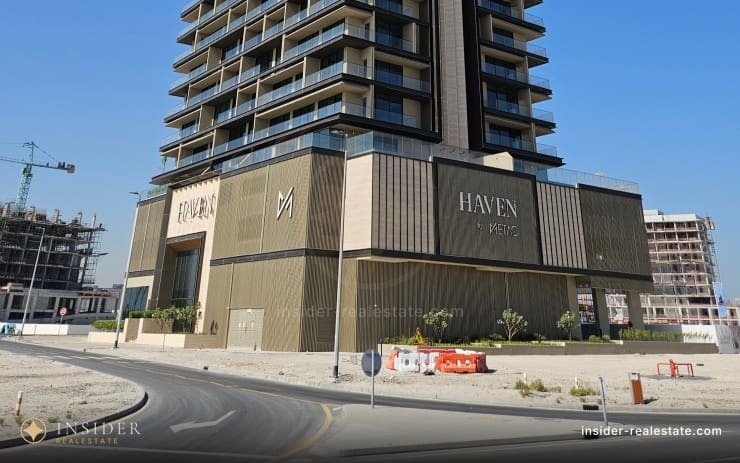
Delivered: Haven Living and Haven Bay on Dubai Islands. The register of the Land Department is the source that matters, not the brochure: it lists the licence, each project’s progress in per cent and the escrow account. On off-plan the buyer’s money sits in that account under RERA control and is paid out as construction stages are verified. The complete dossier is in the write-up above.
Above on this page: 2 projects by Metac Properties from our catalogue, each with a passport covering floors, units, handover and bedrooms. Lots on sale, when there are any, sit right under the project.
For an off-plan buyer the price is identical, because the developer covers the broker’s commission. Going straight to Metac Properties is therefore no cheaper, and the choice there is limited to its own projects — you will not get a comparison with neighbouring buildings or a candid read on handover dates. On resale and assignment the commission is standard: 2% plus VAT.
That depends on what you buy and why. Describe the budget and the aim — I will point out which of this developer’s buildings are justified today and which are better left alone.
Ask on WhatsAppTelegram is the fastest way — I answer personally.
Message on Telegram