
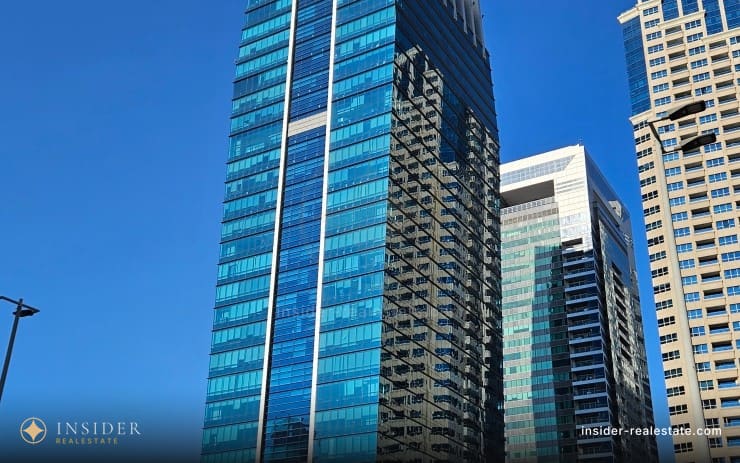
Reef Real Estate
A private developer with a twenty-year history that started with an office high-rise in JLT at the height of the construction boom, and has kept a modest but steady pace ever since — a handful of landmark towers rather than dozens of projects.
1 lot in stock across 1 project. By median price — 3rd of 140.
- Office space in the established JLT business cluster
- Housing in residential districts from a private developer with a stable history
- Buyers who value a private company without a sprawling international structure
- Not for buyers seeking a large portfolio of many simultaneous projects
Median price $12M AED 45 000 000
Entry price $12M AED 45 000 000 — the cheapest lot
Per square foot $1 021 AED 3 750 / sq.ft, median
Where they build
The districts where this developer has the most lots in our stock.
JLT 1
The company in brief
Checkable facts about the developer itself. Unlike the figures above, these are not about our stock and do not move with what happens to be listed today.
- Founded
- 2004, a private company
- Reef Tower, JLT
- launched in 2006, delivered 2008–2009 — 34 storeys, an office high-rise
- Portfolio
- three high-grade towers fully delivered to date
What kind of developer this is
Who this is, and what the growth style is
Reef Real Estate Investment is a private company founded literally on the eve of Dubai's construction boom peak. Its first project — an office high-rise in Jumeirah Lake Towers — launched at the market's peak and delivered during the global financial crisis, meaning the company went through that crisis while building its debut property and still carried it through to handover.
Over two decades of operating, the company has delivered only a handful of high-grade towers — a fundamentally different growth pace from mass-market developers, who complete dozens of projects in the same span. That points to a deliberately conservative model: not chasing volume, but concentrating on quality and financial resilience for each individual project.
The debut project — survived a crisis and was still delivered
The JLT office tower is notable not only as the company's first project but for the circumstances under which it was completed. It launched at the market's peak, and was delivered during the sharpest moment of the global financial crisis that derailed many Dubai off-plan projects of that period. A company with no prior track record, hit by a crisis right on its debut property, still carried it through to handover — a rare display of resilience for what was then a new structure.
For a buyer, this is a historical fact worth knowing: the company already lived through one of the harshest crises in Dubai's property market history at the earliest stage of its existence and did not default on the project. That is not a guarantee for the future, but a meaningful precedent of resilience.
The format — high-grade one-off properties, not a mass conveyor belt
The company's portfolio is limited to a handful of towers, but each is positioned as high-grade — meaning the company follows a one-off-building logic rather than a mass-segment conveyor belt. With few projects, a developer can give more attention to each individual building's details than a large developer splitting resources across many simultaneous sites.
The flip side of this format is less choice within one brand: if a specific location or format of one of the company's towers does not suit you, there are not many alternatives within its own portfolio, unlike developers with dozens of simultaneous projects across different districts.
What private status without an international structure means
Unlike some developers with a branched international or holding structure, this is a private company with a relatively simple ownership structure. For a buyer that means a clearer chain of accountability — fewer questions about which specific entity within a branched group is party to the contract — but also less capital diversification for the developer to lean on if problems arise with a specific project.
These points are worth weighing together: a simple structure eases due diligence, but it means the company's resilience is tied primarily to the success of its own small number of projects, rather than the backing of a large diversified conglomerate.
What to check before buying
The real condition of the company's already-delivered towers years after handover — facade, lifts, management company performance, especially at the oldest, debut JLT tower, which has already been tested by time and crisis. The registered resale transaction history for the building you are interested in, to gauge that specific asset's liquidity.
If considering a new or under-construction project — the escrow account status and registration in the current developer register, along with actual construction progress against the stated schedule. Confirm whether it is a residential or office format — the company's portfolio includes both, and the evaluation logic differs between them.
How I work with its properties
With this developer I always tell the client the story of the debut project — surviving that crisis at the earliest stage of the company's existence genuinely demonstrates financial resilience better than any later claims. That is especially useful for clients wary specifically of unfinished-construction risk with relatively small private developers.
For specific properties I look at their format — office or residential — and compare price against direct competitors in the same cluster, because the company's small portfolio does not offer much choice within one brand, and it is often more sensible to compare a specific property with neighbouring buildings of the same use, rather than the company's own projects against each other.
Projects by Reef Real Estate
All projects →Reef Real Estate listings in stock
All stock → What these numbers mean, and what they do not
Lots are matched to Reef Real Estate by project name, since the base has no developer field. The numbers above therefore describe our stock rather than the company’s market share: a developer with a large completed portfolio can show fewer lots than one whose buildings are resold more often.
All prices are asking prices, not sales. For the building you pick I pull the registered Land Department transactions and show the prices deals really closed at.
Other developers
All developers → Questions
Reef Real Estate: questions and answers
How much does a Reef Real Estate apartment cost?
The median across this developer's lots in our stock is $12M (AED 45 000 000), with entry from $12M. The median per square foot is $1 021. They are drawn from asking prices in our own base and refreshed every night — a picture of current supply rather than of the official price list.
Is Reef Real Estate a reliable developer?
Founded: 2004, a private company. Delivered: three high-grade towers fully delivered to date. A developer is checked against the Land Department’s open register rather than a brochure: it shows the licence status, the construction progress of each project and the registered escrow account. On off-plan the buyer’s money goes into that account under RERA supervision and is released against verified milestones. The full dossier is in the write-up above.
What projects is Reef Real Estate building?
Above on this page: 1 project by Reef Real Estate from our catalogue, each with a passport covering floors, units, handover and bedrooms. The districts holding most of its lots are grouped under “Where they build”. Lots on sale, when there are any, sit right under the project.
Should I buy from Reef Real Estate direct or through a broker?
Money-wise there is no difference: on off-plan the broker is paid by Reef Real Estate, not by you, so calling the sales office direct saves nothing. What differs is the view — the developer’s sales team sells only its own buildings and will not mention that the same unit costs less next door or that this project hands over later. On resale and assignment the commission is the usual 2% plus VAT.
Is Reef Real Estate worth buying
The answer depends on the purpose. Send your budget and goal — I will go through which Reef Real Estate projects are worth considering now and which I would skip.
Ask on WhatsAppAsk a question
Telegram is the fastest way — I answer personally.
Message on Telegram