
Dubai leads the world on rent growth — reading the UBS index properly
UBS Global Real Estate Bubble Index put Dubai first worldwide for real rent growth, with a 17% annual change in real house prices. Madrid and Zurich trail by half; New York, Paris and Singapore went negative. What the number means — and the three ways it is routinely misread.
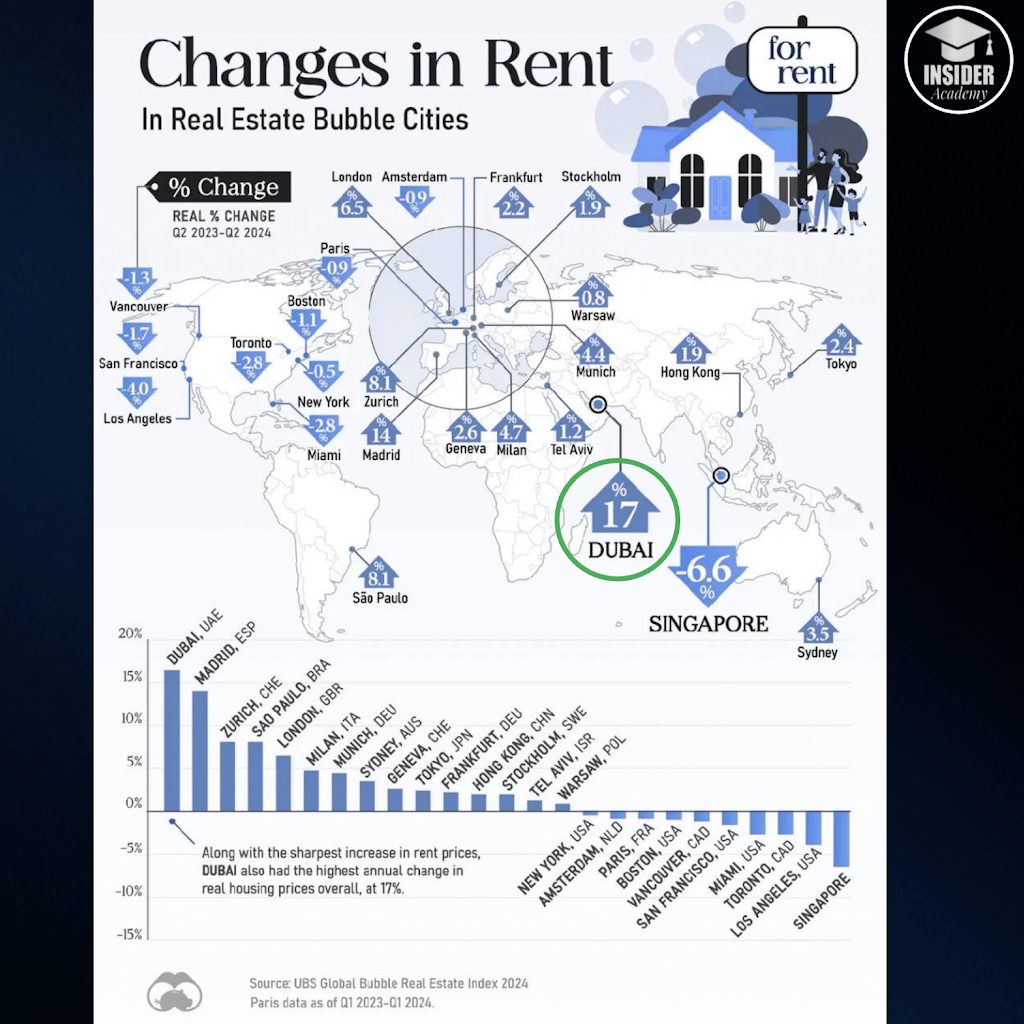
UBS publishes the Global Real Estate Bubble Index every year, comparing major housing markets by overheating risk. In the 2024 edition, Dubai came first in the world for real rent growth over the year to Q2 2024 — and posted the highest annual change in real house prices at 17%.
The rest of the table
| City | Real change in rents |
|---|---|
| Dubai | top of the index |
| Madrid | +14% |
| Zurich | +8.1% |
| São Paulo | +8.1% |
| London | +6.5% |
| Milan | +4.7% |
| Munich | +4.4% |
| Sydney | +3.5% |
| Tokyo | +2.4% |
| Hong Kong | +1.9% |
| New York | −0.5% |
| Paris | −0.9% |
| Amsterdam | −0.9% |
| Toronto | −2.8% |
| Miami | −2.8% |
| Los Angeles | −4.0% |
| Singapore | −6.6% |
The operative word is real — inflation-adjusted. A double-digit real increase means rent outran general price growth in the economy by that margin. In the cities showing negative numbers, rents simply failed to keep up with inflation; landlords there did not necessarily cut anyone’s rent.
Why Dubai separated from the field
- Population arrived faster than towers completed. Net inward migration outpacing delivery is the only thing that reliably moves rents anywhere.
- Zero personal income tax and a residence visa attached to property. Demand is set by relocating capital, not only by local salaries.
- Short-let absorbed part of the long-term stock. Every unit moved to holiday rental is one fewer on the annual market.
- A low base. The market was recovering from the 2016–2020 correction, so part of the move is recovery rather than new ground.
Three ways this number gets misread
- It is a bubble-risk index, not a buy signal. Within the UBS framework, fast rent growth is evidence of strain as much as strength.
- It is history, not a forecast. The figure describes the year to mid-2024. Rental markets normalise as supply lands, and Dubai has a very large delivery pipeline.
- Rising rent does not mean rising yield. If prices rose faster than rents, the percentage yield fell while the headline looked spectacular. Yield is computed per unit, never from an index.
One local mechanic international readers usually miss: Dubai Land Department maintains a rental index, and a landlord cannot raise an existing tenant’s rent to market at will — increases are capped on a sliding scale tied to how far below market the current rent sits. Most of the growth in the statistics comes from new contracts, not from repricing sitting tenants.
Talk to a licensed broker: 📲 +971 50 120 32 64 on WhatsApp, @dubai_oleg on Telegram
What to do with it
An income property pays you twice — cash flow and capital growth — and the two rarely move together. When rents outrun prices, yields improve. When prices outrun rents, you earn on capital and lose on percentage. Which of the two you are buying should be a decision, not an accident.
How the arithmetic works per unit, including service charge and void periods, is set out in our market notes; district medians and entry prices are in areas, and live stock is in the catalogue.
Source: UBS Global Real Estate Bubble Index 2024, real change in rents Q2 2023 — Q2 2024.
Video on this topic
The same subject on the English channel — each clip has a written version of its own.
 19:59
19:59 Imperial Avenue: a profitable resale in Downtown Dubai
Imperial Avenue by Shapoorji Pallonji in Downtown Dubai — a full breakdown of why this project has produced good resale outcomes and how to evaluate a resale opportunity in a completed Downtown tower.
WatchIn the news
Other write-ups on the site about the same thing.
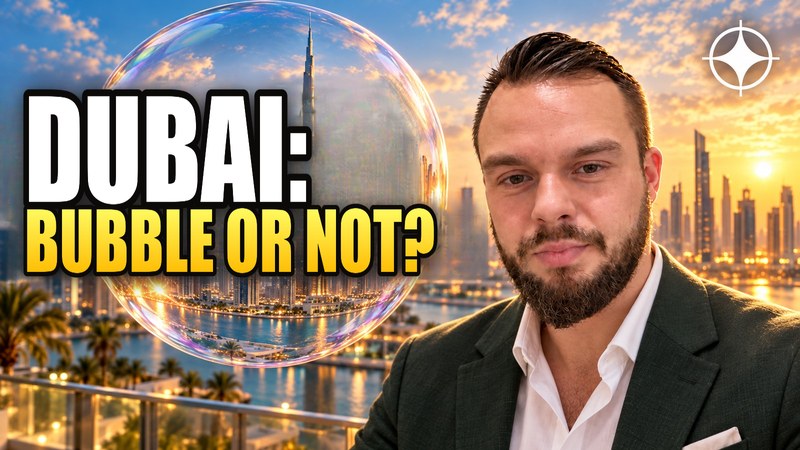
Is Dubai property a bubble? What the UBS index says about Dubai, Frankfurt, Hong Kong and Singapore
The Swiss housing-bubble index places Dubai in fair-value territory: inflation-adjusted prices were still about a quarter below the 2014 peak, and rents grew faster than prices. How that compares with cities the index rates as overvalued.

Payback period: why Dubai’s low ranking is good news
International tables measure how many years of rent it takes to repay a home’s price. Dubai is regularly at the bottom — and that is the right place to be.
A JBR penthouse went from AED 11.7m to 22m: what actually sits behind stories like that
One documented case broken down by numbers — 88% growth, AED 5 813 a foot, AED 666 700 of annual rent — and the mistake people make when they use a story like this as a forecast.
UAE Economic Stability: Second in the World, Behind Only Switzerland
An international stability study ranks the UAE second worldwide, ahead of Canada, Germany and Japan. GDP per capita rivals Western Europe, and the country’s sovereign wealth funds hold trillions of dirhams in assets.
Four deals with the full numbers: what Dubai property actually returned
Talk about Dubai yields is usually percentages without a denominator. Four transactions with every figure named, including costs — and one caveat that governs all of them.

Twenty-fold in fifteen years: three record Dubai deals and what is behind them
Three transactions Dubai quotes as benchmarks. Looking at them together is more useful than at any of their percentages — and what they have in common is not repeatable.