
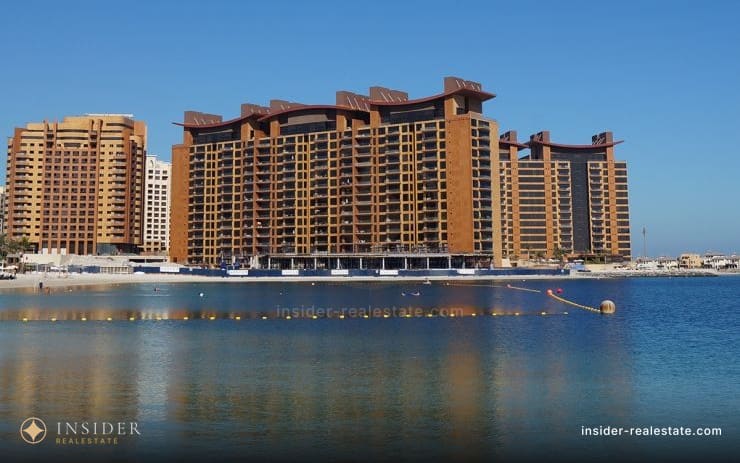

Parshwa Holdings Ltd and Zabeel Investments: buying from a joint venture
A Palm Jumeirah building delivered by two companies together. Joint ventures are common in Dubai development and they change one thing that matters: who exactly owes you what.
A joint venture between two companies that delivered a six-tower complex on Palm Jumeirah's trunk in 2009, each tower named after a gemstone — and by now the question is not about construction but about how to read a joint-venture contract on the resale market.
1 project by this developer in the catalogue. Nothing of theirs is in the discounted stock right now — nearby listings are below.
Checkable facts about the developer itself. Unlike the figures above, these are not about our stock and do not move with what happens to be listed today.
Tiara Residences on Palm Jumeirah was delivered by two companies together — Parshwa Holdings and Zabeel Investments, for whom this was a first development project. Joint ventures are standard practice in Dubai development: one side typically brings land or capital, the other experience or connections, and in a complex built this way there is not just a sale contract but an arrangement between the partners themselves that a buyer usually never sees.
That raises a question that does not arise when buying from a single developer: who exactly is your counterparty. A joint venture most often operates through a separate project company, and the contract sits with that entity rather than either parent directly — the name on the banner and the party to the contract do not always match.
Whether either founder of the joint venture personally guarantees anything — usually neither does, and where a guarantee exists it is only worth what is in writing. A dispute between partners can halt a project even when both sides are solvent — a distinct scenario from a simple funding shortfall, and hard to predict from outside signals.
After handover the project company is often wound up — a normal practice, but one that can leave no one to answer a defect claim if liability was not anchored somewhere that survives the wind-up. None of this argues against buying from a joint venture; it argues for reading the pages of the contract most buyers skip.
The complex was delivered more than fifteen years ago, so construction risk and every joint-venture question from the building stage are now history. What remains is a mature building on the Palm, and the checks shift from construction risk to operating risk: a technical survey now matters more than the partnership agreement ever did.
Beachfront structures work hard, and at this age the facade, waterproofing, chillers and lifts are either due for scheduled renewal or have already had it. A gemstone name on the tower offers no protection from the ordinary problems of an ageing seafront building — salt air is equally harsh on a luxury address and a mass-market one.
The reserve fund balance and the annual contribution rate — the figure that decides whether owners are facing a special assessment for major works. Several years of owners' association minutes will show what work was planned, what quotes were requested, and whether there was dispute over them — a building that deferred decisions for years is in a different position from one that funded renewal on schedule.
A five-year history of the service charge and both fees — the specific tower's charge and the Palm's district levy — are worth reviewing together, since maintaining the shoreline and the crescent's shared infrastructure is funded separately from the building's own charge.
On the Palm, beach access rights differ from building to building — in some, the beach is common property controlled by the association itself; in others, it is a right of way over the master developer's land on its own terms. This is worth establishing from documents, not from the view at a viewing: the difference is contractual and directly affects what you are actually acquiring along with the unit.
Short-let rules on the Palm also differ from building to building, and for an investor counting on short-stay income, this is worth checking separately rather than assumed to be the same for any address on the crescent.
I start with the owners' association's minutes from recent years and the reserve fund balance — for a building this age, that tells you more than the developer's own history does. Next I pull comparable transactions in the same building, matched by floor and orientation, from the Land Department's open register, to see the actual price spread across the complex's six towers.
I separately confirm the beach-access arrangement in the specific unit's documents and the current short-let rules — for a client considering Tiara Residences for short-term letting, that settles the yield question before the finish quality does. For owners who already hold a unit in the complex and are planning to sell, I separately show how the gap between the six towers looks in actual closed transaction prices, rather than the generic label 'a building on the Palm' — a resale buyer negotiates at exactly that level of detail.
The developer is inferred from the project name — there is no developer column in the base. So the figures describe our stock, not the company's share of the Dubai market: a developer sitting on an enormous volume of completed housing can look smaller here than one whose projects reach the resale market more often.
These are asking prices, not closed transactions. For a specific building I pull the registered Land Department sales and show where deals actually closed.
A Palm Jumeirah building delivered by two companies together. Joint ventures are common in Dubai development and they change one thing that matters: who exactly owes you what.
Delivered: 2009 — Zabeel Investments' first project. Check Parshwa Holdings Ltd and Zabeel Investments in the Land Department’s open register, not in the marketing: licence status, per-project construction progress and the registered escrow account are all there. Off-plan payments land in that escrow under RERA supervision and reach the developer only against verified construction milestones. The full dossier is further up the page.
Our catalogue holds 1 project by this developer, each with a building passport: storeys, unit count, handover date, the mix of bedrooms. The list is on this page. Under each project sit the lots on sale, where there are any.
For an off-plan buyer the price is identical, because the developer covers the broker’s commission. Going straight to Parshwa Holdings Ltd and Zabeel Investments is therefore no cheaper, and the choice there is limited to its own projects — you will not get a comparison with neighbouring buildings or a candid read on handover dates. On resale and assignment the commission is standard: 2% plus VAT.
That depends on what you buy and why. Describe the budget and the aim — I will point out which of this developer’s buildings are justified today and which are better left alone.
Ask on WhatsAppTelegram is the fastest way — I answer personally.
Message on Telegram