
Class A offices in Dubai: 3% vacancy and AED 370 a square foot
Vacancy in the best stock sits near 3%, and between zero and two per cent in DIFC and Downtown. What that means in practice — a balanced market runs at 8–12% — and where rents went.
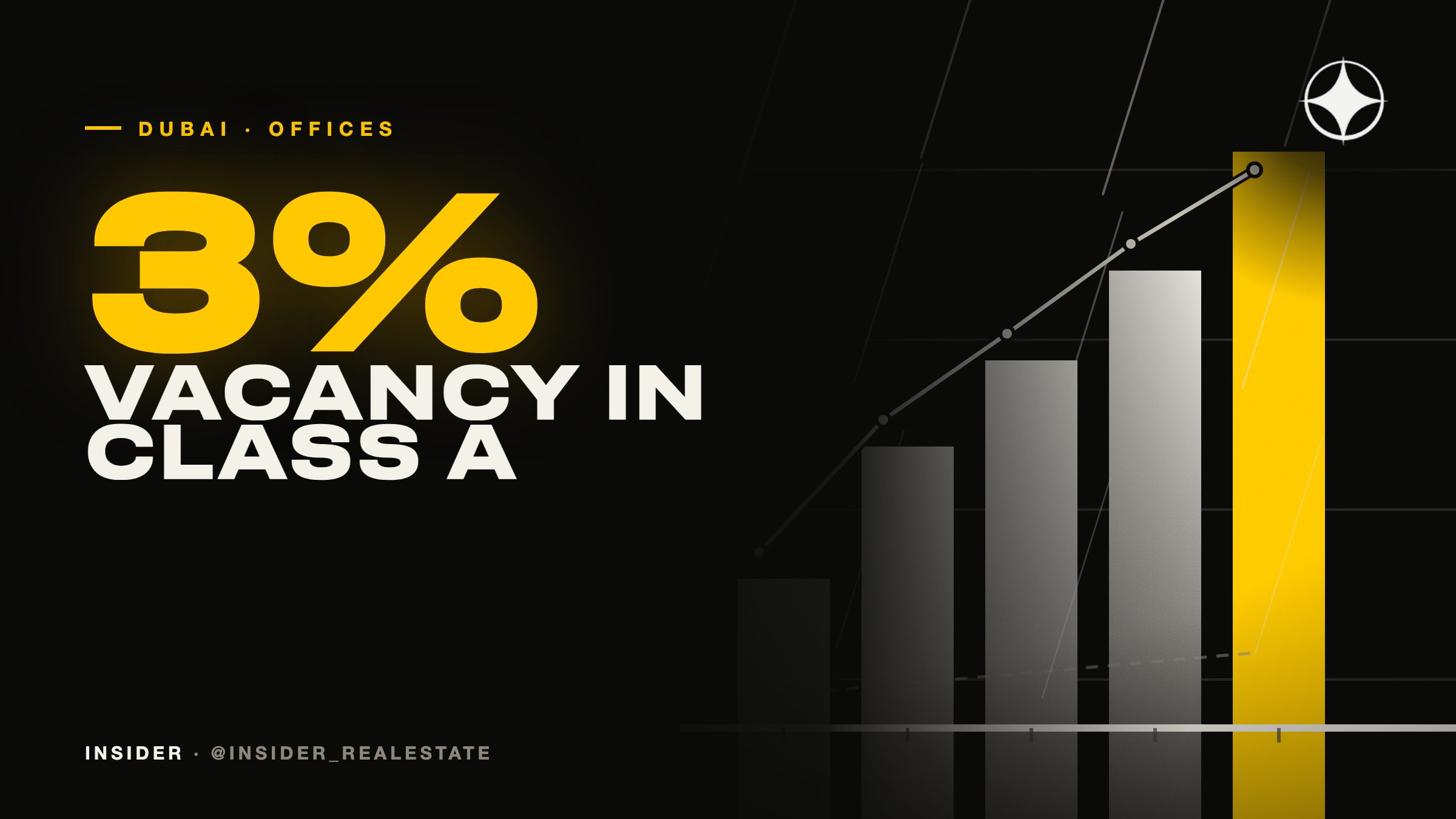
The Dubai office market has reached a state that reports describe dryly as "historically low vacancy" and that in practice means renting a decent office in the centre is a project measured in months.
The numbers
Through the first half of 2025 vacancy in class A stock held around 3%, and in the most sought-after addresses — DIFC and Downtown — it ranged between zero and two per cent. Average class A rent reached AED 370 per square foot a year, after a 28% rise over twelve months and a third consecutive year of double-digit growth.
What 3% actually is
An office market is considered balanced at 8–12% vacancy: that cushion is what allows a company to move when it needs to rather than when a floor happens to free up. Three per cent is a technical figure. It consists largely of space currently being fitted out or changing hands, and contains almost nothing available to transact.
Talk to a licensed broker: 📲 +971 50 120 32 64 on WhatsApp, @dubai_oleg on Telegram
Zero to two per cent in DIFC means precisely what it says: there are no vacant offices there, there is a queue.
Consequences for a tenant
Planning horizons stretch. Companies now negotiate space twelve to eighteen months before a building completes, because waiting for a floor to be released is not a strategy. Fit-out periods, break clauses and expansion rights become negotiating points in a way they are not in a soft market — and mostly the landlord wins them.
Consequences for an owner
Rental growth of this order does not persist indefinitely, and the pipeline arriving towards 2030 will loosen it. But the immediate position is unusual: a re-let in a good building is close to instantaneous, and the void assumption that dominates an office investment model is currently near zero.
The practical instruction is to model both states. What the asset yields at today's rent with a two-week void, and what it yields at a normalised rent with a two-month void. If the case only works in the first, it is a bet on the cycle.
Video on this topic
The same subject on the English channel — each clip has a written version of its own.
 17:28Commercial mortgage in Dubai: offices, retail and warehouses under construction20 September 2026
 7:59Investing in Dubai offices: why the numbers beat apartments20 October 2025
 21:45Furnished offices in Business Bay: Rove HQ and the fitted-office model16 October 2025
 10:32Lumena Alta by Omniyat: Dubai’s most luxurious office tower12 October 2025
 1:15Binghatti Circle in JVC: retail and offices at the entry level8 September 2025

In the news
Other write-ups on the site about the same thing.
Dubai office rents: Grade B up 31.5% as vacancy falls to 6.1%
Grade B office rents in Dubai jumped 31.5% in a year, with Grade A and prime adding 14–26%. Citywide vacancy has dropped to a record-low 6.1%. What the office squeeze means for commercial property investors — and for residential demand.
Dubai Office Vacancy Drops Below 5% in DIFC and on Sheikh Zayed Road
New supply is lagging demand: prime-location Grade A rents rose as much as 25% in six months, and the shortage of quality office space is expected to persist until 2027–2028 — a new project takes up to four years to build.
UAE office shortage: prime vacancy at 0.3% in Dubai and 0.1% in Abu Dhabi
JLL puts prime office vacancy at about 0.3% in Dubai and 0.1% in Abu Dhabi. In Q2 2026 Dubai Grade A rents rose 26.2% year on year and Grade B 31.5%; CBRE puts occupancy at 94% in Dubai and 96% in Abu Dhabi. What the squeeze means for office owners and buyers.
Office rents by Dubai district: from AED 250 in Internet City to 760 in DIFC
Location matters more in offices than in housing — the spread across the city is threefold. The annual rate per square foot in the main business clusters, and what tenants are actually paying for in DIFC.

DIFC Offices at 2% Vacancy: What a Square Foot Costs in Dubai’s Tightest District
In a district with roughly 2% vacancy, offices in a renovated tower were offered at AED 4 000–4 500 per sq ft with a projected yield of 8.75–11.5%. Here’s what makes up the price in Dubai’s tightest office location.
Offices in residential districts: Dubai Hills at zero vacancy and AED 350 a foot
The office shortage produced a solution that would have looked illogical a few years ago. One district proved it works; the next candidate is an assumption rather than a fact.