
Whisky +191.7%, furniture +140.9%, watches +125.1% — and why that is not the comparison
The Knight Frank Luxury Investment Index ten-year table has rare whisky up 191.7%, antique furniture 140.9%, watches 125.1% — and coloured diamonds up 3.8%. A useful table, routinely misused against property. Here is the honest comparison with a Dubai apartment.

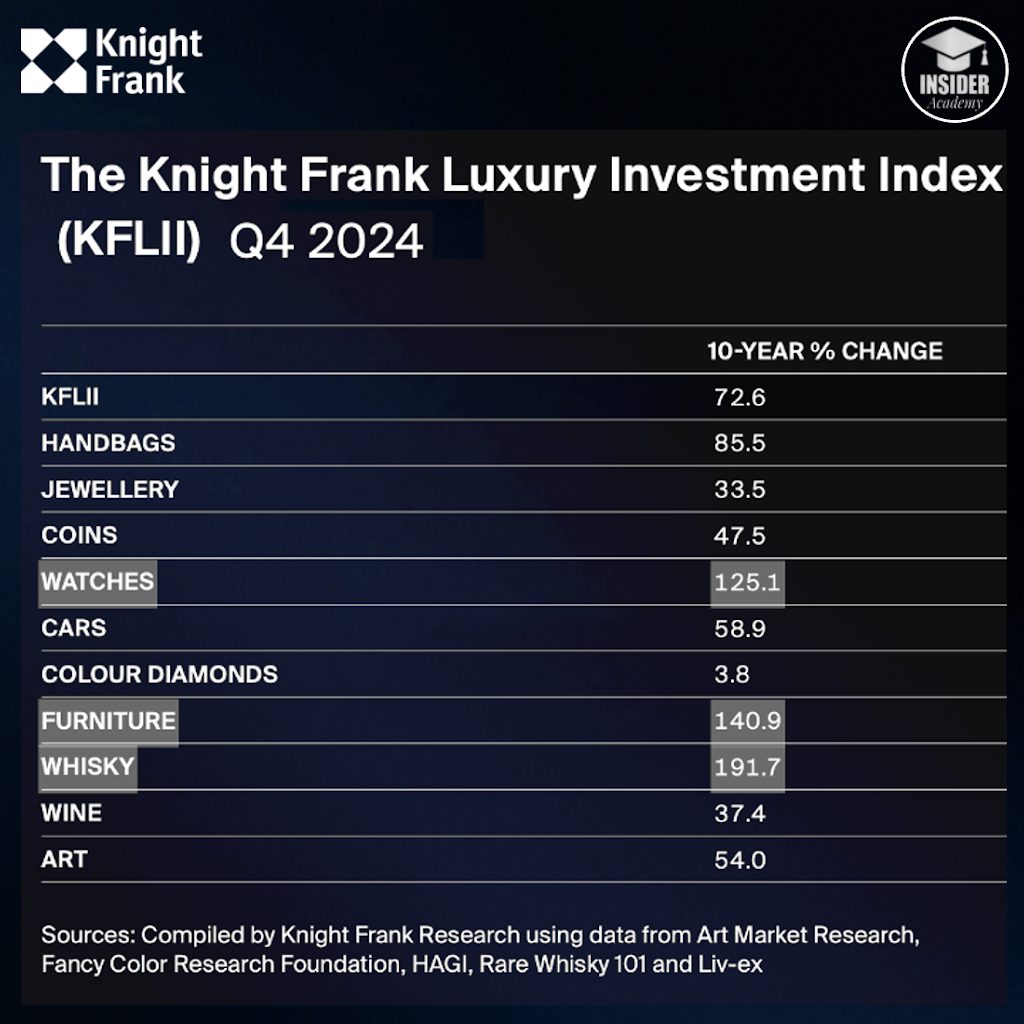
Knight Frank tracks KFLII, a basket of ten passion assets that wealthy owners buy for pleasure and, increasingly, for return. Here is the ten-year change as of Q4 2024:
| Asset | 10-year change |
|---|---|
| Rare whisky | +191.7% |
| Furniture | +140.9% |
| Watches | +125.1% |
| Handbags | +85.5% |
| KFLII overall | +72.6% |
| Cars | +58.9% |
| Art | +54.0% |
| Coins | +47.5% |
| Wine | +37.4% |
| Jewellery | +33.5% |
| Coloured diamonds | +3.8% |
Start with the spread
Inside one basket the range runs from +3.8% to +191.7% over a decade. This is not "luxury goes up" — it is "a few categories went up and others sat still for ten years". The index as a whole returned +72.6%, roughly 5.6% a year compounded.
Coloured diamonds at +3.8% over ten years are a useful reminder of what an asset that "always appreciates" looks like in a table rather than in a sales pitch.
Talk to a licensed broker: 📲 +971 50 120 32 64 on WhatsApp, @dubai_oleg on Telegram
Why the comparison with property is usually wrong
"Whisky beat real estate" is a headline, not an analysis. The assets differ structurally, not by a few percentage points:
- Cash flow. An apartment pays you monthly. A bottle pays nothing until it is sold; the entire return is a single price difference realised once.
- Cost of ownership. Property has service charge and maintenance. Collectibles have climate-controlled storage, insurance and authentication — and with whisky and wine, the additional risk of degrading the asset by storing it badly.
- Liquidity. A Dubai apartment sells on an open market with a public transaction record at the Land Department. A rare watch or a piece of furniture sells at auction: house commission, waiting for the right sale, no guarantee the right bidder shows up this season.
- Price transparency. Any Dubai building has registered comparables you can pull. A collectible is worth an estimate until the hammer falls.
- Scalability. A property portfolio scales. A collection does not — a second identical bottle does not double the result, because rarity is the value.
Where Dubai property sits on this picture
In our database as of 14 August 2026 the median price per square foot in Dubai is AED 2 433 — about AED 26 200 per square metre — with a median listing at $1.13m. Gross rental yields in the city generally land in the 5–8% range before costs, and that income arrives every year regardless of what the capital value did.
So the honest framing is not "191.7% versus X%". It is: a collectible may deliver more at exit, pays nothing along the way and costs money to hold; property pays continuously and lets you model the outcome in advance.
Which one fits which objective
- You need income — to live on, to service a mortgage, to support a residence visa: property, and nothing else on that list qualifies.
- You want to preserve and pass on capital with some enjoyment attached: collectibles work as a portfolio component, not as its base.
- You need a fast exit: neither. Liquid property sells in weeks; a collection sells in seasons.
We work on the first objective. Current below-market stock is in the catalogue, district-level pricing in areas, and if you want a specific unit modelled end to end, write to us.
Source: Knight Frank Luxury Investment Index (KFLII), Q4 2024, ten-year change.
Video on this topic
The same subject on the English channel — each clip has a written version of its own.


In the news
Other write-ups on the site about the same thing.
Dubai homes over $10 million: 500 sales in 2025 and a record 296 in the first half of 2026
Knight Frank counted 500 Dubai home sales above US$10m in 2025, worth US$9.05bn, against 30 in 2020. The first half of 2026 added 296 more worth US$5.1bn, a half-year record. Where the money went and why the top of the market held up.
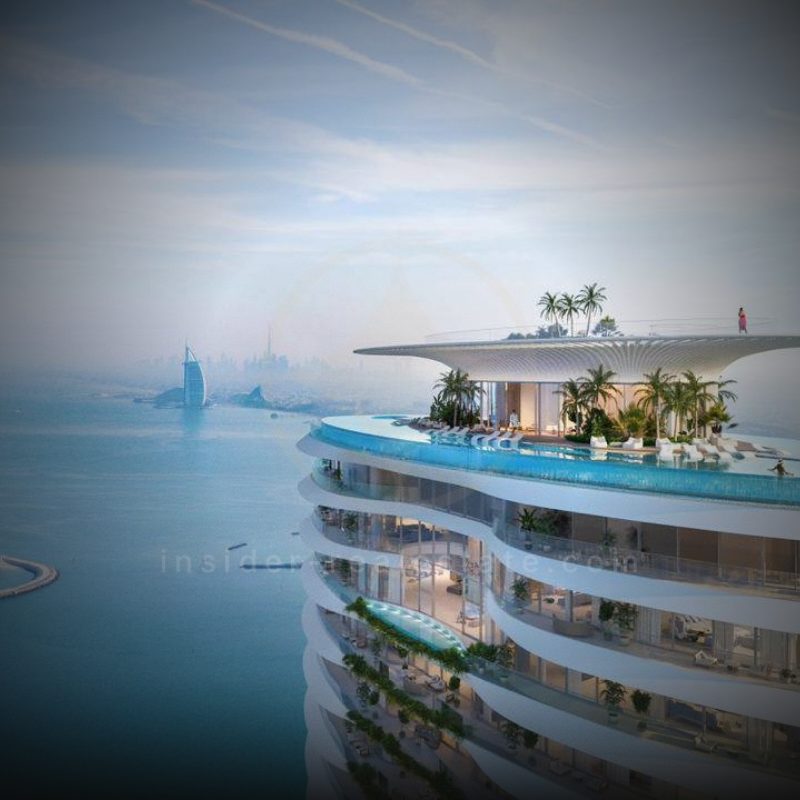
Dubai prime property 2022–2024: how the city became the world’s busiest $10m home market
Knight Frank counted 219 Dubai home sales above $10m in 2022, 434 in 2023 and a record 435 in 2024 (about $7bn). In the first half of 2023 Dubai overtook New York, Hong Kong and London. How a shortage of supply made Palm Jumeirah the core of the market — the background to 2025–2026.
Dubai property market H1 2025 review: a record quarter and AED 431bn of transactions
Dubai in the first half of 2025: 125 538 transactions worth about AED 431bn (+26% and +25%), per the DLD. Knight Frank counted a record 51 000+ home sales in Q2 and 94 000 worth AED 268bn over the half. Prices +13.7% a year, villas +16% and 49% above the 2014 peak.
Dubai property market 2023 review: AED 634bn of transactions and villas past the 2014 peak
Dubai in 2023, from official data: 166 400 real estate transactions worth AED 634bn (+36% by number, +20% by value) and 71 000 first-time investors. Knight Frank had villas 9% above the 2014 peak while apartments were still 10% below it. A reference review, with the status as of September 2026.

Payback period: why Dubai’s low ranking is good news
International tables measure how many years of rent it takes to repay a home’s price. Dubai is regularly at the bottom — and that is the right place to be.

Trophy property: why it has no ROI, and what to calculate instead
A unique asset cannot be modelled like a rental flat: no comparables, no predictable income stream, no predictable exit. What actually sets price at the top of the market, and which calculations are worth doing there.