
UAE Ports: The Industrial Heart of the Country
From historic gateways to global networks — the ports that keep the country moving. From Mina Zayed in 1972 to Jebel Ali and Khalifa Port, how the UAE's port infrastructure quietly powers its economy.
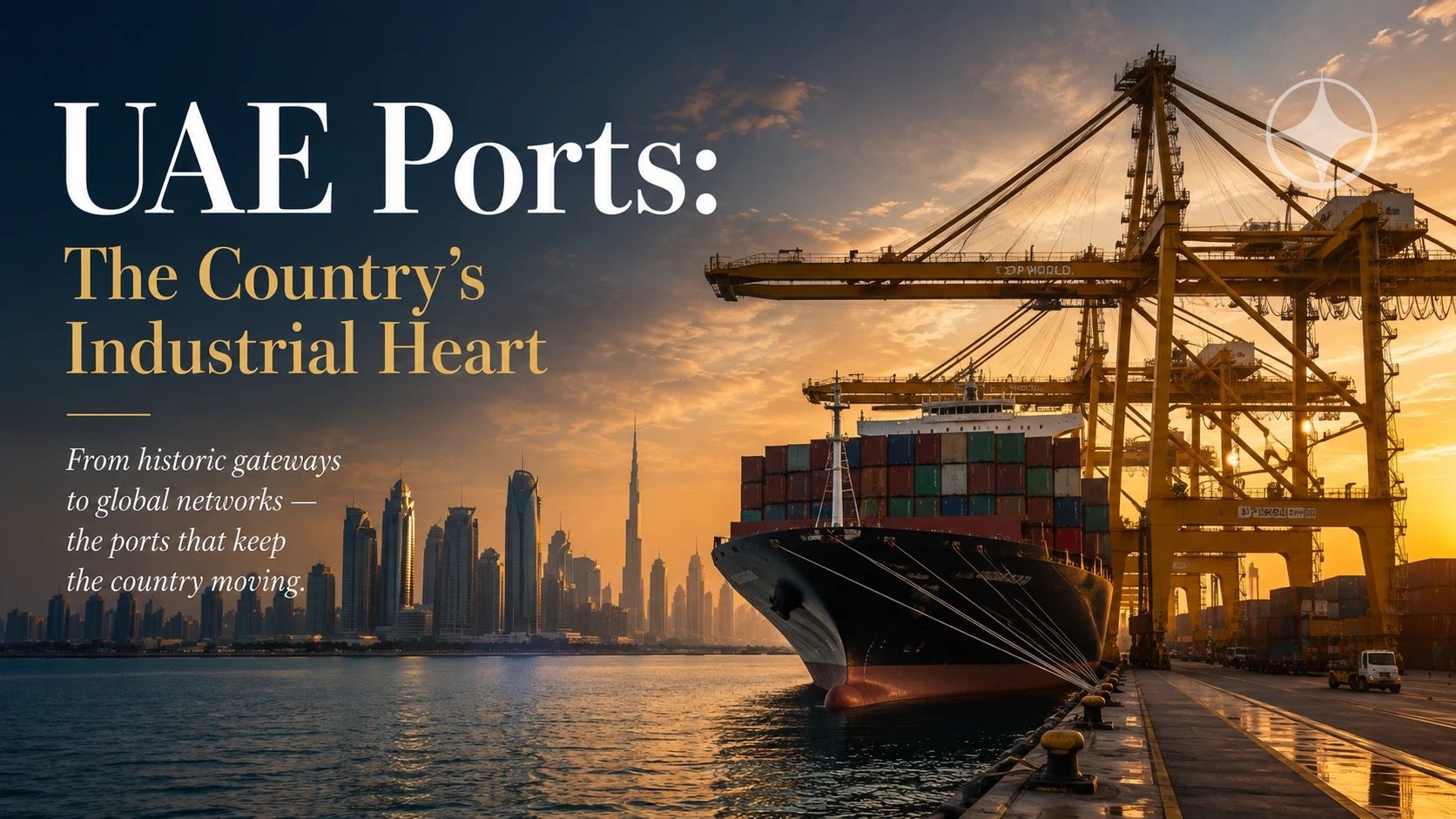
The UAE's ports are far more than places where ships load and unload cargo. They form a vast logistics network connecting factories, warehouses, free zones, energy infrastructure and international trade routes. Much of what reaches supermarket shelves, construction sites and industrial facilities across the Emirates has passed through this system.
1972: the foundations
The foundations were laid early in the country's history. In 1972, just a year after the formation of the UAE, Mina Zayed in Abu Dhabi and Mina Rashid in Dubai began operating. Both cities were expanding rapidly, and their new ports provided the materials and goods required to support that growth. At the same time, dedicated terminals were already exporting oil, establishing maritime trade as one of the pillars of the national economy.
Jebel Ali and JAFZA: the world's largest man-made harbour
Dubai took the next major step seven years later with the opening of Jebel Ali Port on what was then a largely undeveloped section of coastline. In 1985, the Jebel Ali Free Zone (JAFZA) was established nearby. This combination allowed manufacturers and logistics companies to import components, assemble or package products close to the port, and then redistribute them internationally.
Talk to a licensed broker: 📲 +971 50 120 32 64 on WhatsApp, @dubai_oleg on Telegram
Warehouses, factories and logistics facilities gradually expanded around the harbour, turning Jebel Ali into an enormous industrial ecosystem. The port eventually became the world's largest man-made harbour and the UAE's principal container hub, connected with more than 150 ports worldwide.
Containers arriving in Jebel Ali may continue into the UAE to shops, factories and construction sites, or remain at the port only briefly before being transferred onto another vessel. In this sense, Jebel Ali operates as a global transit hub in much the same way a major airport connects passengers between flights.
In 2025, Jebel Ali handled approximately 15.6 million TEU, equivalent to 15.6 million standard twenty-foot containers.
Khalifa Port and the AD Ports Group network
Abu Dhabi developed its own major logistics hub around the same principle: keeping ports, warehouses and industrial production close together. Khalifa Port, opened in 2012 between Abu Dhabi and Dubai, sits alongside the KEZAD economic zone and serves as a central component of AD Ports Group's UAE network.
In 2025, ports within that network handled approximately 6.6 million TEU, representing growth of around 21% year-on-year. Khalifa Port is also notable for hosting container terminals operated by MSC, COSCO and CMA CGM, three of the world's largest shipping and logistics groups.
Its infrastructure extends well beyond the waterfront. Warehousing, onward transportation, customs processing and payments are integrated into the wider logistics system, while Etihad Rail connects Khalifa Port with Fujairah and inland industrial areas.
Energy and Fujairah
Energy remains another critical component of the UAE's maritime economy. Tankers load crude oil and refined products at Ruwais, Jebel Dhanna and offshore terminals.
On the UAE's eastern coast, Fujairah has developed a particularly important role in fuel storage, bunkering and maritime services. Around 12 000 vessels use its anchorage annually. Its strategic advantage is geography: because Fujairah lies outside the Strait of Hormuz, ships have direct access to the Gulf of Oman and onward to the Indian Ocean.
Farther north, Khorfakkan uses the same eastern coastline primarily for container traffic.
Specialised ports across the Emirates
Other Emirates have developed ports around their own industrial strengths. In Ras Al Khaimah, Saqr Port handles limestone and other construction materials originating from the emirate's quarries. Musaffah supports Abu Dhabi's steel, shipbuilding and offshore industries.
Meanwhile, historic gateways such as Mina Zayed and Mina Rashid have evolved to accommodate cruise ships alongside other activities. Smaller ports in Ajman and Umm Al Quwain continue to support local commerce.
Exporting expertise
The expertise created by this infrastructure has itself become an export industry. DP World expanded from its UAE port operations into an international logistics network, while AD Ports Group now operates across more than 50 countries. Emirati companies manage ports, terminals, shipping routes, warehouses and digital customs systems far beyond the country's borders.
The real scale of this infrastructure is often invisible in everyday life. A resident may never watch a container pass through Khalifa Port or see a tanker being loaded at Jebel Dhanna. Instead, they encounter the final result: fresh produce in a supermarket, a spare part arriving at a factory, steel reaching a construction site or a UAE-manufactured product beginning its journey overseas.
That invisibility is precisely what demonstrates how deeply the ports are integrated into the economy. They are not isolated industrial monuments on the coastline — they are part of the system that keeps the UAE functioning.
Video on this topic
The same subject on the English channel — each clip has a written version of its own.
 55:13Land plots and joint ventures in Dubai: how investors and developers split the profit9 October 2026
 15:43Nobu in Ras Al Khaimah and Abu Dhabi: why the RAK one is the more interesting asset10 December 2023
 15:37Abu Dhabi property investment: Saadiyat Island and the Aldar launch numbers16 February 2023

In the news
Other write-ups on the site about the same thing.

UAE's New Oases: How Dubai and Abu Dhabi Are Turning the Desert Green
Dubai ecotourism and green communities: Al Layan Oasis in Al Marmoom, Expo Valley Nature Reserve at Expo City Dubai, Hudayriyat Island in Abu Dhabi and Kalba in Sharjah. What is being built, when it opens and why nature is becoming part of UAE real estate.

Flying taxis hit UAE skies in 2026: DXB to the Palm in 12 minutes, Abu Dhabi to Dubai in under half an hour
Dubai and Abu Dhabi air taxis start commercial flights in 2026: the first vertiport at DXB is finished and the capital has priced its routes. Where the vertiports are, flight times, what an Abu Dhabi to Dubai air taxi will cost and what it means for property.

Mandatory health insurance in Dubai and Abu Dhabi in 2026: what the basic plan covers
Since 1 January 2025, health insurance has been mandatory nationwide for private-sector staff, but the rules differ by emirate: Abu Dhabi employers must cover up to four family members, Dubai only the employee. What a basic policy covers, and where you pay extra.

Weekend trips from Dubai: Fujairah, Khor Fakkan and Saadiyat Island in one or two days
Three weekend escapes from Dubai: the east coast at Khor Fakkan and Fujairah, 1.5–2 hours by car and now reachable by Etihad Rail from Abu Dhabi; and Saadiyat, where the Louvre is joined by new museums and the Guggenheim opens on 11 December 2026. What each tells a property buyer.

UAE Golden Visa through property in 2026: mortgages, off-plan and how Dubai, Abu Dhabi and RAK differ
The threshold is AED 2m everywhere, but it is not measured the same way. Since January 2024 Dubai counts a mortgaged home at its full DLD valuation; Abu Dhabi wants AED 2m of your own equity. Mortgages, off-plan, three emirates and what the visa gives beyond residence.

Russian-curriculum schools in Dubai and Abu Dhabi: the two schools that teach the Russian programme and issue a Russian certificate
Two schools in the UAE teach the full Russian national curriculum: the Russian International School in Dubai and the school partnered with the Primakov Gymnasium in Abu Dhabi. How they differ from international schools, and how the school choice fixes where you live.