
Dubai Metro: the lines, the Blue Line to 2029, and what a station does to apartment prices
Red, Green and the 30 km Blue Line with 14 stations opening in 2029. Not the map — everyone has the map — but what walking distance to a station actually does to price, to time-to-let, and where you are overpaying for it.
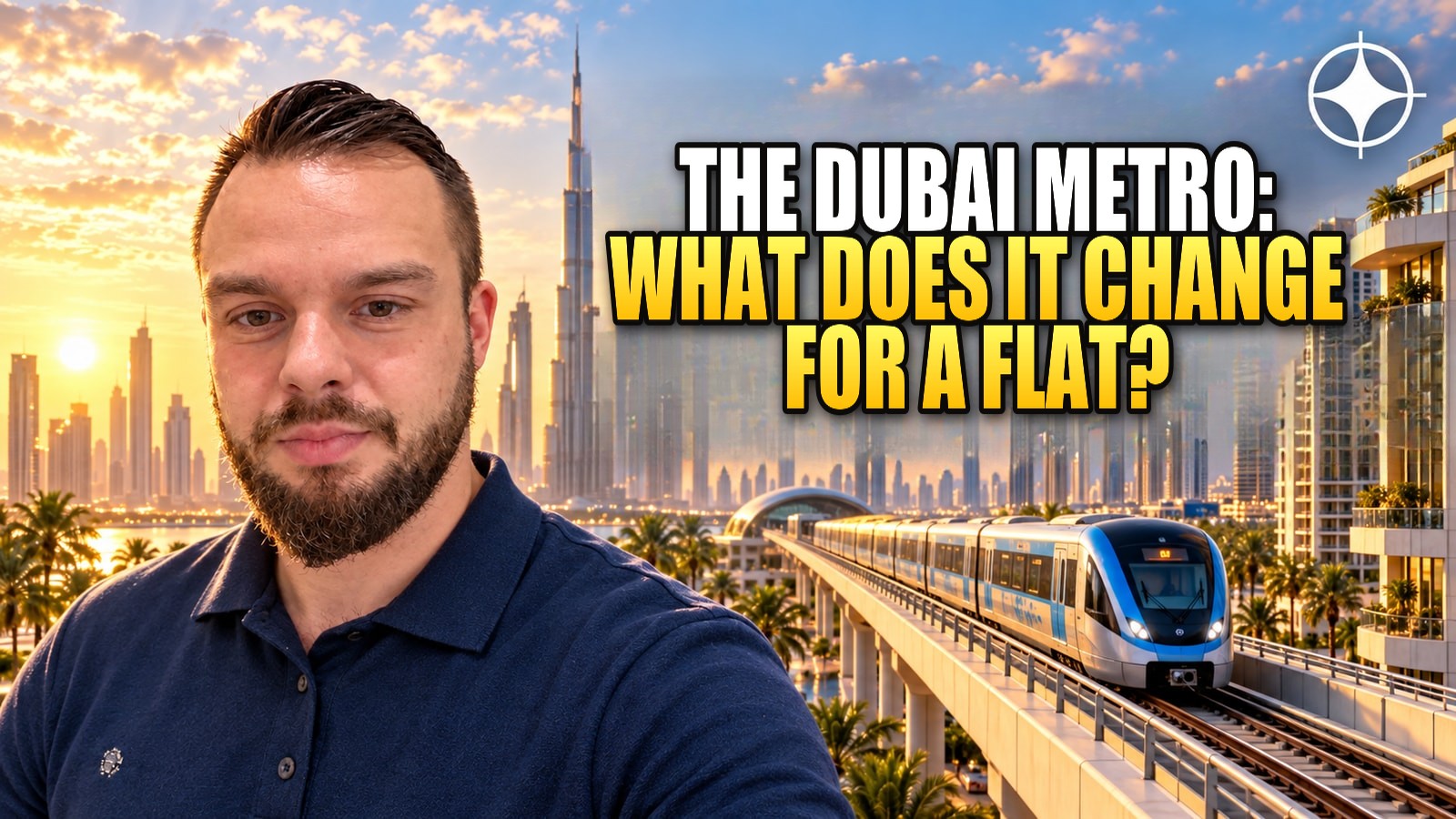
Dubai Metro is two operating lines, Red and Green, and a third under construction, the Blue Line. Every tourism site publishes the map, so this is about something else: why brokers check distance to a station before they check the floor plan, and what happens to price when a station arrives.
What exists today
- Red Line — the city's main axis along Sheikh Zayed Road: Deira and the airport through Business Bay, Downtown, DIFC, Dubai Marina and JLT to Jebel Ali. Most of commercial Dubai sits on it.
- Green Line — old Dubai: Deira, Bur Dubai, Al Jaddaf, the Creek, Healthcare City. A different audience and a different price level.
- Route 2020 — the Red Line branch to Dubai South and Expo City, opened in 2021. It is what moved the south-west out of the "too far" category.
- DXB airport sits on the Red Line with two stations — a rare case of an international hub inside the urban network rather than at the end of a commuter branch. More on the airport and the districts around it on its own page.
The Blue Line: what changes by 2029
Construction started in June with a budget of AED 18bn (about $4.9bn). The line runs roughly 30 km with 14 stations — nine elevated, five underground — through Mirdif, Al Warqa, International City, Dubai Silicon Oasis, Academic City, Ras Al Khor, Dubai Creek Harbour and Dubai Festival City. Opening is targeted for 2029, the metro's twentieth anniversary, with capacity of 200 000 passengers a day by 2030 and up to 320 000 by 2040.
The kilometres are not the point; the districts are. These are dense, populated areas that today run entirely on cars — International City, Silicon Oasis, Mirdif. A station there does not make life "more convenient": it changes the category of the housing from "for people with a car" to "for everyone".
Talk to a licensed broker: 📲 +971 50 120 32 64 on WhatsApp, @dubai_oleg on Telegram
One station is worth noting on its own: Dubai Creek Harbour at 74 metres, which will be the tallest metro station in the world, designed by the same American architects who did the Burj Khalifa.
What a station is actually worth
Honestly: there is no single coefficient, and anybody quoting "+15% for metro" is selling you confidence rather than analysis. But the patterns are consistent and visible in any developed network, Dubai included:
- Walking distance is the variable, not proximity on a map. The difference between 400 metres and a kilometre is enormous, because at 45°C nobody walks the kilometre. This is why buildings with a covered link to a station command a premium — it is eight months a year of difference, not a nicety.
- The effect is strongest in the mid-market. Somebody buying at $2.5m on the Palm does not take the metro; the tenant of a JVC studio does. Metro moves price in inverse proportion to price.
- Rent reacts before capital value. First the void period shortens and the achievable rate rises; the sale price follows. For an investor that means the yield advantage comes from occupancy, not from the headline.
- The market prices a future station early. By opening day most of the move is already in. Buying "for the metro" makes sense once the alignment is confirmed and construction has not yet reached your window.
The other side
An apartment directly above a station is not automatically an asset. At-grade sections are noisy and lower floors near exits live in a stream of people. The premium for the station is eaten by the discount for noise faster than buyers expect. The optimum is the second or third building back: five minutes on foot, quiet under the window.
And a structural caveat: Dubai remains a city designed around the car. The metro covers the Sheikh Zayed Road corridor and the old centre, but many villa and townhouse districts have no station and will not get one. In the family segment, school proximity and highway access matter more.
How to use it when choosing
- Buying mid-market to let — measure the walking route to the station, not the straight line.
- Looking at future Blue Line districts — compare today's price with a comparable district that already has metro. The gap is what you are paying for waiting.
- Buying premium — do not pay for metro. Your tenant will not use it.
How each piece of city infrastructure feeds into price is covered in Dubai 2040 infrastructure, including the metro itself. District pricing is in areas, live listings in the catalogue.
In the news
Other write-ups on the site about the same thing.
The Blue Line and Dubailand: how a periphery becomes a district in demand
Dubai Land Residence Complex spent years being what agents delicately call “out of town”. The pattern that repeated twice before says what a station does next.
Gold Line: Dubai’s Fourth Metro Line — 42km Underground, 18 Stations, Opening 2032
Dubai has approved its most expensive transport project ever: a fully underground metro line costing AED 34bn, opening in 2032. The route, and what it means for housing along it.
There is no metro in Abu Dhabi: what is being built instead, and by when
Not one operating line, not one station. The metro maps circulating online are drawn from plans rather than from reality — and the difference matters before you choose a district.
Dubai’s largest budget ever: AED 302.7bn, with almost half going to infrastructure
Dubai approved a AED 302.7bn budget for 2026–2028, with AED 99.5bn for 2026 alone. 48% of the annual budget goes to infrastructure — roads, metro, tunnels, parks and promenades. How public capital spending reaches apartment prices.
The World Islands: what it costs to run a property with no city infrastructure
A standalone island has no city utilities, waste collection or emergency services in the usual sense. All of it is someone’s daily work and someone’s budget.
Dubai Auto Market: DP World's 22-million-sq-ft car trading hub, and what it means for warehouses and housing
DP World was mandated in 2024 to expand Dubai's car market eightfold; in November 2025 the project was unveiled at 22 million sq ft — 1 500 showrooms, capacity for 800 000 vehicles a year, an auction house and a hotel. Current turnover of AED 6.8bn is expected to double.