The Blue Line and Dubailand: how a periphery becomes a district in demand
Dubai Land Residence Complex spent years being what agents delicately call “out of town”. The pattern that repeated twice before says what a station does next.
 INSIDERrealestate — Home
Rates are indicative. Contracts and DLD fees are always in dirhams.
A fully driverless network of 55 stations, with half the city's liquid housing strung along it — and the second argument in any district decision.
The metro opened on 9 September 2009 and today runs two lines, red and green. The network covers 90 kilometres, serves 55 stations and carries around 755,000 passengers a day.
Trains are driverless, headways are short, and carriages are split into classes including a women-and-children cabin. In a city built around the car, this is the only transport a traffic jam cannot touch.
That is why the metro in Dubai is a market factor rather than a convenience. In a city where the Marina-to-Downtown drive takes an unpredictable amount of time at peak, a station within walking distance is worth money in both rent and resale.
A third line, the blue, is scheduled to open on 9 September 2029. That is not an extension of an existing route but a new geography, and it gets its own section below.
The red line runs along Sheikh Zayed Road — the city's main axis — connecting Centrepoint in the east with the Expo 2020 station in the west.
Almost everything an international buyer looks at first is threaded onto it: Downtown Dubai, Business Bay, Dubai Marina, JLT, and Dubai International Airport.
Ahead of Expo 2020 the line was extended. The Route 2020 branch brought Discovery Gardens, Jumeirah Golf Estates and Dubai Investment Park onto the network — districts that until then were car-only.
The practical conclusion is straightforward: if a property sits along the red line, its transport question is already answered, and the answer is already in the price. There is no discount to find there.
The green line runs parallel to Dubai Creek and serves the historic districts, Deira and Bur Dubai.
This is a different city: dense, old, with its own trading economy and a completely different tenant from the one on Sheikh Zayed Road. The entry price is markedly lower and the percentage yield is often higher.
The metro matters more here than in the newer districts. Parking in the old city is scarce, and the distances are such that most buildings really are within walking range of a station.
For anyone optimising for yield rather than the prestige of an address, the green line is usually the more interesting of the two. For anyone buying somewhere to live, almost never.
The blue line is scheduled to open on 9 September 2029. It runs 30 kilometres and forms part of the city's twenty-minute-city concept: every daily necessity within twenty minutes on foot or by bike.
It is planned for districts expected to add up to a million residents by 2040. The line will have two branches; it crosses Dubai Creek on a 1,300-metre bridge and links Al Jaddaf, Ras Al Khor and Dubai Academic City.
The station at Dubai Creek Harbour was designed by Skidmore, Owings & Merrill — the practice behind supertall towers worldwide — and is specified to the platinum green building standard.
What matters for a buyer: the line runs into precisely those districts that are currently penalised for transport — Dubai Silicon Oasis, International City, Mirdif. The commute discount is sitting in their prices today.
And in April 2026 a fourth line was announced — the Gold Line: 42 kilometres entirely underground, 18 stations, launch declared for 9 September 2032. It runs through Maritime City, Meydan, Dubai Hills and JVC — districts with no rail at all today — the next wave of the same logic, covered on its own page.
According to CBRE's Dubai Metro Report 2023, residential prices within a fifteen-minute walk of a metro station rose 43.8% in 2022 compared with 2010.
Read that figure carefully. Metro lines are not laid across empty desert: they are routed where density, jobs and demand already exist. Part of the growth belongs to the station, part belongs to the fact that the station was put somewhere good.
The direction, though, is not in doubt, and it is confirmed a second way — through rent. A flat within walking distance of a station lets faster and sits empty less, and over a long hold it is vacancy, not the headline rent, that eats the yield.
The working rule that follows: pay for the metro in rent, and do not overpay for it in a purchase where the station already runs. The money is made on the station that does not exist yet.
The pattern is the same in every city on earth: buy before the line opens, in a district that is underpriced today specifically because of the commute. In Dubai right now that trade is the blue line.
Projects are already going up beside the future stations — Palace Residences Creek Blue, Aeon, Altus and others — and their residents will have direct access at handover. Developers have, naturally, already priced part of that prospect in.
So the question is not whether there is a future station nearby, but how much is already being charged for it. Compare such a project against a neighbouring building with no station: if the gap is already in double digits, what you are buying is somebody else's forecast rather than growth.
And budget the time. 2029 means years of ownership before the effect arrives, and infrastructure timelines slip everywhere in the world.
The real walking distance to the station rather than the phrase "steps from the metro" in the listing. Trace the route on a map: in Dubai "five hundred metres" routinely means crossing an eight-lane road and detouring to a footbridge.
And check it in summer. From May to September a ten-minute walk is not a ten-minute walk, and tenants know it: buildings with a covered link to the station let better than their neighbours.
What stands between the building and the station. A straight line on the map means nothing if a highway or a multi-year construction site crosses it.
And whether the future station is already in the price. That is the central question for anything bought along the blue line, and the answer comes from comparing against the building next door, not from the brochure.
Median price, entry price and current stock composition for each one sit on its area page.
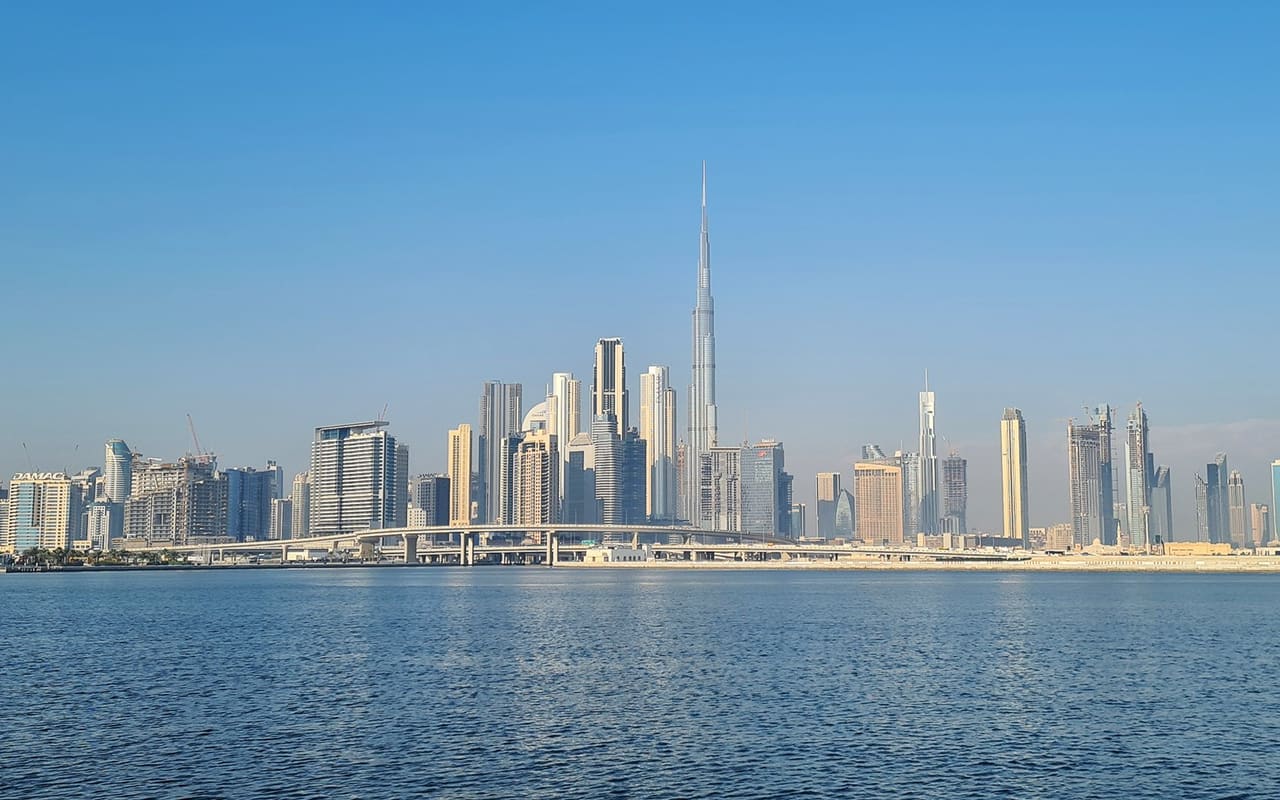
 Burj Khalifa The tallest building in the world for sixteen years running — and the only object in Dubai whose view is a price category in its own right.
  Al Maktoum International The airport the city is building its second half around: a design capacity of 260 million passengers a year, against the ninety-odd million DXB handles today.
  Dubai Tram Eleven stations that close the last mile between the metro on Sheikh Zayed Road and the housing by the sea — and make Marina and JBR a rare walkable pocket of Dubai.
  Dubai Water Canal Three kilometres of water cut through the middle of the city in 2016 — and six kilometres of new waterfront where physically none existed.
  The Dubai Mall The largest mall in the world and the city's main generator of foot traffic: around 105 million visits a year, concentrated on a single block.
  Etihad Rail A railway across all seven emirates: 900 kilometres, freight running since 2023, and a promised 57 minutes from Abu Dhabi to Dubai once passenger services start.
  Dubai International (DXB) The world's busiest airport for international traffic — and the employer that holds up the rental market across half of old Dubai.
  Jebel Ali Port The largest man-made port in the world and the industrial heart of the emirate: not a sight to see, but the thing that pays the rent across an entire belt of districts.
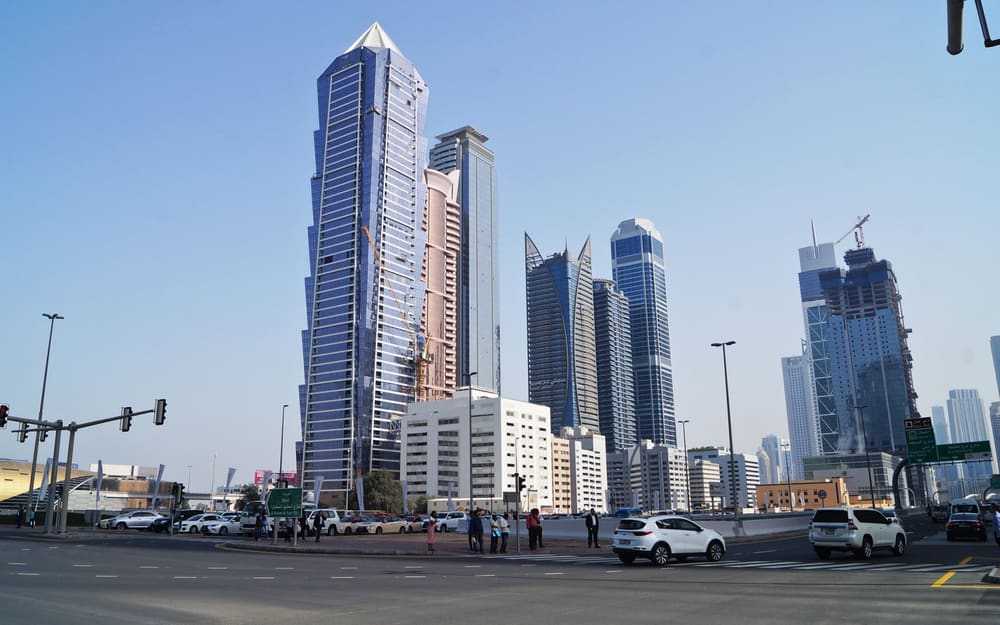
  Sheikh Zayed Road Twelve lanes with the whole of commercial Dubai lined up along them: an address on this road is less about the drive than about which half of the city you ended up in.
  Expo City Dubai The one case in Dubai where an exhibition site was not dismantled but turned into a district with a metro station, a free zone and housing.
  Dubai Creek The inlet the city began on: a trading harbour that became the line between old Dubai and new — and is still a price category of its own.
  Museum of the Future The landmark that gave Sheikh Zayed Road a face: 77 metres of calligraphy with no columns inside — and an honest lesson in what an attraction does not do to prices.
  Ain Dubai The tallest observation wheel in the world at 250 metres — out of service since March 2022. And the best available lesson in how the market treats promised infrastructure.
  Mall of the Emirates A 2005 shopping centre that created an entire residential district single-handedly: before it Al Barsha was an edge of town, after it an address with a metro station, schools and a tenant.
  Dubai Hills Mall The same script as Mall of the Emirates, twenty years later: the centre that in 2022 finished a residential district into a self-sufficient one.
  Palm Monorail Five kilometres of track along the trunk of the Palm with no link to the metro: transport that was built, but that nobody commutes on.
  Infinity Bridge A creek crossing with a 295-metre arch and twelve lanes: an attempt to remove the historic city’s principal price discount — the commute.
  Metro Gold Line Dubai’s first fully underground metro line: 42 kilometres and 18 stations through districts that live without rail today. The map of future stations is a map of future prices — on a 2032 horizon.
  Dubai Opera A 2,000-seat theatre at the foot of Burj Khalifa that gave its name to an entire Downtown quarter. A rare case of a cultural object becoming an address rather than just a landmark.
  The Dubai Fountain A 275-metre fountain on the lake at Burj Khalifa — and the “fountain view” line in Downtown price lists that costs real money. Here is when that line is honest.
 Dubai Land Residence Complex spent years being what agents delicately call “out of town”. The pattern that repeated twice before says what a station does next.
Red, Green and the 30 km Blue Line with 14 stations opening in 2029. Not the map — everyone has the map — but what walking distance to a station actually does to price, to time-to-let, and where you are overpaying for it.
Dubai has approved its most expensive transport project ever: a fully underground metro line costing AED 34bn, opening in 2032. The route, and what it means for housing along it.
Most of Dubai is built around driving, and in most districts a household without a car is a household with a problem. A handful are genuinely different. Which ones, what makes them different, and why the answer changes in July.
Abu Dhabi expects its population and GDP to double by 2040; the emirate had 4.14m residents at the end of 2024. AED 240bn is earmarked for housing, transport, health and schools. The widely quoted "6 million by 2040" is not an official figure. What is actually being built.
Ras Al Khaimah targets 3.5m visitors a year by 2030 (1.35m in 2025), wants to grow hotel stock from 8,700 to about 16,000 keys with 80% premium, and is building a terminal for 3m passengers by 2028. What it means for property buyers.
Dubai Healthcare City has started an AED 1.3bn ($354m) phase one expansion: the 13,000 m² PIXEL office building and the 5,800 m² IBN SINA+ medical complex. Ground was broken on 29 April 2026, with completion planned for 2027. What it means for homes in Al Jaddaf and Healthcare City Phase 2.
Hafeet Rail is a $2.5bn joint venture between Etihad Rail, Oman Rail and Mubadala: 238km from Abu Dhabi through Al Ain to the Omani port of Sohar. The passenger service will run at up to 200km/h; as of spring 2026 the line was 40% complete, and Oman ratified the agreement in September.
Terminal A at Abu Dhabi’s airport opened in November 2023 after years on hold: 742,000 sq m, capacity for 45m passengers a year. Renamed Zayed International in February 2024, it handled a record 32.5m passengers in 2025 (+12.8%). What that means for housing on Yas Island and in Al Raha.
Films from the channel on how the city rebuilds itself: the 2040 masterplan, transport, and the projects that move prices around them. Each one has its own written breakdown here.
 Dubai is learning to walk: the 20-minute city and what it does to rent
 The world's largest solar park, and why a property buyer should care
 Air taxis in Dubai: what eVTOL would change, and what it would not
 Hatta: the mountain half of Dubai nobody puts in the brochure
 Dubai 2040: the masterplan that tells you where demand goes next
 The New Silk Road: what a trade corridor does to the cities on it
 Four cities, four bets on the future: Dubai, New York, London, Tokyo
 Wellness resorts: why Dubai is putting hundreds of millions into health
 The Jebel Ali coast: Dubai's last big stretch of undeveloped shoreline
From the daily off-market feed. Availability and price are confirmed on request.
All below-market listings →Send your budget and what the purchase is for — I will put together a shortlist from live stock and flag where proximity to a station or a tower view is already paid for in the price.
Telegram is the fastest way — I answer personally.
Message on Telegram