
The structure of global wealth in 2024: $680.7 trillion, and 57.8% of it is real estate
Global wealth in 2024 is put at $680.7 trillion. Residential property accounts for $286.9 trillion, or 42.1% — more than every share and bond in the world combined. Gold is $16.6 trillion, 2.4%. The six asset classes, their shares, and what follows for a private investor.
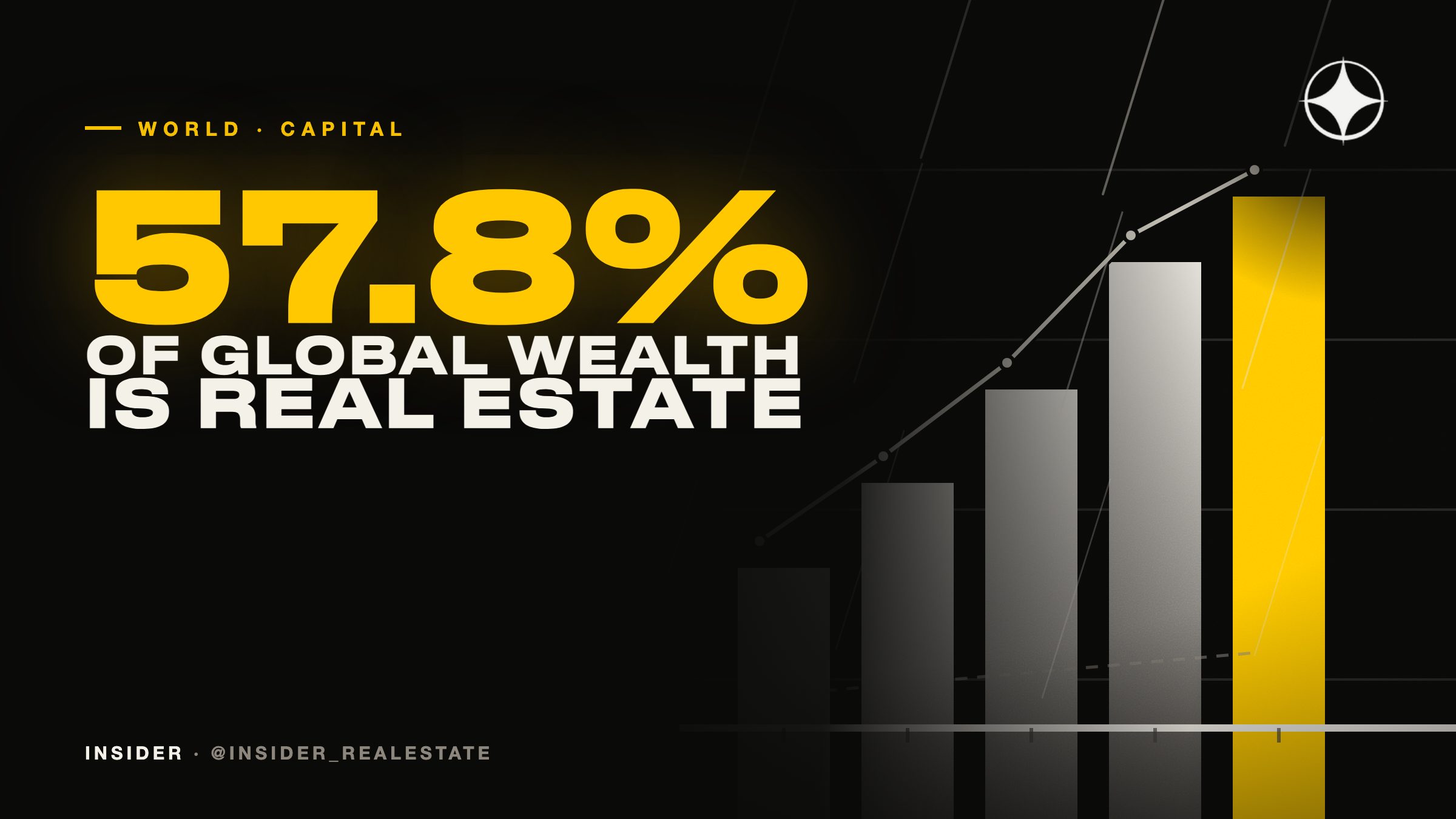
Global wealth in 2024 is estimated at $680.7 trillion. More than half of it — $393.3 trillion, or 57.8% — is real estate: homes, commercial property, farmland and forests. Residential property alone is worth $286.9 trillion, more than all the world's shares and bonds put together.
What is global wealth made of?
Six asset classes: residential property, debt securities, equities, commercial property, farmland with forests, and gold. The amounts below are the 2024 estimate; shares are calculated from the $680.7 trillion total.
| Asset class | Value, $ trillion | Share |
|---|---|---|
| Residential property | 286.9 | 42.1% |
| Debt securities | 145.1 | 21.3% |
| Equities | 125.7 | 18.5% |
| Commercial property | 58.5 | 8.6% |
| Farmland and forests | 47.9 | 7.0% |
| Gold | 16.6 | 2.4% |
| Total | 680.7 | 100% |
The six lines add up exactly: 286.9 + 145.1 + 125.7 + 58.5 + 47.9 + 16.6 = $680.7 trillion.
Talk to a licensed broker: 📲 +971 50 120 32 64 on WhatsApp, @dubai_oleg on Telegram
How much is all the world's real estate worth?
$393.3 trillion, which is 57.8% of global wealth. That is $286.9 trillion of housing, $58.5 trillion of commercial property and $47.9 trillion of farmland and forests.
Count buildings only, leaving out agricultural land and forests, and the figure is $345.4 trillion, or 50.7%. Even on the narrow definition, property is half of everything humanity owns.
How much bigger is housing than every other asset?
Residential property stands at $286.9 trillion, 42.1% of global wealth. It is the largest line by a wide margin: the second, debt securities, is roughly half the size at $145.1 trillion.
- Housing is worth 2.3 times all the world's equities: $286.9 trillion against $125.7 trillion.
- Housing is worth 4.9 times all commercial property: $286.9 trillion against $58.5 trillion.
- Housing is worth 17 times all the gold: $286.9 trillion against $16.6 trillion.
Shares and bonds together come to $270.8 trillion. Housing exceeds that by $16.1 trillion — almost exactly the value of the world's gold.
What share do stocks and bonds hold?
39.8% — $270.8 trillion between them. Debt securities are worth $145.1 trillion (21.3%), equities $125.7 trillion (18.5%). The debt market is larger than the equity market by $19.4 trillion.
That sits oddly with the usual news picture, where stock indices take most of the attention. By value the entire equity market is less than a fifth of global wealth, and real estate is 1.45 times the size of shares and bonds combined.
How much of global wealth is gold?
$16.6 trillion, or 2.4% — the smallest of the six lines. Farmland and forests are worth nearly three times as much at $47.9 trillion, and commercial property 3.5 times as much at $58.5 trillion.
Gold is often called the main safe-haven asset, but by size it is a narrow market. Its total value equals 5.8% of the world's residential property.
What this structure means for a private investor
Three conclusions that follow from the numbers themselves.
- Real estate is the core asset, not a niche. 57.8% of global wealth sits in land and buildings. A portfolio with no property is built differently from the world's wealth as a whole.
- Housing is the deepest market. 42.1% is residential, 8.6% commercial. The residential segment is 4.9 times the size of the commercial one.
- Commercial property is a class of its own. $58.5 trillion is 3.5 times all the gold in the world. Offices and retail deserve to be assessed on their own terms, not as an add-on to housing.
The structure shows where wealth sits, not what will rise in price. A class's share of the global total promises no return on a particular property — location, entry price and holding period decide that.
For how this looks in one market, see our sections: discounted Dubai apartments and villas, Dubai offices to buy or lease and the page for large capital.
Frequently asked questions
How much is global wealth worth?
$680.7 trillion as of 2024. The estimate covers six asset classes: residential and commercial property, farmland and forests, equities, debt securities and gold.
What share of global wealth is real estate?
57.8%, or $393.3 trillion, counting housing, commercial property, farmland and forests. Without land and forests it is 50.7%, or $345.4 trillion.
Which is worth more — all real estate or all securities?
Real estate. It is worth $393.3 trillion against $270.8 trillion for shares and bonds together, a ratio of 1.45. Housing alone, at $286.9 trillion, already exceeds all securities.
How much is all the gold in the world worth?
$16.6 trillion, or 2.4% of global wealth. That is 17 times less than residential property and 7.6 times less than all equities.
Which is bigger, the stock market or the bond market?
The bond market. Debt securities are valued at $145.1 trillion and equities at $125.7 trillion — a difference of $19.4 trillion in favour of debt.
Video on this topic
The same subject on the English channel — each clip has a written version of its own.
 51:14AI in Dubai real estate: what changes for brokers, investors and developers3 October 2026
 9:35Mira Verde at Tbilisi Hills: a Dubai developer building in Georgia6 October 2025
 15:37Abu Dhabi property investment: Saadiyat Island and the Aldar launch numbers16 February 2023
 12:53Force majeure in Dubai real estate: can you withdraw from a deal?1 October 2026


In the news
Other write-ups on the site about the same thing.
Gold Line: Dubai’s Fourth Metro Line — 42km Underground, 18 Stations, Opening 2032
Dubai has approved its most expensive transport project ever: a fully underground metro line costing AED 34bn, opening in 2032. The route, and what it means for housing along it.
DIFC Offices at 2% Vacancy: What a Square Foot Costs in Dubai’s Tightest District
In a district with roughly 2% vacancy, offices in a renovated tower were offered at AED 4 000–4 500 per sq ft with a projected yield of 8.75–11.5%. Here’s what makes up the price in Dubai’s tightest office location.
Downtown Dubai vs Business Bay: where to live and where to buy to let
Downtown is Dubai's tourist and status core, around AED 2 433/sqft on our own data. Business Bay is the business district next door, home to 17 000+ companies, around AED 1 871/sqft. We compare lifestyle, rental economics and who should pick which.
D33: Dubai’s plan to double its economy by 2033, and what it means for property
D33 targets AED 32 trillion in economic activity over ten years and AED 650 billion in foreign direct investment by 2033. We unpack the numbers and why they already translate into rental demand.
Daman Real Estate Capital Partners: when the developer is a fund with an exit date
An investment-managed developer behind a mixed tower in DIFC. Funds behave differently from family developers, and the difference is a timetable you are not told about.
Al Marjan Island: Retail Runs Short Around the UAE’s First Casino Resort
Ras Al Khaimah is building the country’s first integrated casino resort, and Al Marjan Island is being reshaped around it. Ready-to-buy commercial units are almost nowhere to be found — and that’s its own investment story.