The Opus: how a Zaha Hadid building became a price anchor in Business Bay
A cube with a living form carved out of its centre — Zaha Hadid’s last Dubai project, where her practice designed both the exterior and the interiors of the ME Dubai hotel. How an architectural statement works on the value of the district around it.
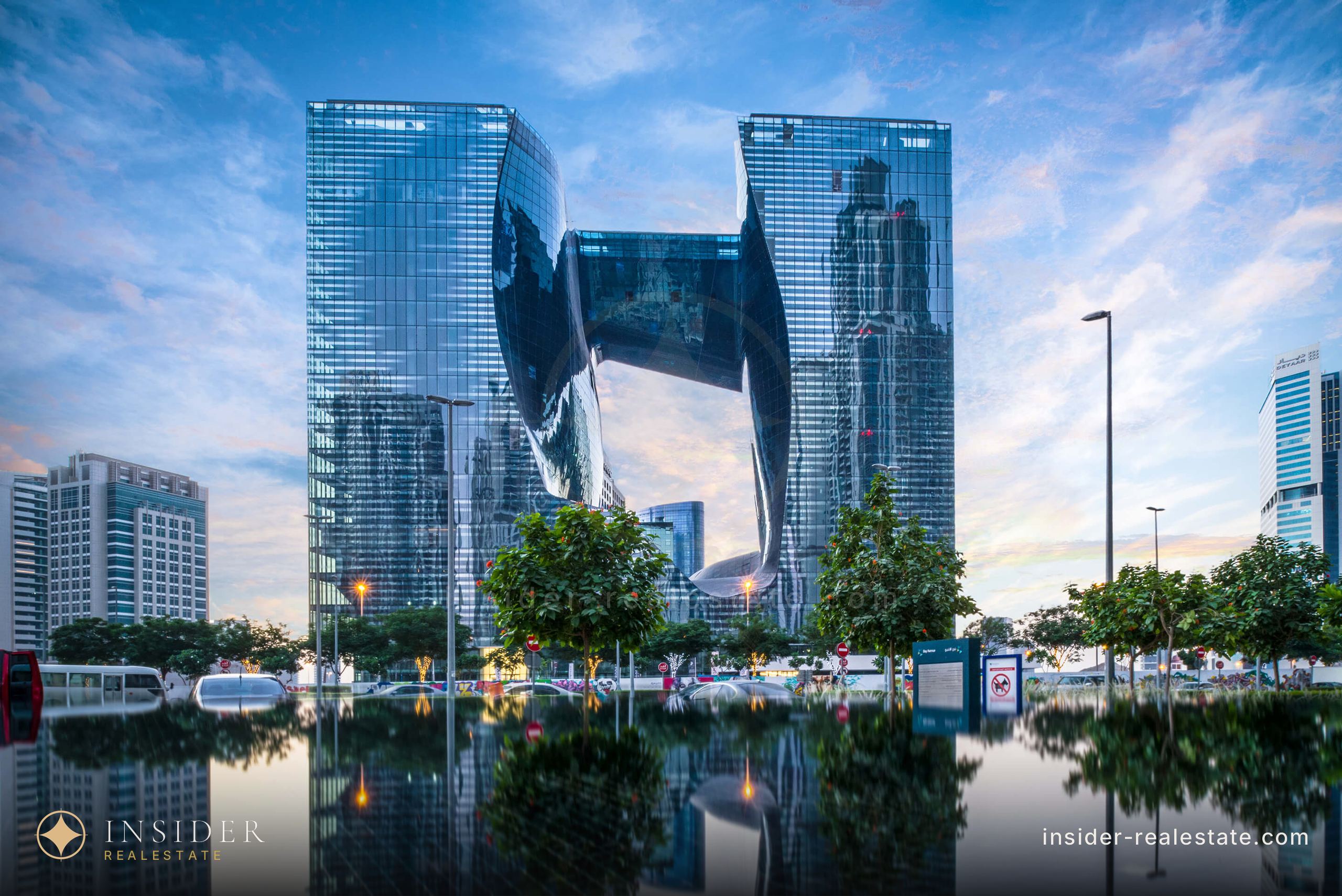
The Opus is a rare case of a building that works as an argument in itself. Amid the standard glass towers of Business Bay stands a perfect cube with a living form carved out of it. By day it reflects the Burj Khalifa and the city; by night the central void is lit by thousands of LEDs and appears to break the laws of physics.
What the building is
The architect was Zaha Hadid, the first woman to win the Pritzker Prize, architecture's highest honour. Her practice designed not only the exterior but also the interiors of the ME Dubai hotel inside: lobby, furniture and lighting all in the same fluid, futuristic idiom.
- Structurally it is two towers joined by a bridge at height, but visually a single volume.
- The façade is assembled from thousands of uniquely shaped panels — engineering work rather than standard glazing.
- Inside are the ME Dubai hotel, office space and residences.
For developer Omniyat the project was a manifesto: instead of another square metre, an object that entered architectural rankings and collected awards.
Talk to a licensed broker: 📲 +971 50 120 32 64 on WhatsApp, @dubai_oleg on Telegram
The economics of an architectural gesture
There is a concrete lesson here for investors. A complex façade of unique panels costs several times a standard one, and in terms of rent per square metre that money does not pay back directly. What pays back is the status of the address.
The mechanism runs like this: a recognisable building becomes a landmark, the landmark becomes address prestige, and prestige lifts the price of everything nearby. Hence a rule worth carrying into a purchase: an icon next door lifts the price of your ordinary building — one of the few situations where overpaying for location rather than for the asset itself makes sense.
Dubai applies this systematically. The Burj Khalifa made Downtown, Atlantis made the Palm, The Opus made its corner of Business Bay. Each time the anchor is built with more than its own returns in mind.
What a buyer in such a building should factor in
- Maintaining a complex façade costs more. Unique panels and non-standard geometry mean a higher service charge — the price of living inside a landmark.
- Liquidity is above average. A recognisable building always has a buyer who wants that specific address; in a falling market that is a real advantage.
- Mixed use cuts both ways. Hotel, offices and residences in one building give round-the-clock life and, simultaneously, a flow of strangers.
Based on architectural material on The Opus and developer Omniyat.
Video on this topic
The same subject on the English channel — each clip has a written version of its own.
 22:22Peninsula Five review: buying a ready unit instead of waiting three years14 February 2025
 21:45Furnished offices in Business Bay: Rove HQ and the fitted-office model16 October 2025
 10:32Lumena Alta by Omniyat: Dubai’s most luxurious office tower12 October 2025
 28:23Peninsula Four The Plaza by Select Group: what you are actually buying2 March 2025


In the news
Other write-ups on the site about the same thing.
Star architecture in Dubai: Zaha Hadid, SOM, Squire & Partners — and what an architect's name actually adds to resale value
SOM designed Burj Khalifa and a 74-metre metro station in Creek Harbour that will be the tallest in the world. Zaha Hadid Architects built The Opus and is now building Oystra in Ras Al Khaimah. What separates a real premium from a marketing line.

Business Bay overtakes Palm Jumeirah in prime deals in August 2026, even as Dubai's wider market cools
Business Bay recorded 14 prime transactions in August 2026 against Palm Jumeirah's 10 — while Dubai-wide transaction volume fell 37% year-on-year and value fell 44%. Rental search demand rose 44% over the same period. What these seemingly contradictory numbers actually mean.

Deyaar: a listed developer that also manages what it builds
A public company with a long delivery record and an in-house property management arm. Why the second part changes the ownership experience, and what to check in the buildings it runs.
New Dubai office towers: Immersive Tower in DIFC, Aldar's Sheikh Zayed Road building and Bureau Lamar in Business Bay
Three major office schemes are rising around DIFC and Business Bay: Immersive Tower ($300m, 58 573 sq m, 2027), Aldar's 88 000 sq m tower by Emirates Towers metro (Q4 2027), and an office park with a theatre on Business Bay's largest plot. Vacancy in central clusters sits at 2–5%.
Dubai skyscrapers: Corinthia Dubai above 500 metres and Al Habtoor’s AED 5bn tower in Al Habtoor City
Corinthia Dubai, twin towers above 500 m on Sheikh Zayed Road with a rooftop pool and a Corinthia hotel, is due by 2030. Al Habtoor Group has announced an AED 5bn ($1.36bn) office tower in Al Habtoor City. What the two projects say about the market and who should care.

Downtown Dubai vs Business Bay: where to live and where to buy to let
Downtown is Dubai's tourist and status core, around AED 2 433/sqft on our own data. Business Bay is the business district next door, home to 17 000+ companies, around AED 1 871/sqft. We compare lifestyle, rental economics and who should pick which.
Related services
Below market in Business Bay right now
From the daily off-market feed. Availability and price are confirmed on request.
All below-market listings →