
Dubai districts compared: Marina, Palm Jumeirah, Business Bay, MBR City, Peninsula and Dubai Hills
There is no best district in Dubai, only the best one for a given goal and budget. On my December 2022 map, rental income pointed to Dubai Marina, Business Bay and Peninsula; family life to Dubai Hills and MBR City; status to Palm Jumeirah and Downtown. Strategy comes first, then the district, then the property.
What is each district for?
Each solves its own task. Dubai Marina is resort living with high rental demand. Palm Jumeirah is ultra-luxury: trophy villas and residences. Business Bay is the business centre, with income-producing apartments.
MBR City means lagoons, villas and premium housing near the centre. Peninsula is a waterfront master project inside Business Bay. Dubai Hills is a green family district with golf.
That was the map as I drew it in December 2022. The market is fast: new master plans and infrastructure change the picture within a year or two, so the comparison should be refreshed before every new purchase.
Talk to a licensed broker: WhatsApp +971 50 120 32 64 · Telegram
Which district suits which goal?
For rental yield: Marina, Business Bay and Peninsula. For capital growth: developing districts and locations on the water. For a family: Dubai Hills and MBR City. For status and luxury: the Palm and Downtown.
The main principle sits behind that list. There is no best district in general; there is the best one for a specific goal and budget. A district ideal for nightly lets can be a poor one for family life, and the reverse.
Occasionally a district to live in and a district to invest in coincide, but more often they are different tasks with different criteria. The clean solution is to separate them: live where it suits the family, invest where the metrics converge.
Which metrics make the comparison honest?
Four. The first is the price per square foot and its trend, which shows where the market is already expensive and where a location is still catching up with its potential.
The second is gross and net rental yield. High-turnover districts such as the business clusters give a higher percentage; premium waterfront ones give a lower percentage and make it up in capital growth.
The third is liquidity: how many transactions take place in the district and how long properties stay on sale. A district with handsome yield figures but rare transactions is a trap, because getting out of the asset will be hard.
The fourth is the ratio of supply under construction to the existing stock. An excess of new phases presses on both rents and resale.
Collected for each district on the shortlist, these metrics turn the choice from an argument about taste into a decision that can be managed.
The mistakes made when choosing a district
Choosing by hype. Loud launches and advertising do not replace metrics, and the most talked-about districts are not always the best performing.
Ignoring transport links. The journey to work and to schools at rush hour is something tenants feel every day and build into the rent they will pay.
Judging a district by today alone, without looking at the volume of future supply and the infrastructure plans.
And deciding without a visit: an hour of walking around the district on a weekday evening gives information that no table contains.
How does the stage of a district change the result?
Every district is at its own point in the life cycle, and that point determines what kind of result an investor should expect. Mature districts — Marina, Downtown, the Palm — have proven demand and maximum liquidity, but prices close to the ceiling of their cycle.
Their profile is stable income and preservation of capital. Developing districts — at the end of 2022, MBR City, Creek Harbour and the like — are still completing their infrastructure, prices are below those of mature neighbours, and the main bet is on growth as they mature.
That means a higher return with a higher risk on timing. Early master plans offer the maximum discount and the maximum uncertainty; they suit investors prepared to wait for years and to choose the developer with great care.
An honest answer to the question of which phase of risk you are prepared to hold narrows the list of districts faster than any overview.
One district or several?
An investor with capital for several properties should rarely concentrate everything in one district, even a favourite. A working portfolio combines an anchor and growth.
The anchor is an income apartment in a mature location with short voids, which provides cash flow. The growth is a unit in a developing district on a payment plan, which carries the potential for revaluation.
A third layer can be a niche product: a view unit on the water, or a family format in a scarce segment. Diversification works within types too — a compact rental unit paired with a family format insures against a swing in demand in one segment.
The limit is manageability. A few deliberately chosen properties at different phases of the cycle are easier to run than a dozen random purchases made because of a promotion.
Why is the district only half the decision?
Because inside any district there are strong and weak purchases, and the gap between them is sometimes wider than the gap between districts. After choosing the location, apply the same analysis at the level of the building and the unit.
That means the position of the block within the district, the view and the floor, the layout, the reputation of the developer, the size of the service charges, and the surrounding development with its plans.
A strong unit in an average district often outperforms a weak unit in a top one, thanks to the entry price and the scarcity of its own characteristics. Service charges differ severalfold between buildings and eat directly into net yield.
Future construction nearby can cancel a view advantage outright, so check the master plan of the surroundings before the transaction.
Frequently asked
Which district should a first-time investor start with?
A mature and liquid one. A mistake in selection costs least there, because the asset can always be sold or let. Developing districts are the second step, once there is experience.
How often should the picture of the districts be reviewed?
Before every new purchase. The Dubai market is fast, and new master plans and infrastructure change the balance within a year or two, so conclusions from earlier years should not be relied on.
Can a district to live in and a district to invest in be the same?
Sometimes, but more often they are different tasks with different criteria. The clean solution is to separate them: live where it is convenient for the family and invest where the metrics converge.
✍️ Message me on WhatsApp for a free consultation — off-market stock, payment plans and honest numbers on any of the projects covered here.
✅ Subscribe on YouTube — investment, property, business and relocation in the UAE and beyond.


In the news
The same subject in writing — analysis and news related to this video.

Jumeirah property: H&H’s Peninsula Dubai — Rosewood Residences and RSHP-designed homes around a new marina
In Jumeirah 2, H&H is building Peninsula Dubai: a waterfront district with a marina, a 195-key Rosewood hotel, 63 Rosewood residences and five villas by Hopkins Architects, and residential buildings by RSHP. Rosewood opens in 2029; the RSHP residences target early 2029.

Business Bay overtakes Palm Jumeirah in prime deals in August 2026, even as Dubai's wider market cools
Business Bay recorded 14 prime transactions in August 2026 against Palm Jumeirah's 10 — while Dubai-wide transaction volume fell 37% year-on-year and value fell 44%. Rental search demand rose 44% over the same period. What these seemingly contradictory numbers actually mean.

Dubai Marina: five of the ten tallest residential buildings in the world
A district designed from nothing on a Vancouver waterfront model, built between 2003 and 2008. The numbers behind it, and what a fully man-made location tells you about how value is created in Dubai.

ETA Star: an engineering group that built apartments
The property arm of a large regional engineering and contracting group, with towers in the Marina and on the Palm. What an engineering parent means in a delivered building.
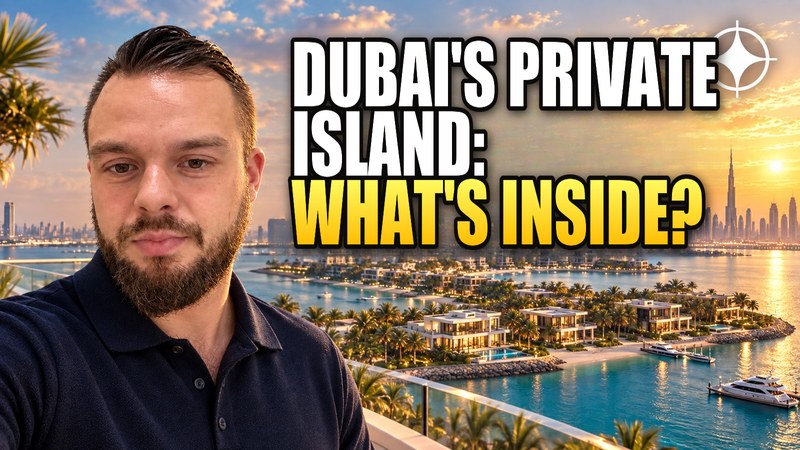
Jumeirah Bay Island: 128 plots shaped like a seahorse, and a market of a few sales a year
A Meraas island off Jumeirah Beach Road: 128 plots for bespoke villas, the Bulgari resort and residences, and the Bulgari Lighthouse tower. How Dubai’s most private address works, and why record prices there describe a deal rather than a market.

Jumeirah Islands: 46 clusters of 16 villas, and a market with no off-plan
A gated Nakheel community on man-made islands: 736 villas, exactly 16 homes per cluster, water instead of fences between plots. Why its statistics behave differently from the rest of the Dubai market.