
Which Dubai districts rose most in price after 2020, and the logic behind the leaders
In the cycle that began after 2020, as it stood in early 2023, three groups led: prime beachfront such as Palm Jumeirah, mature villa communities such as Arabian Ranches and The Springs, and mass districts like JVC rising from a low base. In the first two the common factor is supply that cannot expand.
Which districts led the cycle?
Three groups. The first was prime beachfront — Palm Jumeirah and the coastal areas around Jumeirah Bay — together with Emirates Hills in the villa segment. International capital of the highest tier arrived there, into supply that is physically limited.
The reclaimed land is built out and there are almost no new front-row plots. Scarcity plus a wealthy buyer produced the sharpest rise in prices; by a number of estimates it was a multiple over the cycle.
The second group was mature villa communities of the middle and upper segment: Jumeirah Village, Arabian Ranches, The Springs, Damac Hills and their neighbours. The pandemic-era demand for space and privacy turned villas from a niche product into the main shortage on the market.
Talk to a licensed broker: WhatsApp +971 50 120 32 64 · Telegram
The third was mass districts that had finally matured, such as JVC or Dubai South. Growth there came off a low base: infrastructure caught up with construction, and prices pulled up towards the neighbours.
How uneven was the growth?
Very. After 2020 Dubai went through one of the most powerful growth cycles in its history, but prices rose very unevenly: some locations multiplied in price while others added only tens of per cent.
The difference is explained not by luck but by factors that can be read: scarcity of the format, the stage of maturity of the district and the profile of demand. The ranking here describes the market as it stood in February 2023.
'Which district grew the most' is the right question to ask on one condition — that you understand past growth by itself does not guarantee future growth.
Why do beachfront and villa districts outrun the market?
Because their supply is inelastic. Where new towers can be built without limit, any surge in demand is soon absorbed by new launches: developers bring out thousands of units and prices stabilise.
In locations with a finite number of homes — villas on the water, the front row, low-rise communities with a closed master plan — that balancing mechanism does not work. Demand grows and supply does not.
The second factor is a change in who was buying. Over the cycle, wealthy families from Europe, India, China and the CIS moved to Dubai, and they bought homes to live in, not studios to let: large formats, schools nearby, privacy.
That is why villas on average rose faster than apartments, and family districts faster than purely investment ones.
How do you read growth statistics without being misled?
Start with the base. Growth of 60 per cent from a low base in a young district and the same 60 per cent on the Palm are different stories, both in absolute money and in how durable the rise is.
The mix of transactions distorts the figure as well. If expensive new towers start to be handed over in a district, the average price per square foot rises even when the older stock has not become any dearer.
Look at the price per square foot on comparable properties, not at the average transaction price. Separate off-plan from resale, because excitement at launches can mask stagnation in completed homes.
Check price growth against rental growth too. If rents do not keep up with prices, the yield of the district is compressing, and that is a signal of overheating.
A practical yardstick: a sound district rises in both price and rent while the time homes spend on the market does not lengthen. When prices rise and apartments take longer and longer to sell, growth rests on expectation, not on demand.
What does this mean for a buyer?
If the aim is to preserve capital and earn over a long horizon, the logic of the leaders of the last cycle still holds: scarce formats in mature locations. Even after strong growth, villas and the front row are protected by limited supply.
Corrections in such segments have historically been milder. If the aim is the maximum percentage growth, look at districts on the threshold of maturity.
Those are places where the master plan is close to completion, schools and retail are opening, and prices still lag behind neighbouring locations that have already arrived.
A separate strategy is to follow infrastructure. New metro lines, large malls, business clusters and the relocation of airport capacity have historically pulled up prices in adjoining districts.
Such bets take patience, because years pass between the announcement and the effect. In return, entry happens at the prices from before the event.
Which mistakes come from choosing by the growth chart?
The main one is extrapolation: buying yesterday's champion in the expectation that it will repeat its run. The more a district has risen, the more of its future growth is already in the price.
The best deals of a new cycle rarely coincide with the leaders of the last one. The second mistake is ignoring liquidity: in a small elite segment prices are volatile because of single transactions, and the 'growth of the district' can turn out to be the statistics of five sales.
The third is choosing a district without reference to format. Within one location studios, family apartments and villas live through different cycles; a district can be overheated in one format and undervalued in another.
The decision is always made on two levels: first the district, then the specific format and stack inside it.
Frequently asked
Which Dubai districts rose most in the last cycle?
Prime beachfront and villa locations — Palm Jumeirah, the elite coastal quarters, mature villa communities — and mass districts whose infrastructure had caught up. Exact percentages depend on the period and on the method of calculation.
Is it worth buying in a district that has already risen strongly?
For preserving capital, yes, if the format is scarce and rents are rising together with prices. For maximum growth, as a rule, no: look for locations at an earlier stage of maturity.
How can you check the dynamics of a district yourself?
Through the open data of the Land Department and the aggregators: price per square foot on comparable transactions, the rental trend and time on the market. Look at resale separately from off-plan.
Villas or apartments — which rises faster?
In the cycle just past, villas, thanks to scarcity and family demand. Apartments, however, have the higher rental yield and liquidity, so the choice depends on the goal and not on a single chart.
✍️ Message me on WhatsApp for a free consultation — off-market stock, payment plans and honest numbers on any of the projects covered here.
✅ Subscribe on YouTube — investment, property, business and relocation in the UAE and beyond.


In the news
The same subject in writing — analysis and news related to this video.
Palm Jebel Ali: 5 200 hectares and 90 kilometres of coastline
Dubai’s second palm archipelago, restarted after a long pause. Its dimensions are worth stating in full, because they are what explains its effect on the market — including on the mainland behind it.
Dubai Islands: the last waterfront land, from about $5 200 a square metre
A chain of reclaimed islands under a single government master plan. Almost no coastal land with direct beach access is left inside the emirate — and one or two new projects launch here every month. The opportunity and the risk are the same fact.

Dubai Marina: five of the ten tallest residential buildings in the world
A district designed from nothing on a Vancouver waterfront model, built between 2003 and 2008. The numbers behind it, and what a fully man-made location tells you about how value is created in Dubai.
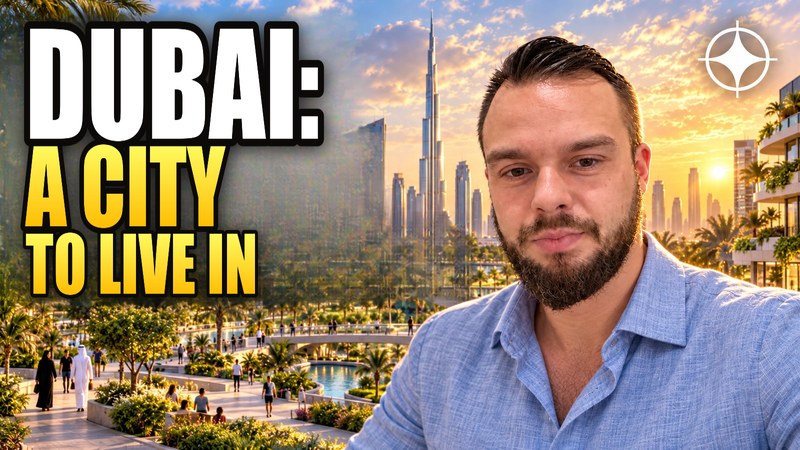
Dubai’s Quality of Life Strategy 2033: 200 parks, the Green Spine, and what districts gain
Dubai is rolling out a 200-plus project quality-of-life plan through 2033, anchored by a 15km green corridor along Sheikh Zayed Road. We break down what is already under way and which districts benefit first.
Water or a metro station: the two kinds of Dubai district, and what each one lets to
Most Dubai districts sell one of two things to a tenant — a view of water or a way to get to work without a car. They attract different people, carry different running costs, and fail in different ways. Which one you are buying is worth deciding before the viewing.

Emirates Hills: 632 villas, plots sold by the foot, and a market of eleven sales in six months
The only Emaar project where land was sold to buyers to build on themselves. How Dubai’s most expensive villa community works, why prices inside it differ thirtyfold, and what to do with statistics drawn from eleven transactions.