
Ritz-Carlton-branded villas in Dubai: how they differ from an ordinary villa community
A villa under a hotel name such as Ritz-Carlton differs from an ordinary Dubai villa community in one respect: the operator stays. It answers for the grounds and the service looking the same ten years on as on handover day, and the owner pays for that every year.
How is a branded villa project different from an ordinary community?
In who remains after handover. In a classic villa community the developer builds the houses, passes the grounds to a management company and leaves. From then on the quality of the place depends on the owners' association and on how conscientious the manager is.
In a branded project the operator stays. It answers for the standard to which the grounds are kept, for the service side, and for the community looking in ten years as it did on the day it was handed over.
Branded residences are usually associated with towers, but the format exists among villas too. There it is a fundamentally different model of ownership, and what changes is far more than the name at the gate.
Talk to a licensed broker: WhatsApp +971 50 120 32 64 · Telegram
I filmed this in June 2023 as a look at the format and not at one price list, so no figures for a particular project are quoted here.
What does the owner actually get?
Hotel-level service around a private house: a concierge, security, upkeep of the grounds, and often cleaning and household help on request.
A maintained standard comes with it. Landscaping, lighting and the shared areas are kept to the operator's rulebook and are not funded from whatever happens to be left over.
The architecture stays uniform. Rules on the exterior of the houses are enforced strictly, and that protects the look of the street for decades.
And the asset is easy to read at resale. The next buyer does not have to investigate the reputation of a local developer, because the name does that work.
What does a branded villa cost to own?
More than the purchase price suggests. Service fees are the main item, and for a villa they are higher than for an apartment even without a brand: they cover grounds, landscaping, irrigation and security. A hotel standard pushes the sum up noticeably further.
In a branded project the operator's own servicing fee is added to the service charge. Together they produce a figure that does not compare with a classic community of the same floor area.
On top come the costs of any house in the UAE: the garden and its irrigation all year round, the pool, and air conditioning for a large area in summer. The electricity bill for July and August surprises people who move out of a tower.
The practical rule is to count the cost of ownership per year and not the purchase price alone. Over five years the difference in running costs is usually more noticeable than the difference in price.
Does a branded villa work as an investment?
Rarely on yield. Rental return is low relative to the price, as it is across the premium villa market: rents are large in absolute terms, but so is the cost of entry.
Liquidity is limited by the size of the segment. There are few buyers for expensive houses at any given moment, and the time on the market when selling is measured in months.
That is normal at the top of the market, but a quick exit should not be part of the plan. The logic of buying here is almost always to live in the house yourself and not to count a percentage.
Branded project or classic community: the trade over one horizon
The classic community offers a lower entry price, lower fees and more freedom to alter the house. In return, the quality of the place rests on the manager and on how active the owners are, and in ten years the result can be anything.
The branded project costs more to enter and more to hold, under a strict rulebook. In return it gives predictability: the grounds are kept to the operator's standard, the look of the street does not change, and the service works.
What you receive is service you would otherwise have to organise yourself: security, maintenance of the house and plot, a concierge, access to the resort's facilities. For an owner who uses all of that, the exchange is a fair one.
For an owner who visits twice a year it is payment for something that goes unused. In that case a classic community, with a larger plot for the same money, is the more sensible purchase.
What should you check before the deal?
The operator agreement first: how long it runs, and what happens if it is terminated. Ask whether the level of service would survive that, and what it would do to the price.
Then the full list of fees and how they have moved: the actual amount for the last year and the change over three years, with what is included in the servicing and what is billed separately.
Ask about the rules. Which changes to the house and the plot need approval, and whether there are limits on letting the house or on the length of a lease. In branded projects such limits do occur.
The answers describe the cost of ownership more accurately than the price in the listing does.
What should you look at on a viewing?
The shared areas in the part of the project that is already lived in. That is the operator's work in its plainest form, and the best indicator of how it performs in practice.
Look at the landscaping in the hot season: the irrigation, the state of the lawns and the planting. Check whether the service side is actually staffed, meaning the concierge, the security and the maintenance team.
And talk to the people who live there. Residents are the most honest source on how a community is really run.
The short version: a branded villa project is bought for the environment and the service, not for a percentage. If you will use both, the premium is justified. If not, a classic community gives more floor area for the same money.
Frequently asked
Who is a branded villa community for?
For people buying a house for themselves who value service and a predictable environment, and who are willing to pay not to look after the grounds. It does not suit investors counting yield, or owners who want freedom to rebuild.
Are service fees higher in a branded villa project?
Yes. Villa fees are higher than apartment fees even without a brand, and a hotel standard adds to them, as does the operator's own servicing fee. Ask for the actual figure for the last year and how it changed over three years.
What happens if the operator leaves the project?
That depends on the agreement, which is why its term and its termination terms are the first things to check: whether the level of service remains, and how the change would affect the price.
Can I rent out a branded villa?
Sometimes only within limits. Branded projects can restrict letting or the length of a lease, so ask before buying. Rental return is low relative to the price in any case.
✍️ Message me on WhatsApp for a free consultation — off-market stock, payment plans and honest numbers on any of the projects covered here.
✅ Subscribe on YouTube — investment, property, business and relocation in the UAE and beyond.


In the news
The same subject in writing — analysis and news related to this video.

Ramhan Island villas in Abu Dhabi: Eagle Hills, the Ritz-Carlton Reserve and where the project stands in 2026
Ramhan Island launched in 2023 with 3–7 bedroom villas from about AED 6.5m. In 2024 Marriott signed a 50-villa Ritz-Carlton Reserve there, due in 2029. First villa handovers have slipped to late 2026–2027, and the bridge to the island is still being built.

Ras Al Khaimah branded residences: Nobu, Moonstone by Missoni and the Ritz-Carlton villas, checked in 2026
Three branded RAK launches of 2023–24: Nobu Hotel & Residences on Al Marjan (nearly 300 homes, handover now Q1 2028 rather than 2026), Moonstone with Missoni interiors (from about AED 1.29m, due Q4 2026) and Ritz-Carlton villas in Al Wadi (from about AED 16m, sold out, due Q1 2027).

Ras Al Khaimah villas: Four Seasons and Armani Beach Residences at Mina by RAK Properties
RAK Properties is building two ultra-prime schemes at Mina: Four Seasons (about 150 keys and 130 private residences, villas of 4–6 beds) and the world’s first Armani villas on Raha Island. In 2026 the Four Seasons masterplan was finalised and Armani beach works began. What is known, and what is not.

Omniyat: the ultra-prime end, where the rules are different
A developer that builds few buildings at the very top of the market. How the ultra-prime segment behaves differently on pricing, liquidity and comparables — and what due diligence looks like there.
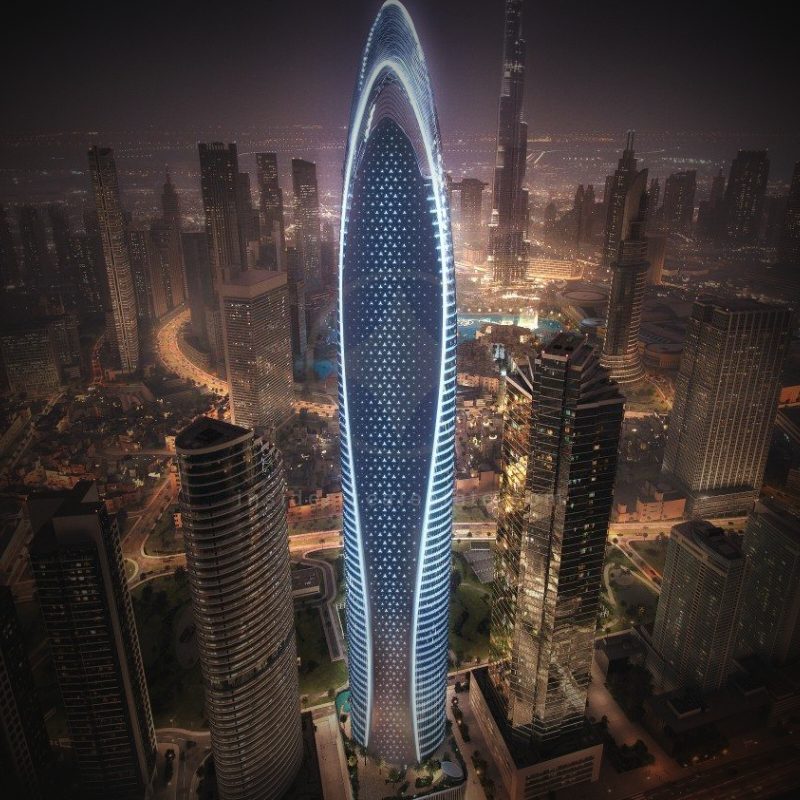
Car-brand residences in Dubai: Bugatti, Mercedes-Benz, Aston Martin, Pagani and Bentley compared
Five car makers now put their names on Dubai homes: 182 Bugatti Residences in Business Bay, the 341-metre Mercedes-Benz Places, Aston Martin interiors at Viewz, a 19-storey Pagani tower on the canal and Bentley Home villas from AED 20m. What the badge actually buys.

Kempinski Floating Palace: 48 self-propelled Neptune villas from AED 29m, and where the project stands in 2026
Kempinski Floating Palace pairs an on-water hotel near Jumeirah Bay Island with 48 self-propelled Neptune villas of 2–4 bedrooms. Summer 2024 prices were AED 29m, 32m and 46m; completion was set for late 2026. What buyers are actually purchasing, and what to check before signing.