
Dubai utility bills in 2026: the DEWA bill, the housing fee, and what it costs a month
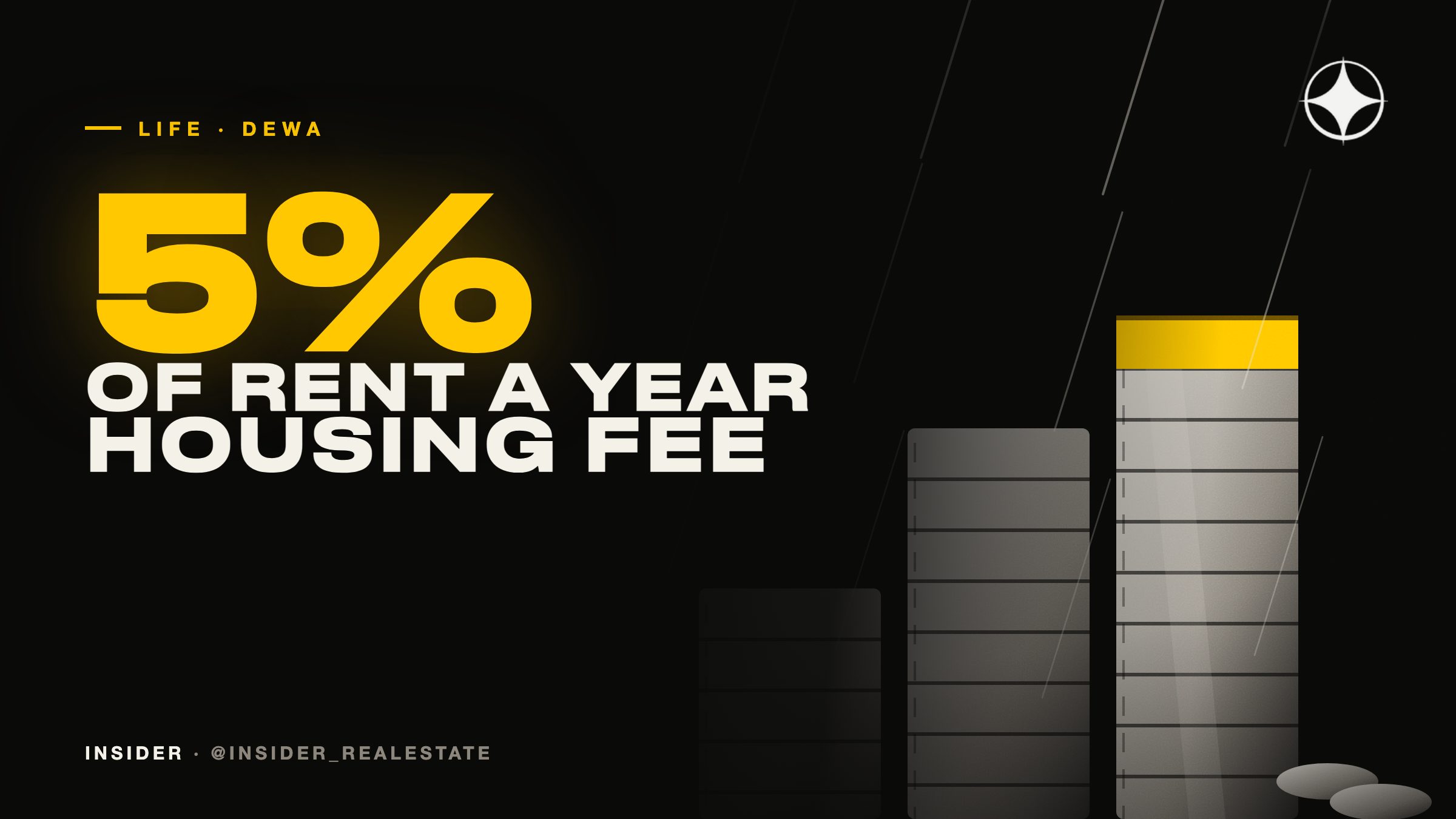
One DEWA bill bundles electricity, water and the housing fee — a 5% municipal levy on annual rent, split into 12 instalments. A two-bedroom apartment runs about AED 300–500 a month; a villa with a chiller, AED 700–1,000-plus.
Dubai has no separate bills for electricity, water and a municipal "housing charge" — once a month, through the app or the online account, a single bill arrives from DEWA (the Dubai Electricity and Water Authority) that bundles all of it together. Here is what makes up that bill, and why two neighbours in the same building can end up paying twice as much as each other.
What is inside one bill
The DEWA bill has four components. Electricity is billed on a rising slab: the first 2,000 kWh a month cost 23 fils per kWh, 2,001–4,000 kWh cost 28 fils, 4,001–6,000 kWh cost 32 fils, and anything above 6,000 kWh costs 38 fils — so the more you use, mainly on air conditioning in summer, the higher the rate on every additional kilowatt. Water is billed per imperial gallon: the first 6,000 gallons a month at 3.5 fils, and anything above that at 4.0 fils per gallon. Both lines carry a fuel surcharge on top — as of May 2026 it stood at AED 0.060 per kWh for electricity and AED 1.100 per m³ for water — plus 5% VAT.
The fourth line is the housing fee, a municipal levy that has nothing to do with actual consumption at all.
Talk to a licensed broker: 📲 +971 50 120 32 64 on WhatsApp, @dubai_oleg on Telegram
The housing fee: 5% of annual rent
The housing fee is 5% of the annual rental value, split into 12 equal monthly instalments and folded into the DEWA bill. For a tenant, the base is the amount stated in the registered Ejari contract: on AED 100,000 annual rent, the fee comes to AED 5,000 a year, or AED 417 a month. For an owner living in their own home, the base is the property's estimated annual rental value, which the municipality determines from its own data (Ejari, DEWA, the RERA rental index) rather than from an actual lease.
Who actually pays the housing fee — owner or tenant — comes down to whose name the DEWA account is in: if the account is registered to the tenant, which is standard practice when renting, they pay it, since it is billed alongside electricity and water to whoever holds the account.
What it costs a month
The total depends heavily on floor area, property type and season:
| Property type | Monthly bill, AED | Main driver |
|---|---|---|
| Studio / 1BR, summer | 300–500 | AC + housing fee |
| 2–3BR apartment, summer | 500–900 | Floor area, number of split units |
| Villa with central chiller, summer | 900–1,500+ | Cooling the whole house |
| Any home, winter | 30–50% below summer | Minimal AC use |
The summer and winter bill for the same apartment can differ by 50–100% — almost all of it driven by air conditioning. It is worth checking separately whether cooling runs through the building's centralised chiller system: in some projects it is billed by a separate district-cooling provider rather than through DEWA, a case we covered in Mismak Properties: district cooling, the bill nobody expects.
Connection and deposit
Opening a DEWA account requires Ejari (or a tenancy contract on first application), an Emirates ID and a passport with the visa; the application is filed online through the account portal or the app. A deposit is charged on connection — smaller for an apartment, larger for a villa — refundable when the account is closed, net of any outstanding balance.
How the DEWA bill and housing fee fit into the full monthly family budget is covered in our 2026 Dubai cost-of-living breakdown, and what actually reaches a landlord after all deductions from the rental stream is in Renting in Dubai: rates, deposits, Ejari — and what actually reaches the landlord.
In the news
Other write-ups on the site about the same thing.

Renting in Dubai with a dog or cat in 2026: which districts and homes actually work for pet owners
Written landlord permission for a pet in Dubai is mandatory — a verbal agreement is not enough. Keeping a dog in Downtown or Business Bay is close to impossible, while a villa in Arabian Ranches or Al Furjan solves the walking problem by design.
Cycling and e-scooters in Dubai in 2026: the bike-lane network, RTA rules and the JBR ban
Dubai's cycling network grew from 560km at the end of 2024 to 636km by the end of 2025, targeting 819km by the end of 2026. E-scooters are capped at 20km/h with a mandatory helmet, and devices have been banned at ground level in JBR since August 2024.
Hatta in 2026: the mountain exclave of Dubai, 50km of bike trails, and what real estate looks like there
Hatta is part of the emirate of Dubai, tucked into the Hajar Mountains, about 90 minutes to two hours from the city. A mountain-bike centre with 50km of trails, hiking, kayaking on Hatta Dam and a night sky free of city glow. What the enclave offers, and what housing there actually is.
Taxis in Dubai and Abu Dhabi in 2026: roof colours, women-only taxis and fares
Roof colour in Dubai shows the operator, not the price — the RTA fare is the same for everyone: from AED 5 flag-fall by day and AED 2.26 per km. A pink roof means women- and family-only. In Abu Dhabi, Yango now runs alongside Careem.

Mandatory health insurance in Dubai and Abu Dhabi in 2026: what the basic plan covers
Since 1 January 2025, health insurance has been mandatory nationwide for private-sector staff, but the rules differ by emirate: Abu Dhabi employers must cover up to four family members, Dubai only the employee. What a basic policy covers, and where you pay extra.
Dubai beaches in 2026: where night swimming is legal, where to surf, and the best beach for a family
Official night swimming is limited to five spots: Sunset Beach runs 24/7, four more stay lit until sunrise. Surf season runs November to February. Since June 2026, swimming outside marked zones carries a AED 500 fine.