
UAE housing market after the boom: Moody’s calls it a “reset” — 47% developer margins, sales half the peak
Moody’s says sales at large UAE developers are about half their peak, yet average gross margins were around 47% in 2025, double the US. Higher material costs would cut that by only about 4 points; Emaar’s backlog is AED 159bn. What it means for off-plan buyers.
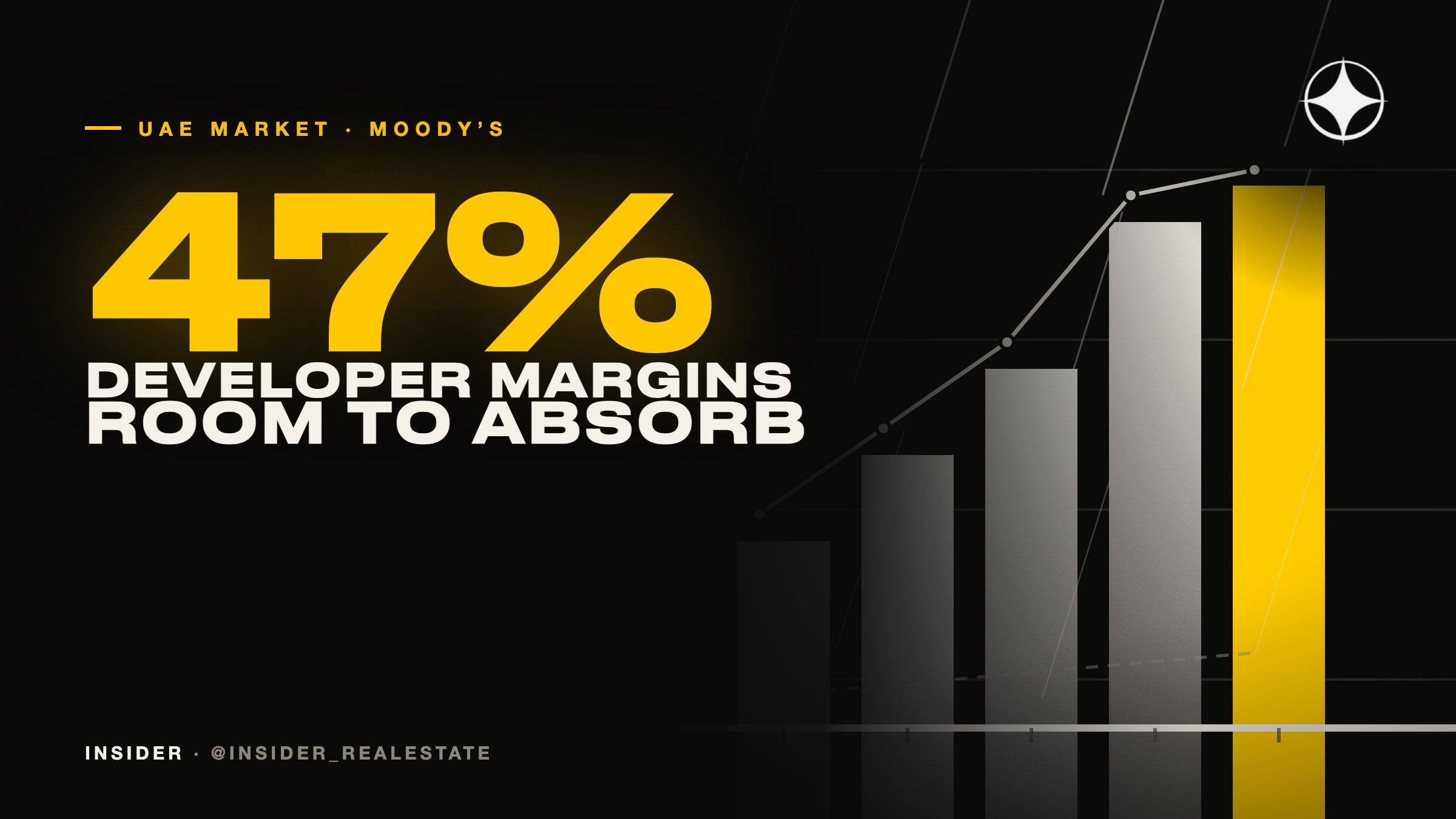
Moody’s says the UAE housing market has moved from boom to “reset”: sales at large developers are roughly half their peak, but average gross margins were about 47% in 2025, more than double the US level. Leading developers have a wide cushion, and construction is largely on schedule.
What did Moody’s actually say?
The report came out on 18 November 2026. Its headline view is that the upswing that began in 2021 is over, with sales volumes at the developers it covers about half their previous peaks.
It is not an alarm call. Construction is mostly on schedule, buyers are still paying their instalments, and the agency says geopolitical tension and shipping disruption have not seriously derailed pricing, delivery or collections.
Talk to a licensed broker: 📲 +971 50 120 32 64 on WhatsApp, @dubai_oleg on Telegram
Why does a 47% margin matter to a buyer?
Margin is the cushion a developer uses to absorb higher building costs, discounts and buyer incentives. The thicker it is, the lower the risk that a tower stalls for lack of cash.
Moody’s ran a stress case: if the entire rise in imported material prices were absorbed by developers, gross margins would fall by only about 4 percentage points. US homebuilders run on less than half the Dubai margin to begin with.
For context on the cost side, see our piece on Dubai construction costs.
Which developers are best placed?
The agency names four companies. Emaar’s backlog of pre-sold revenue not yet recognised stands at about AED 159bn ($43bn).
- Emaar — backlog of roughly AED 159bn;
- Aldar — supported by Abu Dhabi demand and high occupancy across its rental portfolio;
- Damac and Sobha — entering the slower cycle with large order books.
Project pipelines are on our pages for Emaar and Aldar.
Will prices fall?
Moody’s expects only moderate price declines that developers can absorb. Dubai’s ultra-luxury segment has softened the most, while Abu Dhabi and Sharjah remain strong and balance the market.
Index data agrees: ValuStrat recorded a 0.1% monthly gain in Dubai values in October 2026, the first since February — see our note on the October index.
How is developer behaviour changing?
Many developers borrowed during the boom to buy land. Moody’s now expects fewer land deals, with freed-up cash going to debt repayment through 2027.
The key caveat is financial policy. Large shareholder payouts or aggressive land buying would slow deleveraging, and Moody’s says this will increasingly separate strong credits from weak ones.
Joint ventures with landowners reduce upfront funding needs, but dilute the developer’s future returns.
What does it mean for off-plan buyers?
First, the risk of a stalled project is lower with market leaders, whose margins and backlogs cover cost inflation.
Second, buyers have more room to negotiate. Moody’s says margins leave space for incentives and modest price cuts, so discounts, a covered DLD fee or a softer payment plan are now fair asks.
Third, judge the developer as well as the project: debt, land buying and dividends. Our earlier look at the sector is in UAE developers under S&P and Moody’s review.
Frequently asked questions
Is the UAE property boom over?
According to Moody’s on 18 November 2026, yes: sales at major developers are about half their peak. The agency calls it a reset rather than a crisis, as construction and collections continue.
What margins do UAE developers make?
Average gross margins for UAE residential developers were about 47% in 2025, more than double the US level.
Will Dubai property prices drop?
Moody’s expects only moderate declines, led by the ultra-luxury end of Dubai, with Abu Dhabi and Sharjah holding up better.
Is it safe to buy off-plan now?
Risk is lower with large developers that have big backlogs and thick margins. Check their debt, land purchases and shareholder payouts.
Projects, construction progress and handover dates from Dubai’s largest developer are on our Emaar page.
Video on this topic
The same subject on the English channel — each clip has a written version of its own.
 8:01Island Park at Dubai Creek Harbour: an Emaar tower that is almost finished9 August 2024
 10:13Waterfront property in Dubai: Mina Rashid — Clearpoint, Sunridge, Seascape21 September 2023
 25:03Harbour Lights by Damac and de GRISOGONO: prices, sizes and what the brand costs14 February 2023
 55:13Land plots and joint ventures in Dubai: how investors and developers split the profit9 October 2026
 51:14AI in Dubai real estate: what changes for brokers, investors and developers3 October 2026

In the news
Other write-ups on the site about the same thing.
UAE developers under S&P and Moody's review: liquidity, construction costs and handover dates in 2026
In March 2026 S&P saw no liquidity pressure at Emaar, DAMAC, Omniyat and PNC Investments. In July Moody's reported most UAE projects due in 2026–27 on schedule despite imported materials costing 20–25% more. What off-plan buyers should take from both.

Dubai's top developers by 2025 sales, and the 648 projects launched in a single year
Emaar sold about AED 65.8bn in Dubai in 2025, DAMAC AED 35.9bn, Sobha about AED 30bn and Binghatti AED 26bn. Meanwhile 258 developers launched 648 projects with 167 000 units. What that mix of concentration and crowding means for buyers.
Construction Week's Top 100 GCC Developers: UAE firms take more than half the list
Construction Week ranks the 100 largest developers in the Gulf by the value of completed and under-construction projects. UAE developers hold more than half the spots — from Emaar and Aldar to DAMAC and Danube. How to read the ranking, and what it tells a buyer.

Emaar to buy out Emaar Development at AED 15 a share: what the AED 60bn deal means for buyers
Emaar Properties has offered AED 15 a share for the 20.84% of Emaar Development it does not own — about AED 12.5bn, valuing the unit at roughly AED 60bn. The offer runs to 10 December 2026. Here is what it changes for people buying Emaar homes.

Dubai handover wave 2027–2028: S&P Global expects 20% more homes and a price correction in investor apartments
S&P Global expects Dubai’s housing stock to grow by about 20% over two years, mostly apartments. Deliveries due in 2027–2028 could accelerate price corrections in investor-driven segments. What it means for off-plan buyers.
Emaar credit rating: S&P affirms BBB+ with a stable outlook, backed by a $44.9bn revenue backlog
S&P Global Ratings has affirmed Emaar Properties at BBB+ with a stable outlook. At 30 June 2026 the developer had AED 164.9bn ($44.9bn) of revenue backlog from homes sold but not yet handed over, and its malls were about 98% occupied.