
A billion-dollar home in Dubai: how the ultra-luxury market actually works
As of mid-2023, no publicly confirmed sale in Dubai had reached a billion dollars: the registered records stood in the hundreds of millions, and figures near a billion were asking prices for one-off residences. The headline is still worth reading, because the economics behind it show where the city's most protected addresses are.
Do billion-dollar homes actually exist in Dubai?
Not as closed deals, on the evidence available when this was filmed in June 2023. Publicly confirmed transactions were at the level of hundreds of millions of dollars, and price tags approaching a billion appeared as asking prices for unique residences.
That is still a remarkable position. Ten years earlier the phrase would have read as fantasy, and by 2023 residences with nine-figure and even ten-figure price tags were part of the ordinary conversation about the market.
Within a few years Dubai had become one of the world capitals of ultra-luxury property. The city was consistently among the leaders by number of deals above ten million dollars, and the bar for a record was rising almost every year.
Talk to a licensed broker: WhatsApp +971 50 120 32 64 · Telegram
Individual mansions on Palm Jumeirah and villas in gated communities were changing hands for sums comparable to the budget of an entire development project.
What goes into a nine-figure price tag?
Land first. At this level the buyer is paying for a place that cannot be reproduced: the first line of sea on Palm Jumeirah, a plot on Jumeirah Bay Island, hectares in Emirates Hills.
Such plots are few and no new ones are coming. The man-made islands are built out and the coastline is finite, so the scarcity is absolute, and land in the top locations rises faster than any other segment.
The second component is the house itself: thousands of square metres, architecture by well-known practices, museum-grade finishes, private spas and cinemas, gallery garages for dozens of cars, berths for yachts. Building a residence like that costs tens of millions on its own.
The third is intangible: privacy, the history of the property, the neighbours. An address where the people next door appear on the world's rich lists carries a premium of its own, and nothing measures it.
So a price in the hundreds of millions is no longer about square metres. It belongs to a separate economy, in which a home is a trophy asset, a work of art and an instrument of status at the same time.
Who buys trophy property in Dubai?
A wider group than before. The traditional buyers from the Gulf states and India have been joined by capital from Europe, China, the CIS and both Americas.
The motives are similar. Dubai offers a rare combination: no property or inheritance tax in the form familiar in the West, safety, world-class infrastructure, and the standing of a neutral haven in a turbulent world.
For this audience a residence costing hundreds of millions is rarely the only home. It is one element of a global portfolio: a house in London, an apartment in New York, a chalet in the Alps, a villa in Dubai.
Property of this class is bought for decades and often held through family structures. It is treated as a way of carrying capital from one generation to the next, alongside art and stakes in businesses.
Does ultra-luxury work as an investment?
Not by the usual measures. Trophy homes have practically no rental yield, because nobody lets them, and liquidity is limited: the worldwide circle of buyers for a house at a hundred million dollars or more is narrow, and a sale can take years.
A different logic applies. The rarest assets in scarce locations have historically gained faster than inflation over a long horizon, and in a crisis they fall less than the mass market, because nothing substitutes for them.
Scarcity holds that up: the supply of top plots is finite, while demand is global and grows with the number of very wealthy people. A trophy asset also depends less on local conditions than ordinary housing does.
And there is a return in status. Owning a landmark property opens a kind of social capital that cannot be bought any other way, which places the asset class closer to art than to a rental business.
What do record deals mean for the rest of the market?
They are an indicator and not a curiosity. When capital willing to pay nine-figure sums for a residence arrives in a city, the rest of the demand pyramid follows it: senior management, wealth managers, the industries that serve them.
That supports premium rents and prices in the segments below. Records also work as global advertising: every loud deal strengthens Dubai's name as the market where the most expensive things happen, and brings new buyers into every price bracket.
For a private investor the practical reading is geographical. The map of ultra-luxury is a map of the city's best-protected locations.
The districts where the largest capital goes, meaning Palm Jumeirah, Jumeirah Bay, Emirates Hills and the coastal enclaves, tend to show the most resilient prices. Buying even a small property in the orbit of those addresses is a bet on the same scarcity with a smaller ticket.
Where the marketing sits in the big numbers
In the gap between an asking price and a registered one. Some headline figures are valuations or asking prices and not closed deals, and some fold together the land, the construction and years of ownership.
The working principle is simple. Reality is the price in the Dubai Land Department register, and everything else is a negotiating position or public relations.
For a buyer of luxury property that becomes a rule of practice: check the transaction history for the specific address and community, and do not rely on figures from the media.
Transaction data in Dubai is public, and a competent broker is obliged to back any claim of a record with extracts from the register.
Frequently asked
Has a home in Dubai sold for a billion dollars?
Publicly confirmed deals were in the hundreds of millions of dollars when this was filmed in 2023, and price tags near a billion appeared as asking prices for unique residences. The trend was clear all the same: the record bar was rising almost every year.
Where is Dubai's ultra-luxury property concentrated?
The key addresses are Palm Jumeirah, Jumeirah Bay Island, Emirates Hills, Dubai Hills and the gated coastal communities. That is where the record deals take place.
Does the owner of such a home pay tax on it?
The UAE has no annual tax on owning a home and no inheritance tax in the familiar form; a Dubai Land Department registration fee is paid on purchase. It is one of the reasons large capital flows in.
Is ultra-luxury property a sensible investment?
As a source of cash flow, no. As a long-term store of capital in a scarce asset, yes, for fortunes of the corresponding size.
✍️ Message me on WhatsApp for a free consultation — off-market stock, payment plans and honest numbers on any of the projects covered here.
✅ Subscribe on YouTube — investment, property, business and relocation in the UAE and beyond.


In the news
The same subject in writing — analysis and news related to this video.
Branded residences: Dubai leads the world, and what the premium actually buys
Dubai has more branded residential schemes than any other city — roughly one in seven worldwide. Where the format started here, what the premium over comparable luxury pays for, and the five clauses to read before signing.
Short-term versus long-term letting in Dubai: which actually pays more
Holiday-home letting produces higher gross income and much higher costs. What the licensing requires, where the format works and where it does not, and the occupancy level at which the two strategies converge.

Kempinski Floating Palace: 48 self-propelled Neptune villas from AED 29m, and where the project stands in 2026
Kempinski Floating Palace pairs an on-water hotel near Jumeirah Bay Island with 48 self-propelled Neptune villas of 2–4 bedrooms. Summer 2024 prices were AED 29m, 32m and 46m; completion was set for late 2026. What buyers are actually purchasing, and what to check before signing.

Lanai Islands: 13 villas on a private island inside Tilal Al Ghaf
Architecture by SAOTA, interiors by Kelly Hoppen, up to seven bedrooms. Why building around water rather than a golf course changes what the product is — and why thirteen houses rather than three hundred.
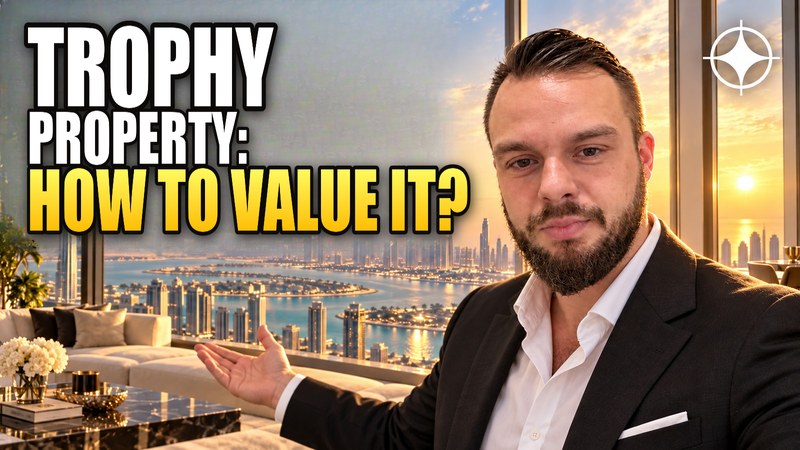
Trophy property: why it has no ROI, and what to calculate instead
A unique asset cannot be modelled like a rental flat: no comparables, no predictable income stream, no predictable exit. What actually sets price at the top of the market, and which calculations are worth doing there.

Letting a Dubai apartment long term: Ejari, cheques, and what the landlord actually nets
Rent arrives a year in advance, which flatters every model. Here is the rest of it: the registration without which a tenant cannot connect power, the deposit convention, the notice periods, and the six lines that separate gross rent from what reaches you.