
HELM Abu Dhabi longevity cluster: 30,000 jobs and $25.6bn of GDP by 2045 — what it means for housing demand
Abu Dhabi launched HELM, a life-sciences and longevity cluster based in Masdar City, in April 2025. Targets for 2045: $11.5bn of investment, 30,000 jobs and $25.6bn added to GDP. The first shared lab opened in 2026. Who it brings to the capital and where they will live.
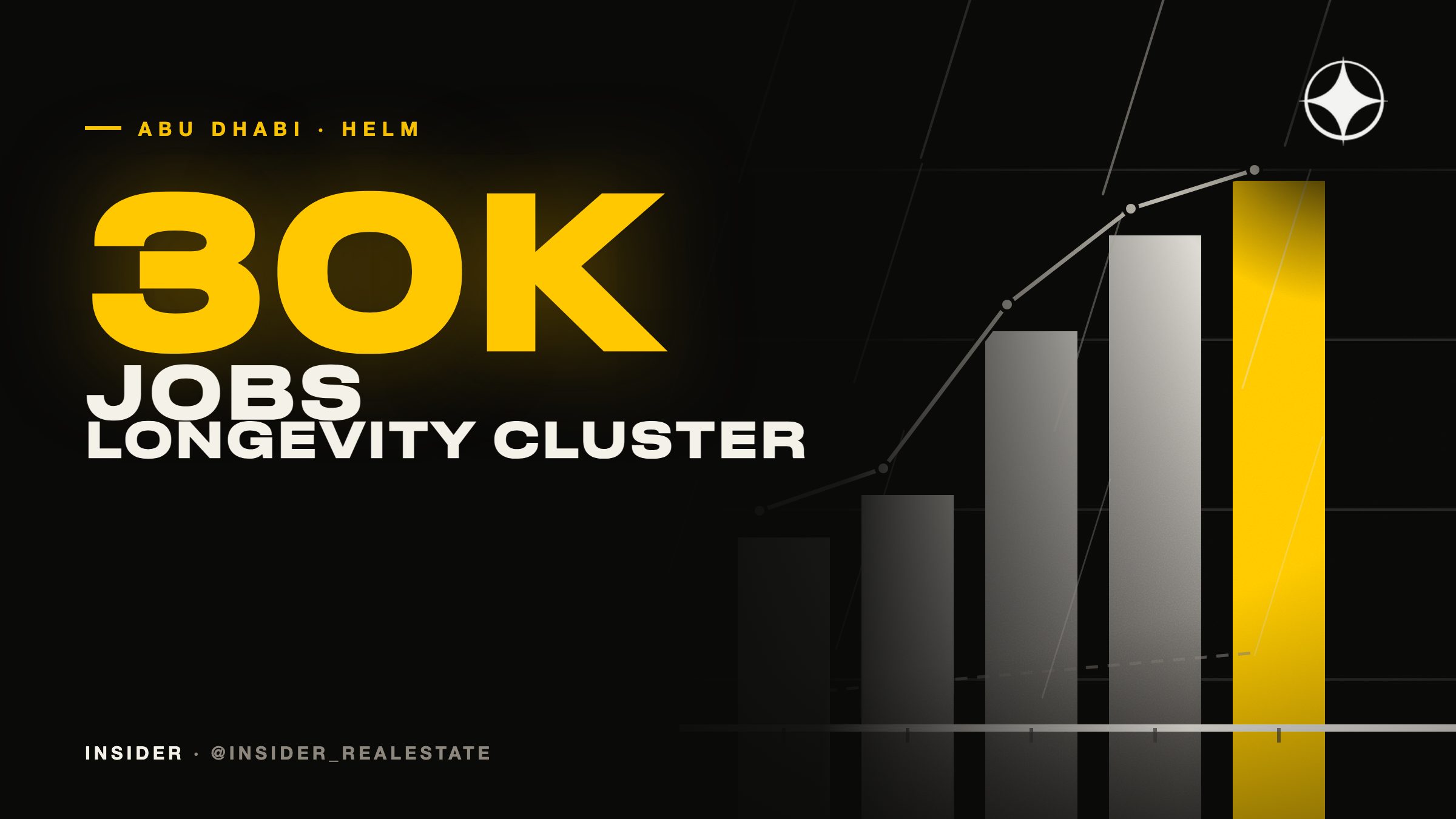
In April 2025 Abu Dhabi’s Crown Prince, Sheikh Khaled bin Mohamed bin Zayed, approved HELM — Health, Endurance, Longevity, Medicine. It is not a hospital project or a medical-tourism push; it is an attempt to build an industry in the emirate, spanning biotech, medtech, pharmaceuticals, gene therapy and AI-driven diagnostics. For property, programmes like this matter for one reason: the people they bring in and what those people earn.
The targets
The cluster is run jointly by the Department of Economic Development, the Abu Dhabi Investment Office (ADIO) and the Department of Health, with Masdar City as its base. The official goals run twenty years out:
| Metric | Target by 2045 |
|---|---|
| Contribution to emirate GDP | $25.6bn |
| Investment attracted | $11.5bn |
| New jobs | 30,000 |
That is a long horizon, and the numbers are a direction rather than a schedule. Still, Abu Dhabi has a record of following sector programmes through — ADGM on Al Reem and the gaming cluster on Yas both grew this way.
Talk to a licensed broker: 📲 +971 50 120 32 64 on WhatsApp, @dubai_oleg on Telegram
Progress by September 2026
The first concrete step came in June 2026: at the BIO 2026 convention in San Diego, Masdar City, M42 and Attentive Science launched Biosphere Labs, billed as the Gulf’s first commercial shared laboratory for life-sciences companies. The point is that a start-up can move to the emirate without building its own lab. The Department of Health also signed a partnership with Biocom California, the US industry association.
Dubai, meanwhile, has taken its own route with a Longevity Authority, which we looked at here. The two emirates are competing for the same people: scientists, clinicians, founders and their investors.
What it means for housing
A biotech professional is a textbook premium tenant — high income, often a family, a long contract, and a need for good schools and a quiet neighbourhood. These tenants stay. That matters more in Abu Dhabi than in Dubai because new supply is thin: in the first nine months of 2025 the capital delivered around 2,700 homes against 28,100 in Dubai.
- Masdar City and the districts near the airport are the first point of demand for people working in the cluster.
- Yas Island and Al Raha Beach are the nearest established neighbourhoods with schools and waterfronts.
- Family villas are where the capital’s shortage is sharpest, and where rental growth shows first.
Keep the scale in proportion: 30,000 jobs over twenty years is roughly 1,500 a year, in an emirate whose population grew 7.5% in 2024 alone. HELM is not a reason to buy on its own today, but it is a sound supporting argument for the corridor between Masdar and Yas.
The projects closest to Masdar City are listed on our Yas Island and Al Raha Beach pages.
Video on this topic
The same subject on the English channel — each clip has a written version of its own.


In the news
Other write-ups on the site about the same thing.
ADGM on Al Reem Island: 190 asset managers, 276 funds and what it means for Abu Dhabi rentals
ADGM has covered Al Reem Island since 2023. By H1 2026 it had 13,974 active licences, 190 asset managers (+23%), 276 funds (+32%), AUM up 54% and 49,027 people working in the district. Why that matters for Al Reem landlords.
Abu Dhabi 2040: a doubling population, AED 240bn of infrastructure and the transport pipeline
Abu Dhabi expects its population and GDP to double by 2040; the emirate had 4.14m residents at the end of 2024. AED 240bn is earmarked for housing, transport, health and schools. The widely quoted "6 million by 2040" is not an official figure. What is actually being built.
Hafeet Rail: the UAE–Oman railway, Abu Dhabi to Sohar in 100 minutes, and 40% built
Hafeet Rail is a $2.5bn joint venture between Etihad Rail, Oman Rail and Mubadala: 238km from Abu Dhabi through Al Ain to the Omani port of Sohar. The passenger service will run at up to 200km/h; as of spring 2026 the line was 40% complete, and Oman ratified the agreement in September.
Zayed International Airport, Abu Dhabi: Terminal A, a record 32.5m passengers, and what it did for Yas Island and Al Raha
Terminal A at Abu Dhabi’s airport opened in November 2023 after years on hold: 742,000 sq m, capacity for 45m passengers a year. Renamed Zayed International in February 2024, it handled a record 32.5m passengers in 2025 (+12.8%). What that means for housing on Yas Island and in Al Raha.
Hudayriyat Island, Abu Dhabi: Modon’s masterplan, Nawayef and Bashayer, and what people are actually buying
Hudayriyat is a 3,000+ hectare island off Abu Dhabi’s southern shore that state developer Modon is turning into a sports and residential district. Nawayef Village’s 378 townhouses (about AED 2bn) sold out on launch day; Bashayer sold roughly AED 3bn in a day in December 2025.
UAE's New Oases: How Dubai and Abu Dhabi Are Turning the Desert Green
Dubai ecotourism and green communities: Al Layan Oasis in Al Marmoom, Expo Valley Nature Reserve at Expo City Dubai, Hudayriyat Island in Abu Dhabi and Kalba in Sharjah. What is being built, when it opens and why nature is becoming part of UAE real estate.