
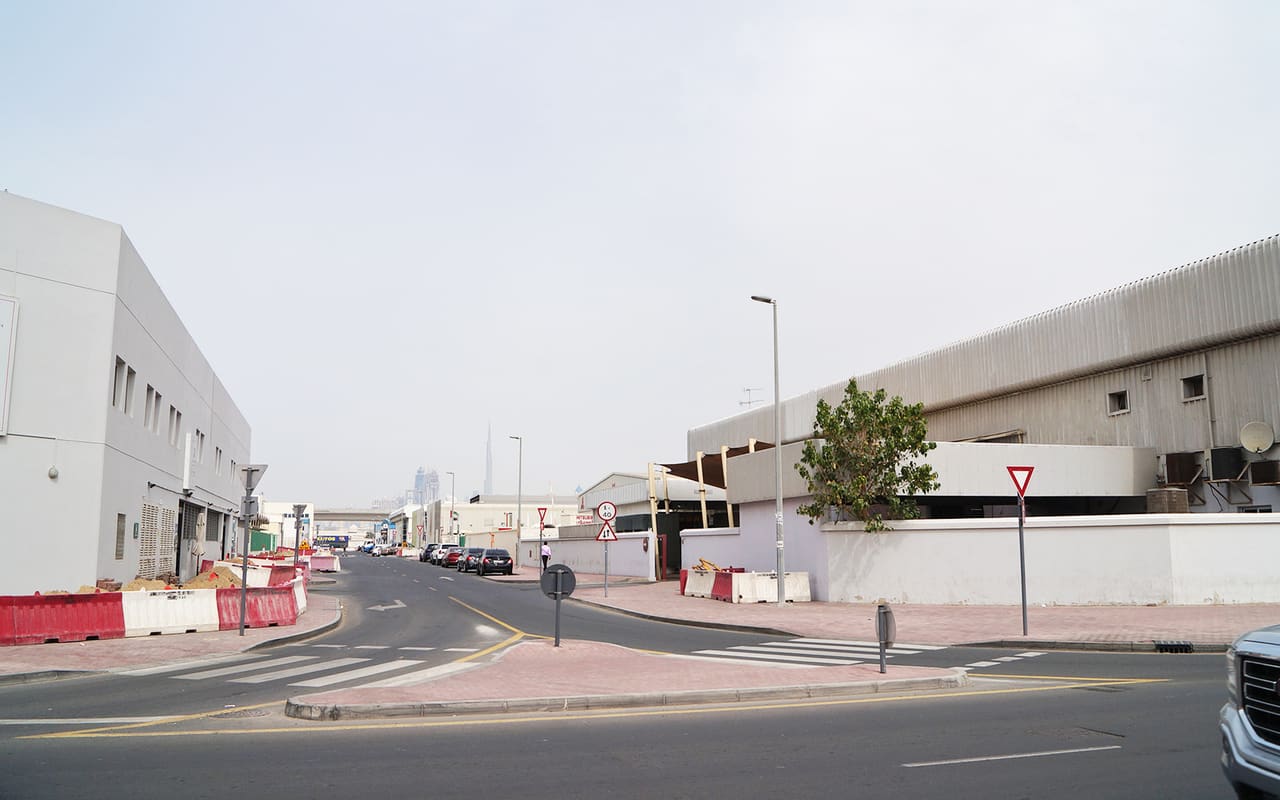
 Photo of the community
 Al Quoz
Warehouses, art galleries and workshops between Sheikh Zayed Road and Al Khail — Dubai’s industrial belt turning creative.
2 units in stock. 1 with a confirmed status: 1 ready, 0 under construction. 37th most expensive of 91 districts by median price.
- central industrial and warehouse property
- creative-sector tenants
- business owner-occupiers
Median price $1.53M AED 5,617,500
Entry price $1.36M AED 5,000,000 — cheapest unit
Per square foot $207 AED 760 / sq ft, median
Ready stock 100% nothing discounted right now
What is nearby, and what it does to the price
What this area is actually like
What Al Quoz is
Al Quoz is a large industrial and light-manufacturing district running between Sheikh Zayed Road and Al Khail Road, roughly between Downtown and Al Barsha. It is divided into industrial sectors and a residential sector.
It contains warehouses, workshops, car showrooms, workers’ accommodation — and, increasingly, the largest concentration of art galleries, design studios and creative businesses in the emirate, centred on Alserkal Avenue.
It is one of the few parts of central Dubai that is not polished, and that is precisely why the creative sector went there.
The creative district
Alserkal Avenue, a converted warehouse complex, became the anchor for Dubai’s contemporary art scene and has since drawn galleries, studios, independent cafés, a cinema and design businesses into the surrounding streets.
That has changed the character of parts of Al Quoz substantially and created a genuine cultural cluster in what remains an industrial area.
For property, it has made warehouse and light-industrial units in the relevant streets considerably more valuable, with creative-sector tenants paying well above traditional industrial rents.
The residential component
Al Quoz 1, 2, 3 and 4 include a residential sector with villas and low-rise housing, much of it older and much of it leasehold or restricted for foreign buyers.
It is not a mainstream residential market and there is limited freehold apartment stock. Most people who live in Al Quoz do so because they work there or because they want space at a low cost near the centre.
Everyday amenity is limited and the environment is industrial, though the central location is genuinely good.
The commercial opportunity
For an investor prepared to look at commercial and industrial, Al Quoz is one of the more interesting markets in Dubai: a genuinely central industrial district with a creative-sector premium emerging in parts of it.
Warehouse units let to a broad tenant base — logistics, workshops, storage, studios, showrooms — with longer leases and lower churn than residential.
The mechanics are specialist: permitted activities, power capacity, ceiling height, loading access and municipality approvals all matter, and getting them wrong makes a unit unlettable.
What to check
The permitted use of the unit and whether it matches your intended tenant. This is the single most important item in industrial property.
Power supply capacity, ceiling height and loading access.
Freehold designation, if buying residential.
Proximity to Alserkal and the creative cluster, which carries a rent premium.
Access routes and how they behave during industrial working hours.
Who it suits
A commercial investor who understands industrial property and wants a central location with an emerging creative-sector premium.
A business owner buying premises rather than renting them.
It suits poorly a general residential investor — the residential market here is small, restricted and not the reason to be in Al Quoz.
What a warehouse actually rents for and to whom
Al Quoz warehouse tenants divide into three groups with quite different requirements. Logistics and storage operators want height, loading access and power, and they are indifferent to the address. Workshops — joinery, metalwork, car preparation, printing — want power capacity and permitted industrial use. Creative tenants want the shell and the location and will pay a premium for both.
Rents across those groups differ by a factor, for physically similar space. A unit let as storage and the identical unit let as a gallery are different investments.
Which one your unit can serve is determined by its permitted activity, its power supply, its ceiling height and its access, not by how it is marketed.
Establish all four before you buy, and establish which tenant type is actually leasing in that specific street, because Al Quoz changes character block by block.
The creative premium and how durable it is
The Alserkal effect is real and measurable: warehouse space in and around that cluster commands rents well above ordinary industrial units of the same size a kilometre away.
It is also concentrated. The premium attaches to a handful of streets with critical mass — galleries, studios, cafés and the foot traffic they generate — and it drops off sharply outside them.
Whether it is durable depends on whether the cluster keeps its tenants, and creative districts in every city are vulnerable to exactly the rent rises their own success produces. Watch for galleries leaving rather than arriving.
For a buyer the disciplined position is to underwrite the unit at ordinary industrial rent and treat the creative premium as upside. That way the investment works if the cluster holds and still works if it does not.
The residential sector, briefly
Al Quoz 1 to 4 include a residential sector with villas and low-rise housing, much of it older, and a substantial amount of labour accommodation. It is not a mainstream market and freehold availability for foreign buyers is limited.
People who live in Al Quoz generally do so because they work there, or because they want space at a low cost within ten minutes of Downtown and Al Wasl.
Amenity is thin and the environment is industrial, though the location is genuinely central and the roads are good in both directions.
If a residential listing here looks unusually cheap, check the designation and the permitted use first — the answer is frequently that it cannot be bought by a foreign national at all.
Photo of the community Photo of the community The market, per the Land Department
Residential price index 167.33 Q4 2025
Quarter on quarter +3.32% QoQ
Year on year +8.9% YoY
Full year 2025 +9.81% index 162.51
This is the official index for the whole emirate, not for Al Quoz: the Dubai Land Department does not publish a district breakdown publicly. Treat it as background — it tells you whether the market is rising or flat while you read the prices above. Transaction data for a specific building I pull separately, on request. Source: Dubai Land Department, read 15/08/2026.
The latest read: July 2026
The Land Department index above is quarterly and emirate-wide. The monthly price index splits villas from apartments — and in 2026 that matters: a single blended figure hides the fact that the two markets have pulled apart.
Villas and townhouses 292.5 flat YoY
Apartments 168.7 −4.2% YoY
All residential 219.2 −0.3% MoM
Price per sqft 2,039 villas · apartments 1,397 AED
What this means for Al Quoz
- +5% year on year — apartments, Al Quoz Fourth. That outpaces its own segment: apartments emirate-wide are −4.2% over the year. Which is why it is named in the monthly review at all — the list usually holds only the extremes. The figure is for that community, not the whole district: within Al Quoz the spread across buildings and completion years is wider than the gap between districts.
The month split by completion status: 72.8% of deals were off-plan, 27.2% ready homes. Ready-home volume rose 11.4% on the month, while off-plan was the only segment down both on the month and on the year (−45.3%). The practical read: there is room to negotiate on apartments and on off-plan, far less on finished villas in established communities. Index base is January 2021 = 100 — a villa reading of 292.5 means growth of 192.5% from that mark, not a premium over a 2021 peak. Monthly ValuStrat market review for July 2026, checked 24/08/2026.
Questions about Al Quoz
What is Alserkal Avenue?
A converted warehouse complex in Al Quoz that became the anchor of Dubai’s contemporary art scene, drawing galleries, studios, independent cafés and design businesses. It has raised values for warehouse units in the surrounding streets.
Can you live in Al Quoz?
There is a residential sector with villas and low-rise housing, but much of it is leasehold or restricted for foreign buyers and the environment is industrial. It is not a mainstream residential market.
Other districts
All districts →Al Quoz in the news
Dubai’s car-free Superblock plan: Al Karama, Al Fahidi, Abu Hail and Al Quoz
In February 2025 Dubai announced Superblock: car-free neighbourhoods with pedestrian streets and more greenery. The first areas are Al Karama, Al Fahidi, Abu Hail and Al Quoz Creative Zone. There is still no public timetable. What it means for rental housing in old Dubai.

Things to do in Dubai beyond the malls: Alserkal Avenue galleries, indoor summer options and cinema
Dubai’s second layer, district by district: Alserkal Avenue in Al Quoz and the DIFC galleries, the free Jameel Arts Centre on the Creek, Deep Dive Dubai’s 60-metre pool, cinemas in the malls. What to do at 40 °C, and why cultural infrastructure shapes where you choose to live.
Al Quoz: an industrial belt that became a creative quarter
Warehouses, workshops, galleries and housing mixed together in the middle of the city. The space is cheap; the questions are not the ones you ask in a residential district.
Living in a warehouse in Al Quoz: what the permitted use of the unit actually allows
High ceilings and large floor plates at well below residential prices are tempting, but the permitted use of a unit decides what you may legally do in it.
Looking at Al Quoz specifically?
Send me the building or the unit and I will pull the registered transaction history, the current service charge and what comparable units actually let for — before you make an offer, not after.
Ask on WhatsAppAsk a question
Telegram is the fastest way — I answer personally.
Message on Telegram