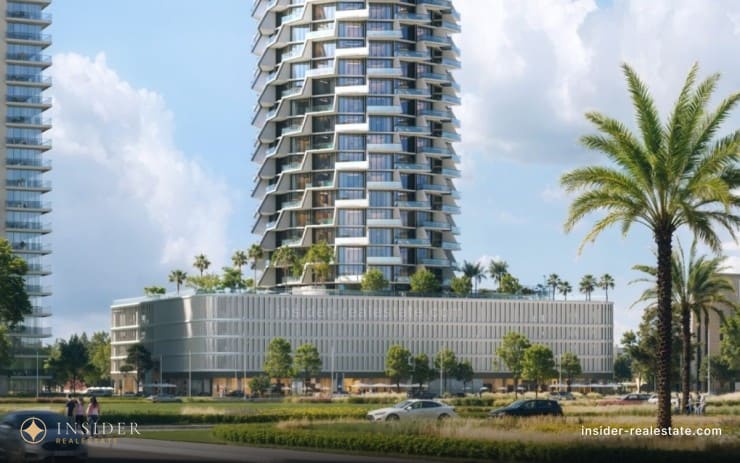
What it is
Dubai Hills Mall opened on 17 February 2022 in the middle of the Dubai Hills Estate master community: more than 650 stores and some 186 000 square metres of retail space, developed by Emaar.
It is a large regional centre inside a residential district rather than on a highway. That distinction matters: it was built for a population that already existed, not the other way round.
Alongside the retail: a cinema, a hypermarket, clinics, children’s zones and a large dining hall — the whole set for which Dubai Hills residents previously drove to Mall of the Emirates or the Dubai Mall.
What it changed
Before 2022 Dubai Hills was handsome, green and inconvenient: villas, a park, a golf course — and a drive for anything at all. The centre closed that gap and turned the district self-sufficient.
On the rental market it shows in the type of tenant. A family that used to weigh Dubai Hills against Al Barsha and left for wherever the everyday infrastructure was now stays.
From that follows a second effect: the district stopped being villas only. The apartment blocks around the centre — Park Heights, Collective, Executive Residences — acquired a rationale they did not have before it opened.
And one thing discussed less: a centre inside a community adds traffic to its internal roads. Anyone choosing a villa for quiet should look at the distance to it in both senses.
What it means when buying
The main step change has already happened: the district opened up, the infrastructure arrived, the price absorbed it. Buying "before the mall opens" is no longer available here.
What remains is the durability of rental demand. This is a district people live in rather than wait out: annual contracts, few departures, short voids.
Against Al Barsha: entry is dearer here, the stock is newer and the service charge higher, while the tenant profile is much the same. Choosing between them is choosing between price and building age.
What to check
The distance from your specific cluster: Dubai Hills is large, and the gap between "ten minutes on foot" and "ten minutes by car" occurs inside one district here.
The service charge and what it covers: in a master community with parks and a golf course it runs above the city norm, and it is a permanent line of costs.
And the aspect relative to the internal roads leading to the centre — on a Friday evening the difference is noticeable.
How to compare it with the other two
The Dubai Mall is a citywide object: people drive to it from across the city and from other emirates, and housing near it is expensive because of Downtown rather than because of the mall.
Mall of the Emirates is a district object around which a district grew. The effect has played out, but the entry price is low.
Dubai Hills Mall is a district object built inside an already finished community. It did not create the district; it closed its weak point, which is exactly why the effect was fast and one-off.
For a buyer that means three different strategies: Downtown is bought for the address, Al Barsha for occupancy, Dubai Hills for quality of life at a high service charge.

 Dubai Metro
  Burj Khalifa
  Al Maktoum International
  Dubai Tram
  Dubai Water Canal
  The Dubai Mall
  Etihad Rail
  Dubai International (DXB)
  Jebel Ali Port
  Sheikh Zayed Road
  Expo City Dubai
  Dubai Creek
  Museum of the Future
  Ain Dubai
  Mall of the Emirates
  Palm Monorail
  Infinity Bridge
  Metro Gold Line
  DIFC Zabeel District
  Dubai Opera
  The Dubai Fountain