What the line is
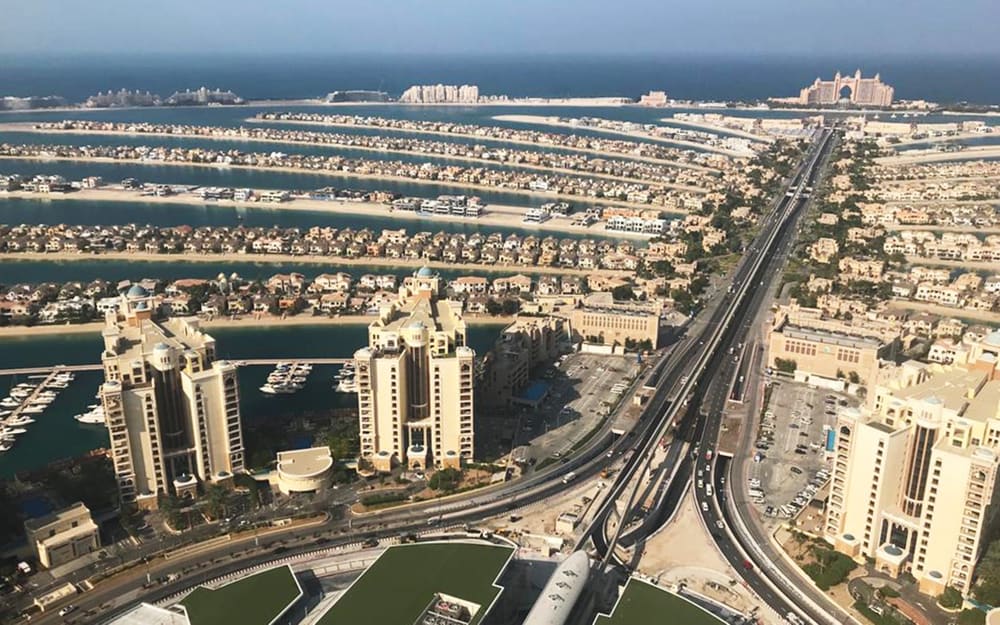
An elevated single-track line along the trunk of Palm Jumeirah, running 5.4 kilometres from the base of the island to Atlantis, with four stations. It opened on 30 April 2009.
That was five months before the Dubai Metro itself, and it was the first system of its kind in the Middle East.
It has no interchange with the metro. The tram passes near the base of the island, and from the tram it is one further change to the red line. A journey from a frond villa to Downtown by public transport is therefore three modes and over an hour.
Why this matters before buying
The Palm is a district with almost no alternative to the car, and that is a cost line rather than a detail. Effectively every adult in a household needs a vehicle here, and parking in the island’s older buildings is scarce.
The second consequence is the entry queue. The trunk is a single road, and at peak it works as a funnel. The tunnel beneath it relieved that; it did not remove it.
The third is the tenant. People who commute by public transport do not consider the Palm at all. The tenant here either drives, works from home, or has come for a week.
Which is why yield on the Palm leans on short-term letting more heavily than the city average: the annual tenant here is dearer and more particular.
What it means for prices
The monorail affects residential prices essentially not at all — the rare case where a transport object in Dubai is not a pricing factor.
The reason is purpose: the line serves tourists heading to Atlantis, not residents heading to work. Walking distance to a monorail station appears in listings but does not command money.
On the Palm, prices are held by other things: which side of which frond, the beach, the view and the property type. Transport does not participate in the price here — it participates in the quality of life.
What to check
Parking: how many bays are allocated to the unit and whether there is visitor parking. On the island this is settled once and for all — at purchase.
Real peak-hour travel time rather than the map on a Sunday afternoon. On the Palm the gap between those two numbers is the largest in the city.
And the short-term letting regime in the building if the yield depends on it: on the island that is the primary case, and the management company is what permits it.
What actually solves transport on the Palm
The tunnel beneath the trunk. It took load off the surface road and changed exit times materially — far more than the monorail ever did.
The tram at the base of the island. It links the Palm to Dubai Marina and JBR and provides the only real interchange into the city network.
And the number of exits from the fronds. A frond is a dead end, and the time to the highway depends on how far your villa sits from the trunk. On the outer plots that is real minutes in both directions every day.
All of it is verified one way: visit the property on a weekday around eight in the morning and again around six in the evening. No render and no map will show it.

 Dubai Metro
  Burj Khalifa
  Al Maktoum International
  Dubai Tram
  Dubai Water Canal
  The Dubai Mall
  Etihad Rail
  Dubai International (DXB)
  Jebel Ali Port
  Sheikh Zayed Road
  Expo City Dubai
  Dubai Creek
  Museum of the Future
  Ain Dubai
  Mall of the Emirates
  Dubai Hills Mall
  Infinity Bridge
  Metro Gold Line
  DIFC Zabeel District
  Dubai Opera
  The Dubai Fountain